Ready to Smile Freely, Permanently?
If you have one or more missing teeth, or will soon need an extraction, dental implants function like natural teeth and prevent jawbone deterioration — and can be fully customized for a perfect smile.
Medically reviewed by Dr. Boris Zusin, DDS, FAGD, MBA, MS, Diplomate, American Board of Dental Sleep Medicine (ABDSM) · Last reviewed August 21, 2026

Get the Confidence That Comes From a Perfect Smile
Dental implants can be used alone or in coordination with a crown, bridge, or denture. As the jawbone heals, it fuses around the implant screw, anchoring it in place and allowing it to support a natural-looking tooth prosthetic. We handle your consultation, treatment planning, and final restoration here, and coordinate the surgical placement with a trusted specialist — see below for how that works. We welcome implant patients from the Upper West Side, Lincoln Center, and throughout Manhattan — see our Dental Implants Near the Upper West Side page for what that looks like locally.
Am I a Candidate?
You may be a candidate if you have one or more missing teeth or teeth in need of extraction, are in generally good health, and have enough bone in your jaw to support an implant — we'll confirm this with an exam and imaging.
How a Dental Implant Actually Works
A titanium (or zirconia) post takes the place of your missing tooth root — here's what happens beneath the gumline.
Osseointegration
The implant is a small titanium or zirconia post placed into the jawbone where the tooth root used to be. Over the following weeks, your bone fuses directly to the implant's surface — a process called osseointegration — creating an anchor that's structurally similar to a natural tooth root. Once that fusion is solid, a crown, bridge, or denture is attached on top. This is a well-established, highly predictable procedure with very high 10-year survival rates in healthy patients when it's placed and maintained correctly. For the full step-by-step, see our anatomy of a dental implant guide.
If There's Not Enough Bone
Bone loss is common after a tooth has been missing for a while, but it doesn't automatically rule out an implant. Depending on how much bone is available, treatment may include bone graft material, a sinus lift (for upper back teeth, where the sinus sits close to the jaw), or in some cases shorter or narrower implants designed for tighter spaces. For patients with severe upper jaw bone loss who aren't candidates for traditional grafting, zygomatic implants — longer implants anchored in the cheekbone (zygoma) instead of the jawbone — can sometimes avoid the need for a graft altogether. These surgical steps are performed by the specialist who places your implant, as part of the referral described below; we map all of it out together with imaging before recommending a plan.
Socket Preservation: Protecting Bone Right After an Extraction
When a tooth is extracted, the surrounding bone naturally begins to resorb within weeks — which can leave too little bone for an implant later if nothing is done. Socket preservation grafts the empty socket with bone graft material at the time of extraction, holding the site's shape and volume so it's ready for an implant down the road. It's a small addition to the extraction visit that can save a patient from needing a larger bone graft procedure later.
Why This Timing Matters
If you know you'll want an implant eventually, socket preservation at the time of extraction is usually simpler and less invasive than rebuilding lost bone months or years afterward. We'll flag this as an option any time an extraction and a future implant are both on the table.
Immediate vs. Delayed Placement: Which Is Right for You?
Long-term survival is comparable either way. What differs is complication risk, and how many separate visits it takes to get there.
The Timing Options
Dentistry generally groups implant timing into a few categories: immediate placement, into the fresh socket the same day as extraction; early placement, at roughly 4–16 weeks, once soft tissue has healed but before the bone has fully remodeled; and delayed placement, 16 or more weeks after extraction into bone that's already healed — usually following a socket preservation graft, especially for front teeth where esthetics matter most. Each has a place; which one fits depends on the specific tooth and site.
Survival Is Comparable
Systematic reviews consistently find no meaningful difference in long-term implant survival between immediate and delayed placement — both land in the mid-to-high 90s percent range over 5–10 years. One large retrospective study of over 4,500 implants found essentially identical removal rates (1.5% immediate vs. 1.1% delayed). Where a difference does turn up, it tends to be small: one meta-analysis found slightly lower survival with immediate placement (about 95% vs. 99%), with that entire gap made up of early failures rather than problems that develop later.
The Real Trade-Off: Complications, Not Survival
Immediate placement means one surgery instead of two, and less time without a tooth — genuinely attractive advantages. The trade-off is a meaningfully higher complication rate: roughly three times more surgical complications and about twice as many later esthetic complications (most often gum recession around the implant), particularly in patients with thin, delicate gum tissue.
What Makes Someone a Good Candidate for Immediate Placement
Immediate placement works best when several things line up at once: no active infection at the site, enough bone beyond the tip and sides of the socket to anchor the implant securely, an intact socket without significant wall damage, no existing gum recession, and enough of a gap between the implant and the outer bone wall once it's positioned. We confirm all of this with 3D imaging (a CBCT scan) before recommending immediate placement — it isn't a default, it's a decision made case by case.
Active Infection Changes the Calculus
Placing an implant into a socket with active infection carries a meaningfully higher failure risk — roughly three times higher in pooled data — which is why we generally favor letting an infected site heal and clearing the infection first rather than placing immediately, even though it means an extra step.
One more distinction worth knowing: immediate placement (when the implant goes in) is a separate decision from immediate loading (when a temporary crown is attached to it). Immediate loading carries its own, larger jump in failure risk when it's not well-suited to the case — see our same-day implants guide for how that decision is made separately.
Who's a Good Candidate — and Who Needs a Plan First
Implants work for most people missing one or more teeth, but a few things are worth addressing before treatment, not after.
Most Common Reason: A Single Missing Tooth
Replacing one missing tooth is now the single most common reason patients get an implant, ahead of replacing several teeth in a row or restoring a full arch. Unlike a bridge, an implant doesn't require grinding down the healthy teeth next to the gap to anchor it.
Address First: Gum Disease & Uncontrolled Conditions
Active gum disease, poor oral hygiene, and untreated cavities elsewhere in the mouth need to be brought under control before placement — a healthy foundation matters as much as the implant itself. Uncontrolled diabetes can also slow healing and raise early failure risk, though most patients with well-managed diabetes do just fine.
Flag at Your Consultation
Smoking is one of the strongest predictors of implant complications and is worth quitting or cutting back before treatment if possible. A history of head or neck radiation, or taking bisphosphonate medications for osteoporosis, also changes the risk profile and needs a tailored plan — tell us about either at your consultation rather than after.
Timing for Teens & Young Adults
Implants are generally held off until jaw growth is complete, since an implant doesn't move or erupt the way a natural tooth does and can end up positioned incorrectly if placed too early. This mostly comes up for a congenitally missing tooth — we'll monitor growth and time treatment appropriately.
A History of Gum Disease? It Changes the Plan, Not Your Candidacy
Periodontitis roughly triples to quadruples the long-term risk of peri-implant disease. That calls for a more careful plan — not a disqualification.
The Numbers
A 2025 systematic review found peri-implantitis affects about 21% of implant patients, with a 20-year cumulative incidence around 22% — and a documented history of periodontitis is one of the strongest predictors of it. Meta-analyses of prospective studies put the added risk at roughly three to four times higher for patients with a periodontitis history compared with periodontally healthy patients, with the risk climbing further in patients whose periodontitis was severe or is still active.
What This Means in Practice
Periodontitis is a risk factor, not an automatic disqualifier — implants routinely succeed in patients with a treated periodontitis history, but the margin for skipped maintenance is much smaller than it is for a periodontally healthy patient. European Federation of Periodontology guidelines frame this as a three-part plan: stabilize gum disease before surgery, control the other modifiable risks alongside it, and commit to a tighter, risk-based maintenance schedule for the life of the implant.
Before Placement
Periodontitis is brought to a stable endpoint first — inflammation resolved and any pocket 5mm or deeper addressed — since untreated pockets act as a reservoir for the same bacteria that can later colonize an implant. We'll also want smoking stopped or cut back, blood sugar under control if you're diabetic, and confirmation that you're ready to commit to maintenance visits before scheduling surgery.
After Placement
Regular maintenance is the single biggest lever for long-term implant health in a periodontitis-susceptible patient. Where a low-risk patient might stretch to an annual check-up, a former periodontitis patient generally needs recall every 3–6 months, with peri-implant probing and bleeding checks compared against a baseline taken once the implant has finished remodeling, around 12 months after placement. We treat any early mucositis right away, before it has a chance to progress to the bone-involving stage described below.
Keeping the Rest of Your Mouth in Check
An implant doesn't exist in isolation — ongoing periodontal maintenance of your remaining natural teeth matters just as much, since untreated pockets elsewhere in the mouth can reintroduce the same pathogens to the implant site. This is part of why we coordinate implant follow-up with your regular periodontal maintenance schedule rather than treating the two separately.
At Placement: Site-Level Factors
How the implant is placed and restored matters, too — proper 3D positioning, enough firm gum tissue around the implant, a crown margin that isn't set too close to the bone, and a shape that you can actually clean around are all recognized risk factors when they're gotten wrong. Malposition and a prosthesis that traps plaque are two of the more preventable contributors to peri-implantitis, which is why treatment planning happens before, not after, the implant goes in.
Risk Scales With Severity
Not all periodontitis histories carry the same weight: patients whose gum disease was severe, or who still have active, unresolved periodontitis, carry the highest peri-implantitis risk of all — in some studies, several times higher than patients with a milder or fully resolved history. This is one more reason we want periodontal disease brought to a genuinely stable endpoint, not just "improved," before moving forward with an implant.
A Formal Way to Individualize Your Recall Schedule
Rather than applying a single default recall interval to everyone, tools like the Implant Disease Risk Assessment (IDRA) combine periodontitis history, bleeding on probing, pocket depth, bone levels, and prosthesis design into a single risk profile that sorts patients into low, moderate, or high risk — and higher-risk patients, which includes most former periodontitis patients, are followed more frequently as a result. It's a structured way of making sure your maintenance schedule actually matches your risk, rather than guessing.
Protecting Your Investment: Long-Term Care
An implant itself can't get a cavity, but the gum and bone around it can still develop problems — this is called peri-implant disease, and it's the main long-term threat to an otherwise successful implant. Catching it early makes a real difference in outcome:
Peri-Implant Mucositis
Inflammation limited to the soft gum tissue around the implant — similar to gingivitis around a natural tooth. It's reversible with a thorough cleaning and better home care, which is exactly why we don't want you skipping check-ups once your implant is placed.
Peri-Implantitis
If mucositis isn't caught and addressed, inflammation can progress to affect the bone anchoring the implant — the same bone-loss process that threatens natural teeth with gum disease, but around an implant instead. This is why we treat implants as requiring the same (or more) attentive follow-up as your natural teeth, not a one-and-done procedure.
Implant-supported crowns and bridges also see somewhat more mechanical wear-and-tear over time — a loose screw or a chipped crown, for instance — than a natural tooth or a traditional bridge, simply because there are more moving parts. None of this is a reason to avoid implants; it's why we build regular check-ups into your care plan for as long as you have one.
“Am I a Candidate for Dental Implants?” Quiz
Answer all 5 questions, then click “See My Result” below.
This quiz is an educational screening tool, not a diagnosis. An exam and imaging are needed to confirm candidacy for dental implants.
Care From a Team That Knows You
Dr. Boris Zusin is an expert in general, cosmetic, implant, and dental sleep medicine, with 30+ years of clinical experience and ongoing continuing education. Lena Zusin, RDH works alongside him to make every visit as warm and comfortable as possible.
“Drawing upon our combined skills refined through years of experience and continued education, Lena and I will do everything possible to ensure that your entire dental experience at our office is as good as possible.” — Dr. Boris Zusin
- Uncompromising clinical excellence
- Meticulous attention to detail
- A gentle approach to dentistry

FAQ: Dental Implants at Zusin Dental, NYC
You may be a candidate if you have one or more missing teeth, or a tooth that needs extraction, are in generally good health, and have enough jawbone to support an implant.
A single implant in New York typically ranges from about $3,000–$5,500. Full-mouth restorations, including All-on-4, can range from $15,000–$60,000+ depending on complexity, materials, and any bone grafting needed. See our full Upper West Side dental implant cost breakdown for more detail.
With proper care — regular check-ups, good oral hygiene, and avoiding smoking or teeth grinding — implants can last 20 years or even a lifetime, compared to 5–15 years for many bridges or dentures. A large systematic review of long-term data found implant survival rates around 96% at 10 years, making implants one of the most predictable and durable options in restorative dentistry when properly placed and maintained.
No — a dental implant itself is made of titanium or zirconia, and its crown is porcelain or another dental ceramic, so there's no natural tooth structure for decay-causing bacteria to break down. What an implant can develop is peri-implant disease, an infection of the gum and bone around it caused by plaque buildup, similar in principle to gum disease around a natural tooth. That's why daily brushing, flossing (or a water flosser) around the implant, and regular check-ups still matter even though the implant can't decay.
All-on-4 uses four strategically positioned implants to support a full arch of upper or lower teeth, often reducing the need for bone grafting and shortening treatment time compared to placing an implant per tooth. Zusin Dental handles the consultation, treatment planning, and final restoration for All-on-4 patients in New York, coordinating the surgical placement with a trusted local specialist. See our All-on-4 guide for the full breakdown.
Standard implants are full-sized and offer maximum strength and longevity for individual teeth or full-mouth restorations. Mini implants are smaller in diameter, less invasive, and often used for limited bone density or to stabilize dentures.
Implants typically offer the best long-term durability, function, and appearance. They don't require altering neighboring teeth (unlike a bridge) and stay securely in place (unlike a removable denture), though the upfront cost is higher.
Yes — we offer flexible payment plans and financing through trusted third-party lenders, and we'll walk you through insurance coverage and out-of-pocket estimates during your consultation.
No — the surgical placement is performed by a trusted oral surgeon or periodontist we refer you to, the same way we refer out root canals. Dr. Boris Zusin handles your exam, imaging, and treatment planning, coordinates that referral so nothing falls through the cracks, and then completes your case by attaching the abutment and your final custom crown once healing is done.
The specialist we refer you to places the implant into the jawbone and sutures the gums around it, and you'll follow up with them through the initial healing period. Healing takes roughly three months before your permanent restoration is fitted at Zusin Dental; a temporary restoration may be used in the meantime. Some early-healing precautions apply (soft foods, avoiding hot liquids/smoking, a soft-bristle toothbrush).
For the first few days, stick to soft, cool-to-lukewarm foods that don't require much chewing near the surgical site — think yogurt, mashed potatoes, scrambled eggs, oatmeal, smoothies (no straw), soup that's cooled down, and soft pasta. As healing progresses over the following week or two, you can gradually add back semi-soft foods like rice, fish, and well-cooked vegetables. Avoid hot foods and drinks for the first 24 hours, and steer clear of hard, crunchy, or sticky foods (nuts, chips, popcorn, caramel, ice), spicy or acidic foods, alcohol, and using a straw (the suction can disturb healing) until we clear you at a follow-up visit.
Learn More From Our Blog
- What Are Dental Implants? A Complete Beginner's Guide
- Are Dental Implants Painful?
- After Your Implant Crown Is Attached
- The Anatomy of a Dental Implant
- Dental Implant Process Step-by-Step
- Dental Implants vs Dentures
- All-on-4 vs All-on-6 vs Snap-On Dentures
- Missing Tooth: What Are My Options?
- Dental Implant Cost on the UWS
- Dental Implants for Seniors
- Same-Day Dental Implants
- Implant-Supported (Snap-In) Dentures
- Signs a Dental Implant May Be Failing
- Does Insurance Cover Dental Implants?
- Second Opinion on Dental Implants
Real Solutions For Real Patients
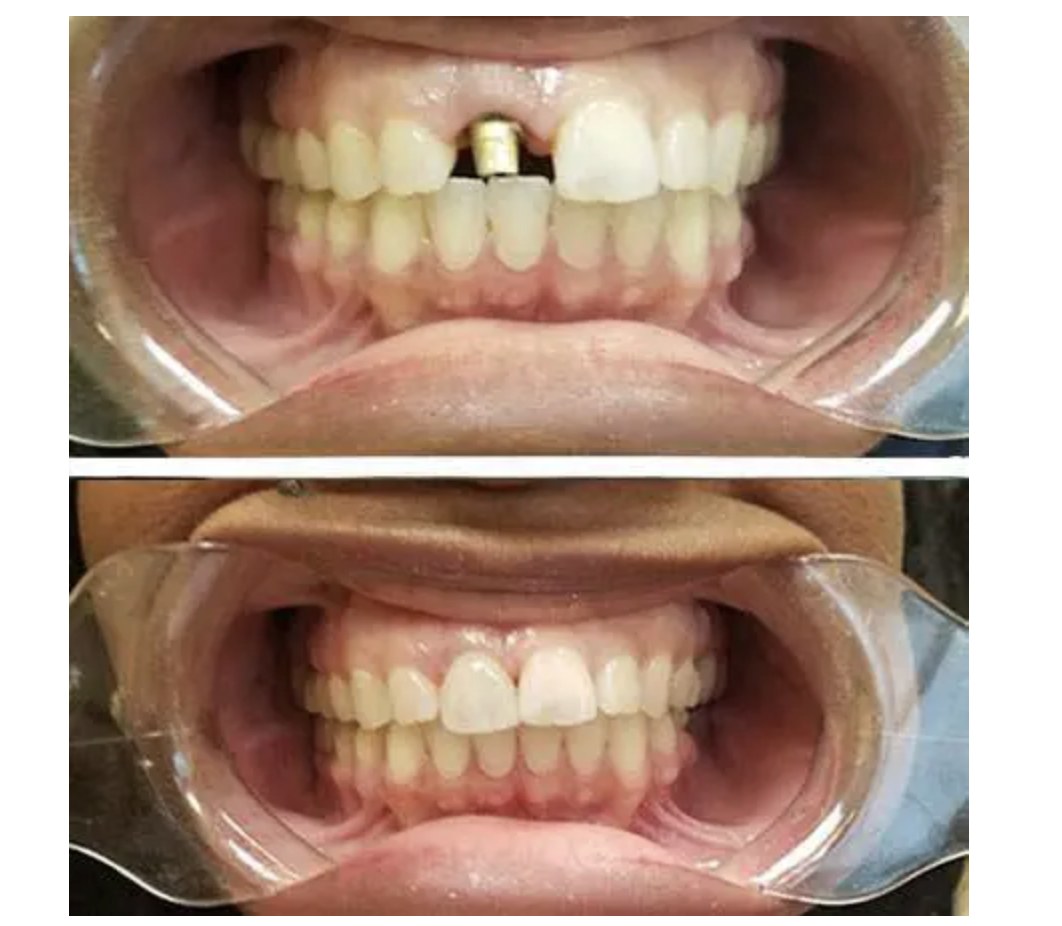
A real Zusin Dental implant case, before and after the restoration was placed.
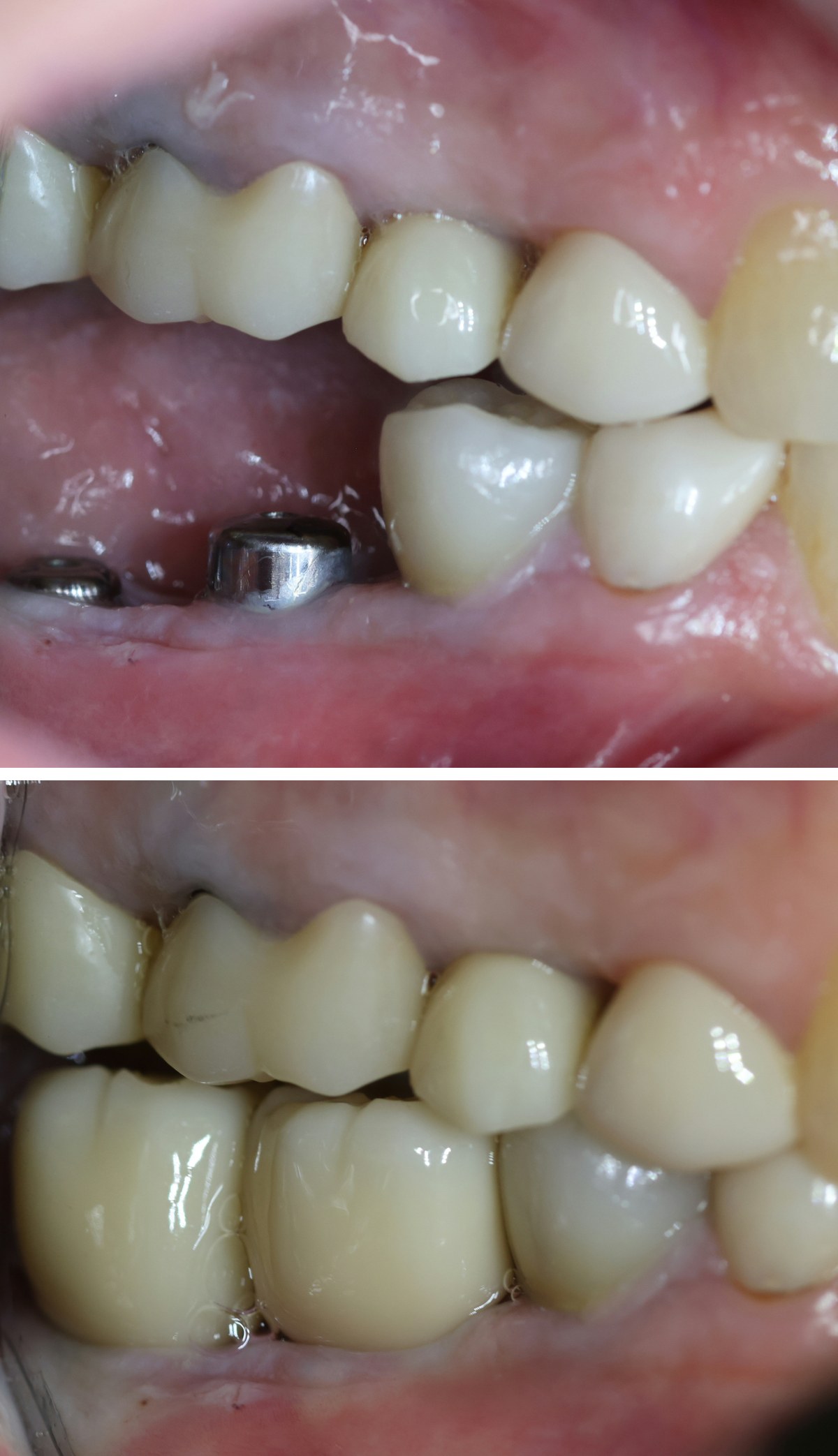
A real Zusin Dental case restoring two lower molars with implants, before and after the final crowns were placed.
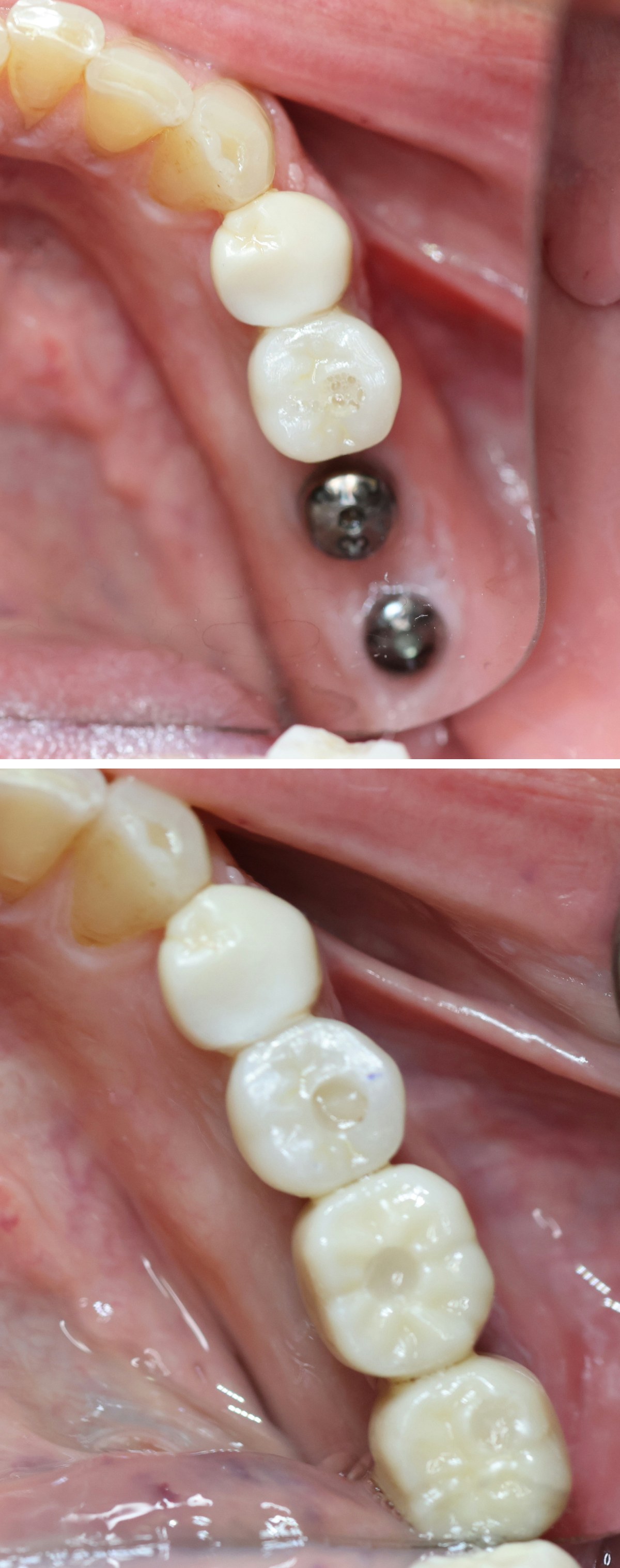
The same two-implant case shown close up, before and after the implant crowns replaced the healing abutments.
Sources
- Oral Implants: The Paradigm Shift in Restorative Dentistry — Lang NP, Journal of Dental Research (2019)
- The Medically Compromised Patient: Are Dental Implants a Feasible Option? — Vissink A, Spijkervet F, Raghoebar GM, Oral Diseases (2018)
- Analysis of Trends in Implant Therapy at a Surgical Specialty Clinic: Patient Pool, Indications, Surgical Procedures, and Rate of Early Failures — A 15-Year Retrospective Analysis — Ducommun J, El Kholy K, Rahman L, et al., Clinical Oral Implants Research (2019)
- Retrospective Analysis of Dental Implants Placed Between 2012 and 2014: Indications, Risk Factors, and Early Survival — Grisar K, Sinha D, Schoenaers J, Dormaar T, Politis C, International Journal of Oral & Maxillofacial Implants (2017)
- Implant Dentistry: The Past, the Present, the Future — Lang NP, Journal of Periodontal Research (2025)
- Patient Selection for Endosseous Dental Implants: Oral and Systemic Considerations — Sugerman PB, Barber MT, International Journal of Oral & Maxillofacial Implants (2002)
- The Provision of Dental Implants: Current Practice Among University and Hospital Specialists in Restorative Dentistry Within the UK and Ireland — Chin JS, Rees J, Addy L, British Dental Journal (2020)
- Dental Implant Considerations in Patients With Systemic Diseases: An Updated Comprehensive Review — Mosaddad SA, Talebi S, Keyhan SO, et al., Journal of Oral Rehabilitation (2024)
- Implant Therapy: 40 Years of Experience — Quirynen M, Herrera D, Teughels W, Sanz M, Periodontology 2000 (2014)
- Interventions for Replacing Missing Teeth: Management of Soft Tissues for Dental Implants — Esposito M, Grusovin MG, Maghaireh H, Coulthard P, Worthington HV, Cochrane Database of Systematic Reviews (2007)
- Long-Term (10-Year) Dental Implant Survival: A Systematic Review and Sensitivity Meta-Analysis — Howe MS, Keys W, Richards D, Journal of Dentistry (2019)
- Prevalence, Incidence, Systemic, Behavioral, and Patient-Related Risk Factors and Indicators for Peri-Implant Diseases: An AO/AAP Systematic Review and Meta-Analysis — Galarraga-Vinueza ME, Pagni S, Finkelman M, Schoenbaum T, Chambrone L, Journal of Periodontology (2025)
- History of Periodontitis as a Risk Factor for Implant Failure and Incidence of Peri-Implantitis: A Systematic Review, Meta-Analysis, and Trial Sequential Analysis of Prospective Cohort Studies — Serroni M, Borgnakke WS, Romano L, et al., Clinical Implant Dentistry and Related Research (2024)
- Prevention and Treatment of Peri-Implant Diseases — The EFP S3 Level Clinical Practice Guideline — Herrera D, Berglundh T, Schwarz F, et al., Journal of Clinical Periodontology (2023)
- Long-Term Periodontal and Peri-Implant Tissue Stability Under Supportive Therapy — Wang HL, Calatrava J, Soldini MC, et al., Periodontology 2000 (2026)
- Prevention and Management of Peri-Implant Disease — Sun TC, Chen CJ, Gallucci GO, Clinical Implant Dentistry and Related Research (2023)
- Breaking the Wave of Peri-Implantitis — Fu JH, Wang HL, Periodontology 2000 (2020)
- Diagnosis and Non-Surgical Treatment of Peri-Implant Diseases and Maintenance Care of Patients With Dental Implants — Consensus Report of Working Group 3 — Renvert S, Hirooka H, Polyzois I, Kelekis-Cholakis A, Wang HL, International Dental Journal (2019)
- Effectiveness of Implant Therapy in Patients With and Without a History of Periodontitis: A Systematic Review With Meta-Analysis of Prospective Cohort Studies — Annunziata M, Cecoro G, Guida A, et al., Journal of Periodontal Research (2025)
- Peri-Implantitis — Schwarz F, Derks J, Monje A, Wang HL, Journal of Clinical Periodontology (2018)
- The Effect of Factors Related to Periodontal Status Toward Peri-Implantitis — Arunyanak SP, Sophon N, Tangsathian T, et al., Clinical Oral Implants Research (2019)
- AO/AAP Consensus on Prevention and Management of Peri-Implant Diseases and Conditions: Summary Report — Wang HL, Avila-Ortiz G, Monje A, et al., Journal of Periodontology (2025)
- Primordial and Primary Prevention of Peri-Implant Diseases: A Systematic Review and Meta-Analysis — Carra MC, Blanc-Sylvestre N, Courtet A, Bouchard P, Journal of Clinical Periodontology (2023)
- Implant Disease Risk Assessment IDRA — A Tool for Preventing Peri-Implant Disease — Heitz-Mayfield LJA, Heitz F, Lang NP, Clinical Oral Implants Research (2020)
- Differences in Dental Implant Survival Between Immediate vs. Delayed Placement: A Systematic Review and Meta-Analysis — Patel S, et al., Dentistry Journal (2023)
- EAO Position Paper: Immediate Implant Placement — Managing Hard and Soft Tissue Stability From Diagnosis to Prosthetic Treatment — Cosyn J, Blanco J, et al., International Journal of Prosthodontics (2023)
- The Effectiveness of Immediate Implant Placement for Single Tooth Replacement Compared to Delayed Implant Placement: A Systematic Review and Meta-Analysis — Cosyn J, De Lat L, Seyssens L, Doornewaard R, Deschepper E, Vervaeke S, Journal of Clinical Periodontology (2019)
- Consensus Statements and Recommended Clinical Procedures Regarding the Placement of Implants in Extraction Sockets — Hämmerle CHF, Chen ST, Wilson TG Jr, International Journal of Oral & Maxillofacial Implants (2004)
- Survival Rates and Factors Affecting the Outcome Following Immediate and Delayed Implant Placement: A Retrospective Study — Chatzopoulos GS, Wolff LF, Journal of Clinical Medicine (2022)
- Immediate Dental Implants Placed Into Infected Sites Present a Higher Risk of Failure Than Immediate Dental Implants Placed Into Non-Infected Sites: Systematic Review and Meta-Analysis — de Oliveira-Neto OB, Lemos CAA, Barbosa FT, de Sousa-Rodrigues CF, Camello de Lima FJ, Medicina Oral Patología Oral y Cirugía Bucal (2019)
- Effect of Implant Loading Protocols and Associated Factors on the Success Rate of Implant Therapy: A Retrospective Clinical Study — Hammoudeh HS, Lang LA, Saponaro PC, Barnett SD, Nassani LM, Azer SA, Hsieh YL, Journal of Prosthetic Dentistry (2025)
Your Experience Matters To Us
5.0 out of 5 on Google (54 reviews) · 4.99 out of 5 on Zocdoc (227 reviews)
“Knowledge is an understatement when you talk about Dr. Zusin! My family and I have been patients of his for over 20 years. I always feel I am given the best advice and never pressured into any unnecessary treatment.”
Faina S. · View on Google →
“I tried a couple different dentists in NYC and Zusin Dental is the best. They are thorough, they don't try and upsell you services you don't need, and they offer appointments on Saturday. The best cleaning I ever had!”
Gordon T. · View on Google →
“Routinely SUPERB level of care, including Dr. Zusin having made himself available for emergent care when needed. The office is always spotlessly clean and there is no waiting at appointment time. Pain-free dentistry!”
Anil N. · View on Google →
“I have never experienced pain with Dr. Zusin. For a practice in busy Manhattan, their office has a small town feel, very relaxed and personable. Lena is always quick to respond to appointment requests or changes.”
Molly P. · View on Google →
“Dr. Zusin is the best dentist! I have been visiting his office for the majority of my life. He has expertly performed teeth whitening and Invisalign, and continued to save my teeth after I chipped my two front teeth.”
Sasha S. · View on Google →
“The West End office is state of the art and very relaxing. Dr. Zusin and Lena are a great team. No matter the dental problem you will get the best results. I highly recommend them.”
Domingo Q. · View on Google →
Ready to Get Started?
You will never be treated like a statistic at Zusin Dental. Let's talk about what's right for you.
Schedule Your Visit Call 212-877-7475