A More Conservative Option Between a Filling and a Crown
When a cavity or old filling is too large for a standard filling but the tooth still has enough healthy structure left to avoid a full crown, an inlay or onlay preserves significantly more of your natural tooth.
Medically reviewed by Dr. Boris Zusin, DDS, FAGD, MBA, MS, Diplomate, American Board of Dental Sleep Medicine (ABDSM) · Last reviewed August 21, 2026
Why We Don't Default Straight to a Crown
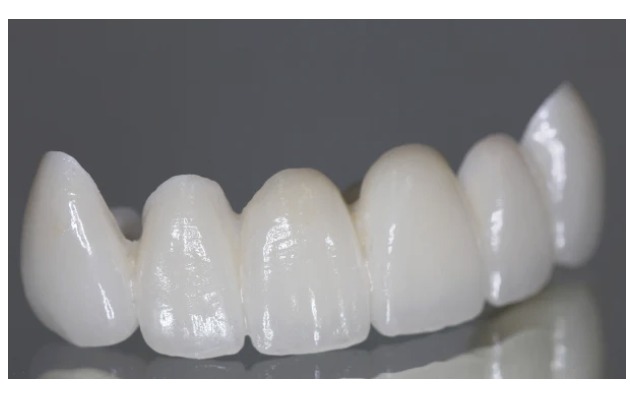
A full crown requires reducing the entire tooth down to a stump-shaped core to make room for a full-coverage cap. An inlay or onlay — a custom, lab-made or CAD/CAM-milled restoration bonded into or over the tooth — only replaces the damaged portion, preserving substantially more of your natural tooth structure while holding up comparably well over the long term.
A full crown gets recommended by default in a lot of practices, even when the remaining tooth structure would support a more conservative option. We'll tell you plainly whether your tooth is a genuine candidate for an inlay or onlay before recommending a bigger restoration.
Am I a Candidate?
An inlay or onlay may be right for you if:
- An existing filling has failed or a cavity is too large for a new filling to reliably support
- One or more cusps are cracked, thin, or undermined by decay or an old filling, but the tooth hasn't lost so much structure that a crown is the only remaining option
- You'd prefer the more conservative restoration when your tooth is a genuine candidate for one
If a tooth has lost too much structure to reliably support an inlay or onlay — or needs full-coverage protection after root canal treatment — a crown is the more appropriate option, and we'll say so directly.
How Much Tooth Structure Does an Inlay or Onlay Actually Save?
The conservative reputation of inlays and onlays isn't just marketing — it's been measured directly.
| Restoration | Typical Tooth Structure Removed |
|---|---|
| Inlay / onlay (partial crown) | ~35.5–46.7% by weight |
| Full-coverage crown | ~67.5–75.6% by weight |
Figures from a gravimetric (weight-based) analysis comparing preparation designs on posterior teeth — a full crown removes roughly twice as much tooth structure as an inlay or onlay preparation on the same tooth.
Inlay vs. Onlay vs. Overlay — Which One Fits Your Tooth?
Inlay
Fits entirely within the cusps on the chewing surface, similar in footprint to a large filling. Appropriate when the cavity or old filling is confined between the cusps and none of the cusps themselves are compromised.
Onlay / Overlay
Extends over one or more cusps to protect them from fracture — sometimes called a “partial crown.” An overlay typically covers all of the cusps while still stopping short of a full crown's total coverage. This is the more common choice once a cusp is thin, cracked, or undermined by a large existing filling, since an unsupported cusp under an inlay is prone to fracturing later.
Research directly comparing outcomes on teeth with extensive mesial-occlusal-distal (MOD) structure loss — a scenario that's traditionally been treated with a crown by default — found that when these teeth do eventually fail, failure with an onlay tends to be less catastrophic (more often repairable) than failure with a full crown. That's part of why minimally invasive treatment philosophy increasingly favors reaching for an onlay before jumping straight to a crown, when the remaining tooth structure allows it.
Inlay, onlay, and overlay aren't the only points on this spectrum. A few related, less commonly discussed options: an occlusal (tabletop) veneer is a thin, often additive restoration — sometimes requiring no tooth reduction at all — used mainly for wear or erosion cases; a vonlay is an overlay that also wraps the visible front surface of the tooth, for cases needing both structural and cosmetic coverage; and an endocrown is a specialized design for a root-canal-treated back tooth that anchors partly inside the pulp chamber instead of relying on a post. We cover this fuller classification, along with how preparation design itself varies (retentive vs. non-retentive, and how much of each cusp gets covered), in more technical detail in our blog post on how dentists classify and design onlay restorations.
How We Prepare the Tooth
An inlay or onlay preparation follows a different set of rules than a crown — the goal is a precise, adequately supported restoration while removing as little healthy tooth as possible.
| Preparation Parameter | General Guideline |
|---|---|
| Isthmus / occlusal box width | Roughly one-quarter to one-third of the intercuspal distance — wide enough for material strength, narrow enough to preserve structure |
| Pulpal floor depth | About 1.5–2 mm to give the restorative material enough bulk to resist fracture |
| Cusp reduction (onlay/overlay) | Cusps left thinner than roughly 2 mm are considered fracture-prone and are typically reduced and capped rather than left unsupported |
| Internal line angles | Rounded, not sharp — sharp internal angles concentrate stress in both the tooth and the restoration |
| Cavosurface margin design | A butt-joint (90°) margin is standard for ceramic; margins extended below the gumline are managed with deep margin elevation before the final impression or scan |
| Wall taper / divergence | A slight outward divergence occlusally, enough for a clean path of insertion without over-tapering and weakening the remaining walls |
These are general operative-dentistry and prosthodontic guidelines, not a substitute for an individualized treatment plan — the right dimensions for your tooth depend on how much structure remains, which cusps are compromised, and where the margins need to sit.
Beyond these baseline dimensions, preparation design itself is a spectrum: traditional preparations use a retentive box-and-isthmus design, while modern adhesive dentistry increasingly favors non-retentive designs that rely on bonding rather than mechanical undercuts — research suggests the non-retentive approach can actually distribute chewing stress more favorably for both ceramic and composite restorations. We'll choose the specific design, and how much of each cusp to cover, based on how much sound structure your tooth has left.
Materials & Fabrication
Materials have shifted heavily toward CAD/CAM ceramic fabrication — digitally scanned and milled from a single block of porcelain or resin-matrix ceramic, often in a single visit — though traditional lab-fabricated gold and porcelain inlays and onlays remain excellent, well-proven options for the right case. Resin-matrix ceramics (hybrid materials combining a ceramic network with a resin component) have become a popular choice for partial-coverage restorations, with systematic reviews reporting favorable short- to medium-term clinical performance. When a margin needs to sit below the gumline, a technique called deep margin elevation — building the margin back up to a more accessible level with a bonded restorative material before finalizing the preparation — is often used rather than extending the crown-lengthening surgery or margin placement deeper into gum tissue.
Care From a Team That Knows You
Dr. Boris Zusin is an expert in general, cosmetic, implant, and dental sleep medicine, with 30+ years of clinical experience and ongoing continuing education. Lena Zusin, RDH works alongside him to make every visit as warm and comfortable as possible.
“Drawing upon our combined skills refined through years of experience and continued education, Lena and I will do everything possible to ensure that your entire dental experience at our office is as good as possible.” — Dr. Boris Zusin
- Uncompromising clinical excellence
- Meticulous attention to detail
- A gentle approach to dentistry

FAQ: Inlays and Onlays at Zusin Dental, NYC
An inlay fits within the cusps on the chewing surface of a tooth, similar in footprint to a large filling. An onlay extends over one or more cusps to protect them from fracture. An overlay typically covers all of the cusps while still preserving more tooth structure than a full crown. All three are custom, lab-made or CAD/CAM-milled restorations bonded into or onto the tooth, rather than a filling placed directly or a crown cemented over the entire tooth.
Gravimetric research comparing preparation designs on posterior teeth found full-coverage crown preparations removed roughly 67.5–75.6% of the tooth's structure by weight, compared with about 35.5–46.7% for an inlay or onlay preparation on the same tooth — the crown removes roughly twice as much healthy structure.
Once a cavity or an old, failing filling is too large for a standard filling to reliably support — particularly if one or more cusps are thin, cracked, or undermined — a filling risks fracturing under normal chewing force. An onlay reinforces the compromised cusps while still preserving substantially more tooth structure than a full crown.
Systematic reviews comparing the two find inlays and onlays hold up comparably well to full-coverage crowns over the long term. Research on teeth with extensive mesial-occlusal-distal structure loss also suggests that when an onlay eventually does fail, the failure tends to be less catastrophic — and more often repairable — than a failed crown.
Most are milled chairside or in a lab from a single block of ceramic or resin-matrix ceramic (a hybrid material combining ceramic and resin), which is why many can be completed in a single visit. Traditional lab-fabricated gold and porcelain remain excellent, well-proven alternatives for the right case.
Yes — unlike a no-drill treatment such as Icon resin infiltration, an inlay or onlay preparation involves removing the damaged tooth structure and shaping the remaining tooth to receive the restoration, so local anesthesia is used just as it would be for a filling or crown.
Good candidates have a cavity or failing filling too large for a standard filling, but with enough healthy tooth structure remaining that a full crown isn't yet necessary. We'll examine the tooth — and take an x-ray if needed — to tell you plainly which restoration actually fits your situation, rather than defaulting to the larger option.
These are related, less commonly discussed points on the same conservative-restoration spectrum. A tabletop (occlusal) veneer is a thin, sometimes no-reduction restoration used mainly for wear or erosion. A vonlay is an overlay that also wraps the visible front surface of a tooth. An endocrown is a specialized design for a root-canal-treated back tooth that anchors partly inside the pulp chamber instead of using a post and core. We cover the full classification in our blog post on how these restorations are classified and designed.
Sources
- Complications and Survival Rates of Inlays and Onlays vs Complete Coverage Restorations: A Systematic Review and Analysis of Studies — Vagropoulou GI, Klifopoulou GL, Vlahou SG, Hirayama H, Michalakis K, Journal of Oral Rehabilitation (2018)
- CAD/CAM Versus Traditional Indirect Methods in the Fabrication of Inlays, Onlays, and Crowns — Oen KT, Veitz-Keenan A, Spivakovsky S, et al., Cochrane Database of Systematic Reviews (2014)
- Tooth Structure Removal Associated With Various Preparation Designs for Posterior Teeth — Edelhoff D, Sorensen JA, International Journal of Periodontics & Restorative Dentistry (2002)
- Interdisciplinary Delphi Study by PROSEC North America: Recommendations on Single Indirect Restorations Made From Ceramic and Nonmetallic Biomaterials for Posterior Teeth — Eggmann F, Orta AL, Abdulmajeed A, et al., Journal of Esthetic and Restorative Dentistry (2024)
- Do Onlays and Crowns Offer Similar Outcomes to Posterior Teeth With Mesial-Occlusal-Distal Preparations? A Systematic Review — Michaud PL, Dort H, Journal of Esthetic and Restorative Dentistry (2024)
- Effect of Deep Margin Elevation With Different Injectable Materials on Performance of CAD/CAM-Fabricated Nanoceramic-Resin Onlays: 3-Year Randomized Clinical Trial — Roshdy BN, Eltoukhy RI, Ali AI, Mahmoud SH, Clinical Oral Investigations (2026)
- Semidirect Composite Onlay With Cavity Sealing: A Review of Clinical Procedures — Alharbi A, Rocca GT, Dietschi D, Krejci I, Journal of Esthetic and Restorative Dentistry (2014)
- Clinical Performance of Resin-Matrix Ceramic Partial Coverage Restorations: A Systematic Review — Fathy H, Hamama HH, El-Wassefy N, Mahmoud SH, Clinical Oral Investigations (2022)
- The Generated Restorative Space Concept: A Digitally Guided Preparation Protocol for Restoring the Vertical Dimension of Occlusion in Patients With Tooth Wear — Albertini G, Bechelli D, Capusotto A, Blasi A, Esquivel J, Journal of Esthetic and Restorative Dentistry (2026)
- Functional or Nonfunctional Cusps Preservation for Molars Restored With Indirect Composite or Glass-Ceramic Onlays: 3D FEA Study — Sellan PLB, Campaner LM, Tribst JPM, et al., Polymers (2021)
Your Experience Matters To Us
5.0 out of 5 on Google (55 reviews) · 4.98 out of 5 on Zocdoc (229 reviews)
“Knowledge is an understatement when you talk about Dr. Zusin! My family and I have been patients of his for over 20 years. I always feel I am given the best advice and never pressured into any unnecessary treatment.”
Faina S. · View on Google →
“I tried a couple different dentists in NYC and Zusin Dental is the best. They are thorough, they don't try and upsell you services you don't need, and they offer appointments on Saturday. The best cleaning I ever had!”
Gordon T. · View on Google →
“Routinely SUPERB level of care, including Dr. Zusin having made himself available for emergent care when needed. The office is always spotlessly clean and there is no waiting at appointment time. Pain-free dentistry!”
Anil N. · View on Google →
“I have never experienced pain with Dr. Zusin. For a practice in busy Manhattan, their office has a small town feel, very relaxed and personable. Lena is always quick to respond to appointment requests or changes.”
Molly P. · View on Google →
“Dr. Zusin is the best dentist! I have been visiting his office for the majority of my life. He has expertly performed teeth whitening and Invisalign, and continued to save my teeth after I chipped my two front teeth.”
Sasha S. · View on Google →
“The West End office is state of the art and very relaxing. Dr. Zusin and Lena are a great team. No matter the dental problem you will get the best results. I highly recommend them.”
Domingo Q. · View on Google →
Ready to Get Started?
You will never be treated like a statistic at Zusin Dental. Let's talk about what's right for you.
Schedule Your Visit Call 212-877-7475