Do Not Delay Periodontal Treatment
Gum disease is an infection that develops when excess bacteria accumulates along the gum line. Left untreated, it can eventually lead to tooth loss.
Medically reviewed by Dr. Boris Zusin, DDS, FAGD, MBA, MS, Diplomate, American Board of Dental Sleep Medicine (ABDSM) · Last reviewed August 21, 2026
Gingivitis vs. Periodontitis
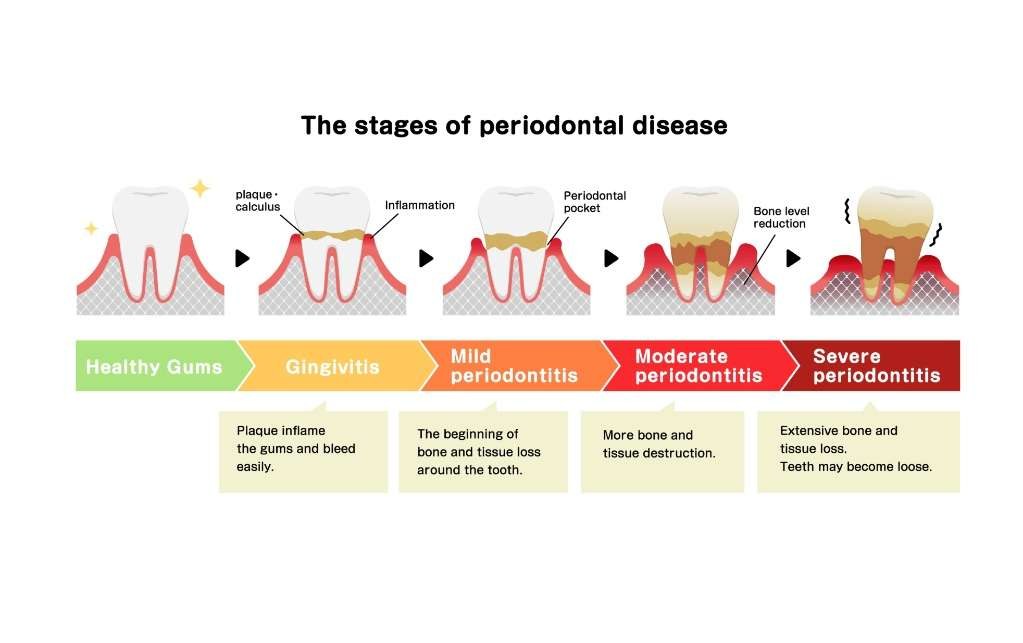
Gingivitis is mild and affects only the gum tissue. Periodontitis is more advanced and affects the gums, cementum, periodontal ligaments, and alveolar bone. Zusin Dental treats periodontal disease at every stage for patients throughout New York City, from an Upper West Side office equipped for both diagnosis and non-surgical treatment.
Treating gum disease isn't just about your teeth — research links periodontal disease to diabetes, heart health, pregnancy outcomes, and more. See the mouth-body connection for the details.
Am I a Candidate?
You may be a candidate for non-surgical periodontal treatment if you're experiencing:
- Bleeding gums, especially when brushing or flossing
- Red or swollen gums
- Bad breath / halitosis
- Loose teeth
What Actually Happens During Treatment
Non-surgical periodontal treatment is the well-established, first-line way to treat gum disease — here's the sequence we follow.
1. Get the Basics Right First
Before any deep cleaning, we make sure your daily brushing and flossing technique is solid and address risk factors that work against healing — smoking and uncontrolled blood sugar in particular slow the response to treatment considerably.
2. Subgingival Instrumentation
This is the actual deep cleaning — carefully removing plaque and hardened tartar from below the gumline, around and along the root surface, using hand instruments, ultrasonic tools, or both. The goal isn't to aggressively strip the root smooth (older "root planing" technique); it's to thoroughly disrupt and remove the bacterial buildup causing the infection, which current research shows is what actually drives healing — not how polished the root surface ends up.
3. Re-Evaluation, 4–8 Weeks Later
We check how your gums have healed — measuring pocket depth and looking for bleeding. Most sites respond well and need nothing further beyond regular maintenance; a small number of deeper, still-inflamed sites may need another round of instrumentation or, occasionally, a referral for surgical access if non-surgical treatment alone hasn't resolved them.
How Well It Works, and How Long It Takes
This is a genuinely effective, well-studied treatment — not a stopgap before "real" treatment. For mild-to-moderate gum disease, which is most cases, it's usually all that's needed.
Most Improvement Comes Early
The bulk of pocket-depth reduction and gum reattachment happens in the first 3–6 months after treatment, then levels off and stays stable as long as you keep up with home care and regular maintenance visits. Long-term studies following patients for 5+ years show low rates of tooth loss and durable improvement, especially among patients who stay on their maintenance schedule.
Why Follow-Up Care Isn't Optional
Periodontitis can be controlled, but the underlying susceptibility to it doesn't go away — ongoing supportive periodontal maintenance is what keeps a good result from slowly reversing. For most patients with moderate-to-advanced periodontitis, that means a maintenance visit every 3–4 months rather than the standard six-month interval; one study following mostly advanced-periodontitis patients found that stretching maintenance to every 5–6 months nearly doubled the odds of disease progression. Your exact interval gets adjusted at each visit based on gum bleeding and remaining pocket depth, not fixed permanently at the start. Skipping maintenance is the single biggest reason treated gum disease comes back.
When We Add Medication — and When We Don't
Antibiotics and other medications can help in specific situations, but they're a supplement to the cleaning itself, never a substitute for it — bacteria protected inside hardened plaque are largely out of reach of a pill or a mouth rinse until that buildup is physically removed.
Systemic Antibiotics
Reserved for more severe or aggressive cases, particularly in younger patients or those with diabetes, and always given alongside (not instead of) the cleaning itself. This isn't a routine add-on for every patient — the evidence supports it selectively, in cases where the extra benefit is worth the tradeoff of antibiotic use.
Site-Specific & At-Home Medication
For isolated stubborn pockets, a locally applied antimicrobial can add a modest additional benefit on top of cleaning alone. We also offer custom take-home delivery trays for prescribed medication as part of an ongoing care plan — see the FAQ below for how that works.
“Do I Have Gum Disease?” Quiz
Answer all 7 questions, then click “See My Result” below.
This quiz is a screening tool, not a diagnosis. An exam is needed to confirm gum disease and its stage.
Care From a Team That Knows You
Dr. Boris Zusin is an expert in general, cosmetic, implant, and dental sleep medicine, with 30+ years of clinical experience and ongoing continuing education. Lena Zusin, RDH works alongside him to make every visit as warm and comfortable as possible.
“Drawing upon our combined skills refined through years of experience and continued education, Lena and I will do everything possible to ensure that your entire dental experience at our office is as good as possible.” — Dr. Boris Zusin
- Uncompromising clinical excellence
- Meticulous attention to detail
- A gentle approach to dentistry

FAQ: Non-Surgical Periodontal Treatment at Zusin Dental, NYC
“Gum therapy” is the patient-friendly term for what dentists call non-surgical periodontal therapy — the same treatment described throughout this page. It covers scaling and root planing (a deep cleaning below the gumline), and sometimes site-specific or oral medication, all aimed at treating gum disease without surgery. If you've heard the term “gum therapy” from a friend or another office, this is what it refers to.
A serious infection of the gums and bone that support your teeth, beginning as plaque along the gum line. Untreated plaque hardens into tartar and causes inflammation (gingivitis); left untreated further, it can progress to periodontitis, where gums pull away from teeth and form infected pockets that damage bone and connective tissue.
Gingivitis — red, swollen, bleeding gums; fully reversible, no bone loss. Early periodontitis — infection begins affecting bone and supporting tissue. Moderate periodontitis — increased bone loss, teeth may loosen. Advanced periodontitis — severe bone damage, shifting teeth, tooth loss likely.
It's linked to heart disease, stroke, diabetes complications, and respiratory infection, since chronic inflammation lets harmful bacteria enter the bloodstream. Tooth loss also affects chewing, speech, appearance, and confidence.
Gingivitis can be fully reversed with professional cleanings and improved home care. Periodontitis cannot be completely cured once bone is lost, but it can be controlled and stabilized with deep cleanings, medication, and regular maintenance to preserve remaining bone and teeth.
A two-part specialized cleaning: first removing plaque and tartar from the tooth surface, gum line, and below the gums; then smoothing the tooth root surfaces to discourage future plaque buildup and encourage gums to reattach.
Custom trays are fabricated from an impression of your mouth, and Dr. Boris Zusin prescribes medication to be placed in the trays for continued at-home treatment of gum disease.
Daily brushing and flossing, a professional cleaning every six months (more often if you're high-risk), avoiding tobacco, managing conditions like diabetes, replacing your toothbrush every three months, and watching for bleeding gums or bad breath.
Sources
- Long-Term Stability After Nonsurgical Treatment of Periodontitis — Sánchez IS, Carra MC, de Albornoz AC, et al., Periodontology 2000 (2026)
- Non-Surgical Periodontal Treatment: SRP and Innovative Therapeutic Approaches — Vinel A, Al Halabi A, Roumi S, et al., Advances in Experimental Medicine and Biology (2022)
- Subgingival Instrumentation — Tomasi C, Abrahamsson KH, Apatzidou D, Periodontology 2000 (2023)
- Periodontal Diseases — Pihlstrom BL, Michalowicz BS, Johnson NW, Lancet (2005)
- Scaling and Root Planing vs. Conservative Surgery in the Treatment of Chronic Periodontitis — Deas DE, Moritz AJ, Sagun RS, Gruwell SF, Powell CA, Periodontology 2000 (2016)
- Evidence-Based Clinical Practice Guideline on the Nonsurgical Treatment of Chronic Periodontitis by Means of Scaling and Root Planing With or Without Adjuncts — Smiley CJ, Tracy SL, Abt E, et al., Journal of the American Dental Association (2015)
- Control of Periodontal Infections: A Randomized Controlled Trial I. The Primary Outcome Attachment Gain and Pocket Depth Reduction at Treated Sites — Goodson JM, Haffajee AD, Socransky SS, et al., Journal of Clinical Periodontology (2012)
- Full-Mouth Treatment Modalities (Within 24 Hours) for Periodontitis in Adults — Jervøe-Storm PM, Eberhard J, Needleman I, Worthington HV, Jepsen S, Cochrane Database of Systematic Reviews (2022)
- Adjunctive Systemic Antimicrobials for the Non-Surgical Treatment of Periodontitis — Khattri S, Kumbargere Nagraj S, Arora A, et al., Cochrane Database of Systematic Reviews (2020)
- Adjunctive Antimicrobials and Host Modulators in Nonsurgical Periodontal Therapy: Focus on Patients With Diabetes and Smokers — Duarte PM, Lazarin R, Vilela N, Feres M, Periodontology 2000 (2025)
- A Systematic Review on the Effects of Local Antimicrobials as Adjuncts to Subgingival Debridement, Compared With Subgingival Debridement Alone, in the Treatment of Chronic Periodontitis — Matesanz-Pérez P, García-Gargallo M, Figuero E, et al., Journal of Clinical Periodontology (2013)
- Adjunctive Therapies in Periodontitis: Current Concepts and the Future — de Molon RS, Steffens JP, de Avila ED, Teughels W, Van Dyke TE, Journal of Periodontal Research (2026)
- Scaling and Root Planing for Gum Disease — MouthHealthy, American Dental Association (ADA)
- Tooth Scaling and Root Planing — Cleveland Clinic
- Predictors of Tooth Loss During Long-Term Periodontal Maintenance: An Updated Systematic Review — Carvalho R, Botelho J, Machado V, et al., Journal of Clinical Periodontology (2021)
- Post-Treatment Supportive Care for the Natural Dentition and Dental Implants — Armitage GC, Xenoudi P, Periodontology 2000 (2016)
- Risk Factors for Tooth Loss and Progression of Periodontitis in Patients Undergoing Periodontal Maintenance Therapy — Siow DSF, Goh EXJ, Ong MMA, Preshaw PM, Journal of Clinical Periodontology (2023)
- Diagnostic Measures for Monitoring and Follow-Up in Periodontology and Implant Dentistry — Ramseier CA, Periodontology 2000 (2024)
Your Experience Matters To Us
5.0 out of 5 on Google (54 reviews) · 4.99 out of 5 on Zocdoc (227 reviews)
“Knowledge is an understatement when you talk about Dr. Zusin! My family and I have been patients of his for over 20 years. I always feel I am given the best advice and never pressured into any unnecessary treatment.”
Faina S. · View on Google →
“I tried a couple different dentists in NYC and Zusin Dental is the best. They are thorough, they don't try and upsell you services you don't need, and they offer appointments on Saturday. The best cleaning I ever had!”
Gordon T. · View on Google →
“Routinely SUPERB level of care, including Dr. Zusin having made himself available for emergent care when needed. The office is always spotlessly clean and there is no waiting at appointment time. Pain-free dentistry!”
Anil N. · View on Google →
“I have never experienced pain with Dr. Zusin. For a practice in busy Manhattan, their office has a small town feel, very relaxed and personable. Lena is always quick to respond to appointment requests or changes.”
Molly P. · View on Google →
“Dr. Zusin is the best dentist! I have been visiting his office for the majority of my life. He has expertly performed teeth whitening and Invisalign, and continued to save my teeth after I chipped my two front teeth.”
Sasha S. · View on Google →
“The West End office is state of the art and very relaxing. Dr. Zusin and Lena are a great team. No matter the dental problem you will get the best results. I highly recommend them.”
Domingo Q. · View on Google →
Ready to Get Started?
You will never be treated like a statistic at Zusin Dental. Let's talk about what's right for you.
Schedule Your Visit Call 212-877-7475