Plaque vs. Tartar: What's Actually the Difference?
They're related, but they're not the same thing — and once plaque hardens into tartar, no amount of brushing or flossing will remove it. Here's what's actually happening on your teeth...
By Dr. Boris Zusin · Published August 24, 2026
"Plaque" and "tartar" get used almost interchangeably in everyday conversation, but they're genuinely different things — one is alive and removable at home, the other is mineralized and requires a dental instrument. Understanding the difference explains why your hygienist can't just tell you to "brush harder" once tartar has formed.
Plaque Is a Living Bacterial Community, Not Just Residue
Dental plaque is a highly organized biofilm — a structured community of bacteria embedded in a matrix of bacterial and salivary material that sticks to your tooth surface. It doesn't appear all at once. Within minutes of a cleaning, a thin protein layer from saliva coats the tooth; oxygen-tolerant pioneer bacteria attach to that layer first, then multiply and recruit other species over the following hours and days until a mature, layered bacterial community is established. This biofilm is the primary cause of both cavities (the bacteria metabolize sugars and produce acid that dissolves enamel) and gum disease (bacterial byproducts trigger the inflammation that becomes gingivitis and, if untreated, periodontitis).
Why Brushing Still Matters So Much
Bacteria organized into a biofilm are considerably more resistant to antimicrobial agents than the same bacteria floating freely would be — which is exactly why mouthwash alone doesn't substitute for physically brushing plaque off the tooth surface. Daily mechanical removal (fluoride toothpaste plus cleaning between teeth) remains the most effective way to control plaque. Essential-oil rinses can help as an everyday add-on, but chlorhexidine — a prescription-strength antiseptic rinse sometimes used after gum surgery, with orthodontic appliances, or in patients who can't clean mechanically as well — is meant for short- to moderate-term use, not an indefinite daily habit.
The reason is a well-documented set of side effects that build up the longer it's used: in clinical testing, roughly half of users developed a measurable increase in tooth staining, and about 1 in 7 had heavy staining by six months — staining that needs a professional cleaning to remove, not something a toothbrush fixes. Chlorhexidine also tends to increase tartar formation, somewhat counterintuitively for an antiseptic rinse, and can cause taste disturbances, a burning sensation, or temporary numbness in some users. Staining is essentially inevitable with four or more weeks of continuous use, which is exactly why the FDA-approved label for one common brand (Peridex) directs use after a professional cleaning, with re-evaluation and cleaning at intervals no longer than six months — it's designed around short courses, not standing daily use. If a chlorhexidine rinse has been recommended to you for an extended period, it's worth a conversation about why, and whether the benefit still outweighs the cumulative side effects in your specific case.
How Plaque Becomes Tartar
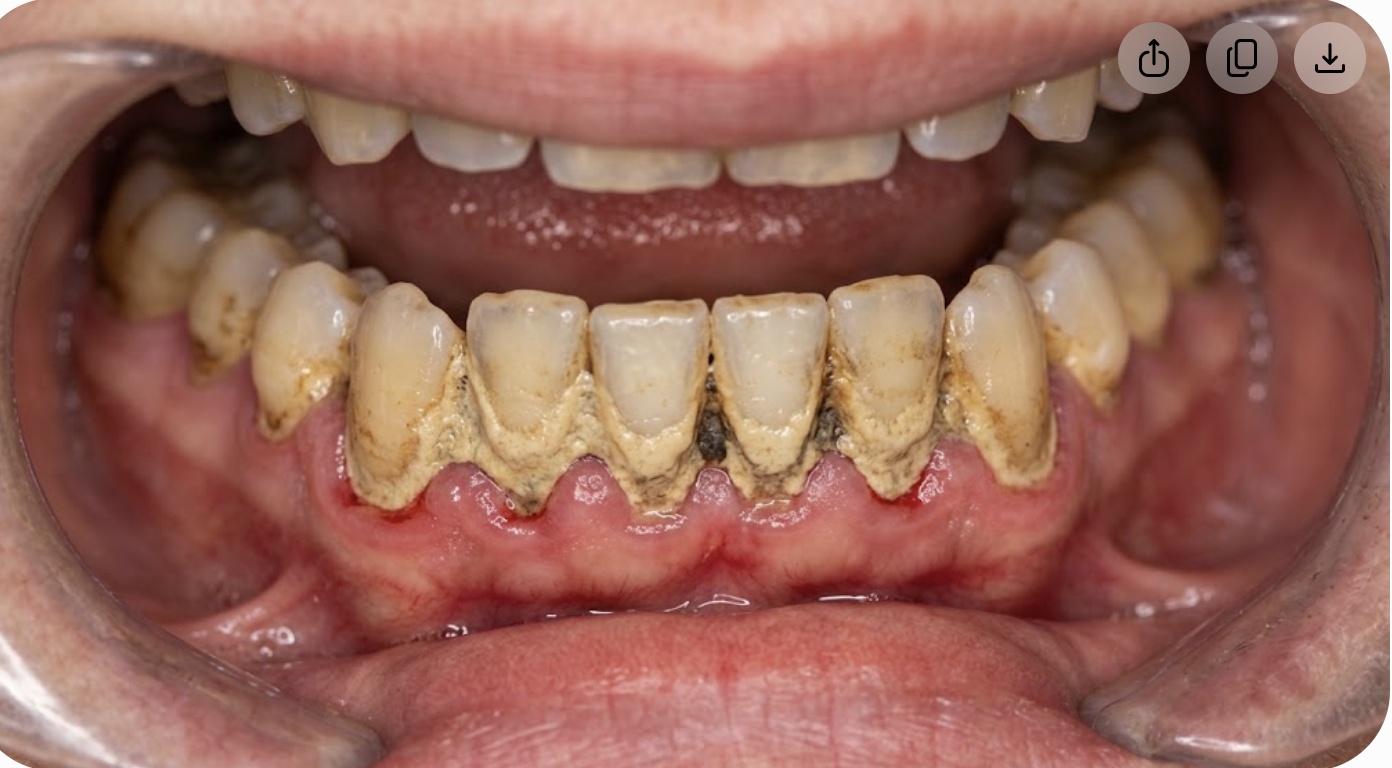
Left in place, plaque can mineralize — calcium and phosphate salts deposit within and between the bacteria, eventually forming hardened calculus (tartar). Not all plaque calcifies, but it's extremely common: roughly 90% of adults have some tartar. Above the gumline, saliva supplies the minerals, and deposits tend to build up fastest near where saliva ducts open into the mouth — behind the lower front teeth and on the cheek side of the upper molars, which is why those spots often need extra attention at a cleaning. Below the gumline, the fluid seeping from inflamed gum tissue (rather than saliva) supplies the minerals for subgingival calculus, which forms without visible warning and is only found on a probing exam.
Why Tartar Still Matters Even Though It's "Dead"
Once fully mineralized, tartar itself is less bacterially active than the living plaque it came from. But its rough, porous surface acts as a scaffold that living plaque continuously recolonizes, and it physically blocks effective brushing and flossing around and beneath it. That combination — a rough surface plus fresh bacterial colonization on top of it — is tartar's real contribution to gum disease, not the mineral deposit itself.
Why Only We Can Remove It
This is the practical bottom line: plaque responds to your toothbrush and floss because it's still soft. Tartar doesn't, because it's chemically bonded to the tooth surface the way a mineral deposit would be — removing it requires scaling with a dental instrument, whether that's a routine cleaning for supragingival deposits or scaling and root planing for tartar that's formed below the gumline. No amount of extra brushing at home will remove tartar once it's hardened; it just isn't the same material anymore.
Can You Slow Tartar From Forming?
Anticalculus ("tartar-control") toothpaste and rinses work by inhibiting the mineralization process, which can meaningfully slow — not eliminate — how quickly plaque calcifies. How fast any individual person forms tartar varies widely and is influenced by diet, the specific composition of their saliva, age, and certain medications, which is part of why some patients reliably need more frequent cleanings than others regardless of how well they brush.
If it's been a while since your last cleaning, our Dental Exams & Cleaning page covers what to expect, and if you've been told you have tartar below the gumline, our Non-Surgical Periodontal Treatment page explains how scaling and root planing addresses it.
Sources
- One-to-One Oral Hygiene Advice Provided in a Dental Setting for Oral Health — Soldani FA, Lamont T, Jones K, et al., Cochrane Database of Systematic Reviews (2018)
- Dental Calculus Formation Rate: The Role of Salivary Proteome and Metaproteome — Cai W, Dubreuil N, Abu Nada L, et al., Journal of Clinical Periodontology (2025)
- Calculus Removal and the Prevention of Its Formation — Jepsen S, Deschner J, Braun A, Schwarz F, Eberhard J, Periodontology 2000 (2011)
- Oral Health Care for Children and Youth With Developmental Disabilities: Clinical Report — Sarvas E, Webb J, Landrigan-Ossar M, et al., Pediatrics (2024)
- Home Use of Interdental Cleaning Devices, in Addition to Toothbrushing, for Preventing and Controlling Periodontal Diseases and Dental Caries — Worthington HV, MacDonald L, Poklepovic Pericic T, et al., Cochrane Database of Systematic Reviews (2019)
- Dental Plaque Biofilms: Communities, Conflict and Control — Marsh PD, Moter A, Devine DA, Periodontology 2000 (2011)
- Recent Concepts in Plaque Formation — Bernimoulin JP, Journal of Clinical Periodontology (2003)
- High Conservation of the Dental Plaque Microbiome Across Populations With Differing Subsistence Strategies and Levels of Market Integration — Velsko IM, Gallois S, Stahl R, Henry AG, Warinner C, Molecular Ecology (2023)
- Dental Calculus: Recent Insights Into Occurrence, Formation, Prevention, Removal and Oral Health Effects of Supragingival and Subgingival Deposits — White DJ, European Journal of Oral Sciences (1997)
- Dental Calculus: The Calcified Biofilm and Its Role in Disease Development — Akcalı A, Lang NP, Periodontology 2000 (2018)
- Chlorhexidine Mouthrinse as an Adjunctive Treatment for Gingival Health — James P, Worthington HV, Parnell C, et al., Cochrane Database of Systematic Reviews (2017)
- Peridex (Chlorhexidine Gluconate 0.12%) Oral Rinse — FDA Drug Label — U.S. Food and Drug Administration, DailyMed (updated 2024)
- Preprocedural Mouth Rinses for Preventing Transmission of Infectious Diseases Through Aerosols in Dental Healthcare Providers — Kumbargere Nagraj S, Eachempati P, Paisi M, et al., Cochrane Database of Systematic Reviews (2022)
- Local Interventions for the Management of Alveolar Osteitis (Dry Socket) — Daly BJ, Sharif MO, Jones K, Worthington HV, Beattie A, Cochrane Database of Systematic Reviews (2022)
Related to This Article
Have a Dental Question of Your Own?
Reach out and we'll help you find the right next step.
Schedule Your Visit Call 212-877-7475