Dental Implants vs Dentures: A Brutally Honest Comparison
If you are struggling with missing teeth or failing dental work, you are likely standing at a crossroads between traditional dentures and dental implants...
By Dr. Boris Zusin · Published December 12, 2025
If you are struggling with missing teeth or failing dental work, you are likely standing at a crossroads: traditional dentures, the solution your parents or grandparents may have used, or dental implants, the modern alternative. The choice isn’t just about money — it’s about quality of life: eating a steak without worry, laughing without covering your mouth, and preserving the shape of your face as you age.
The Fundamental Difference
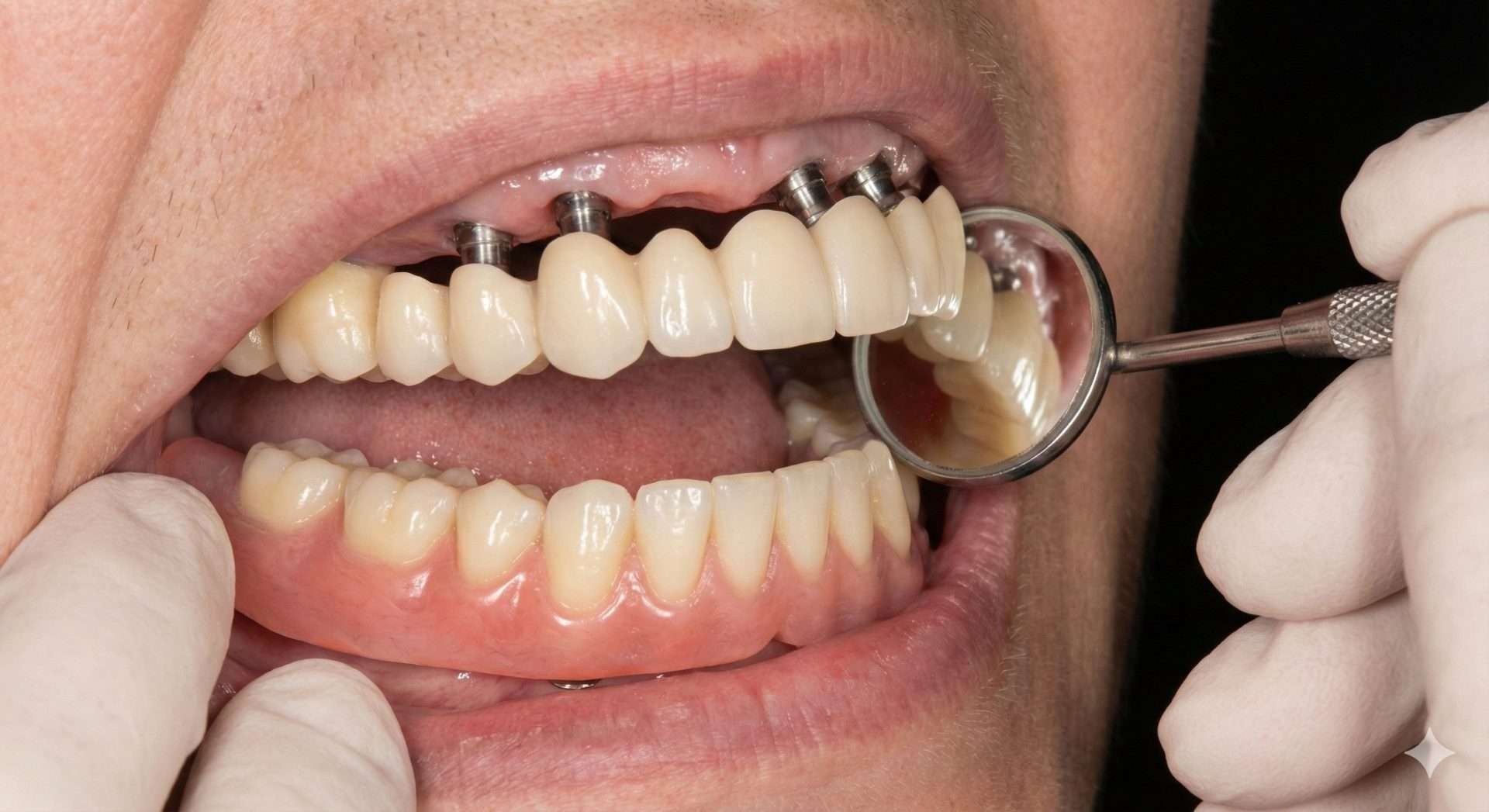
A denture is a removable appliance — artificial teeth set into a pink acrylic base that sits on top of your gum tissue, held in place by suction or adhesive. Because it isn’t anchored to anything solid, it can move, slip, or click when you speak or eat. A dental implant is a replacement for the entire tooth, including the root: a titanium screw is surgically placed into the jawbone, where the bone fuses to it (osseointegration), locking it permanently in place and letting it function like a natural tooth — no glue, no movement.
Chewing and Function
Traditional dentures reduce biting force by roughly 70–80%, since the appliance rests on soft gums; sticky foods, hard foods, and tough meats are often off the table, and upper dentures cover the palate, blunting taste. Implants restore nearly 100% of natural biting force because the load transfers to bone just like natural teeth, with no dietary restrictions, and implant-supported bridges (like All-on-4) don’t cover the roof of the mouth.
Bone Health and Facial Aesthetics
Your jawbone stays strong only because tooth roots stimulate it every time you chew. Once a tooth is pulled and replaced with a denture, that stimulation stops and the body begins to dissolve the bone (resorption) — over 10–20 years this leads to the “sunken” facial look often associated with old age. Implants are the only replacement option that preserves bone, since the titanium screw transmits chewing forces into the jaw and signals the body to keep it dense and healthy.
Daily Life and Maintenance
Dentures need to be removed nightly to let gums breathe and soaked in a cleaning solution, often need adhesive pastes during the day, and require a “reline” every 1–2 years as the jawbone shrinks — and eventually a full replacement. Implants are cared for like real teeth (brushing and flossing), stay in permanently, and don’t slip or click.
Cost: Short-Term vs. Long-Term
Dentures are cheaper upfront but are a recurring expense — typically replaced every 5–7 years, plus the ongoing cost of adhesives and cleaning supplies. Implants are largely a one-time cost: with proper care the titanium fixture can last a lifetime, though the crown may need replacement after 15–20 years of normal wear. Calculated per day over 20–30 years, many patients find implants the better financial choice.
A Middle Ground: Snap-On Dentures
For patients wanting more stability than a traditional denture but a lower cost than a full set of individual implants, 2–4 implants can be placed with a denture that “snaps” onto them — still removable for cleaning, but far less likely to slip, with the implants also helping slow bone loss in the front of the jaw.
Which Should You Choose?
Traditional dentures make sense with significant budget constraints, certain health issues that make even minor surgery risky, or as a temporary solution while saving for implants. Dental implants make sense if you want teeth that feel and function like natural teeth, want to preserve your jawbone and facial structure, want to eat without worry, and want a permanent solution without glue or nightly removal. If you’re tired of loose dentures or failing teeth, the first step is a consultation to see if your bone density makes you a candidate for implants.
Related to This Article
Have a Dental Question of Your Own?
Reach out and we'll help you find the right next step.
Schedule Your Visit Call 212-877-7475