Is Getting Dental Implants Painful? What to Expect After Placement
Mild pain and swelling that peak around 24-48 hours and resolve within about a week are the expected norm after implant placement — here's the real symptom timeline, self-care steps, and the signs that need a follow-up instead...
By Dr. Boris Zusin · Published January 25, 2026 · Updated September 5, 2026
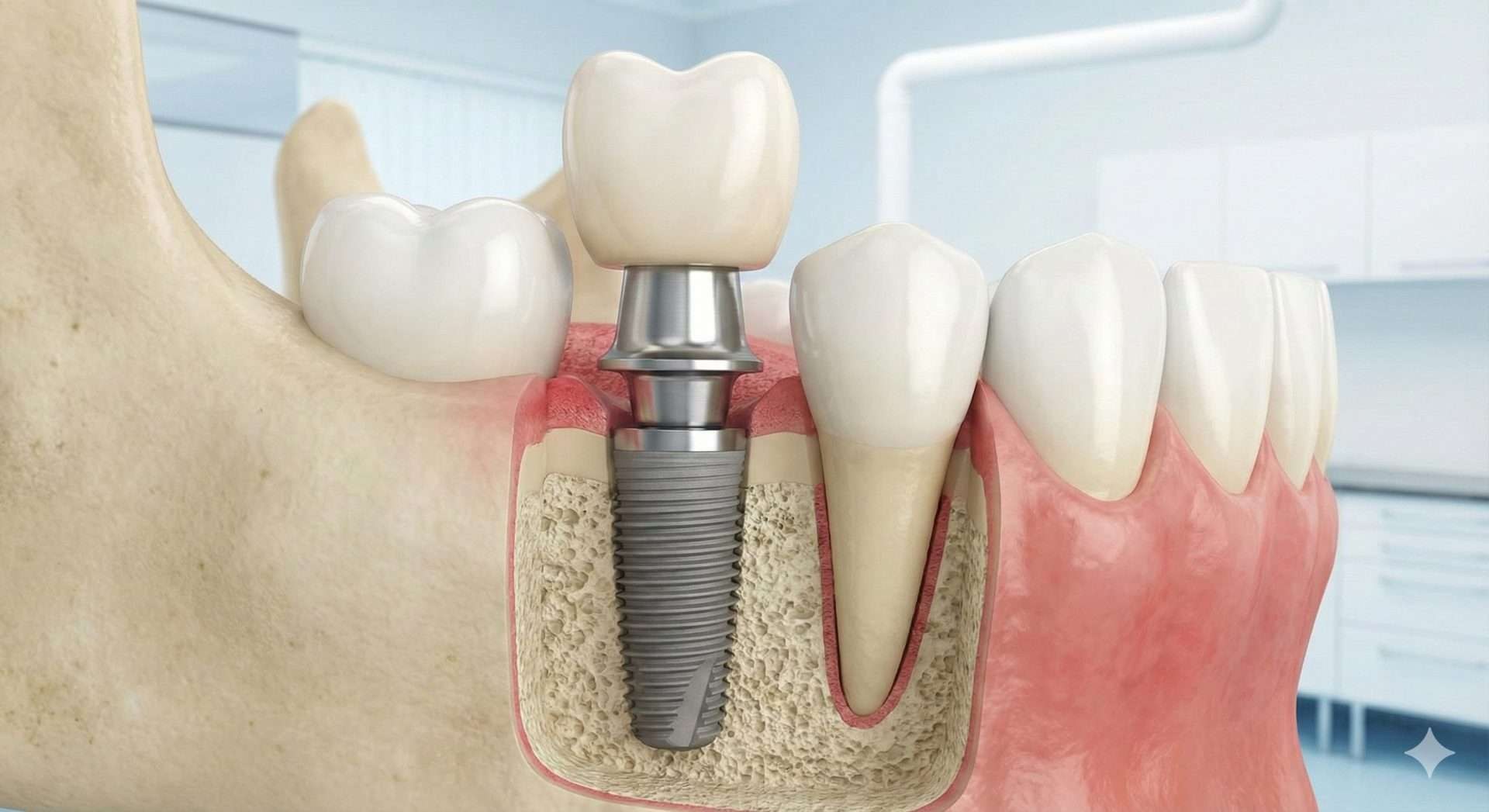
Dental implants replace missing teeth by placing a small titanium post into the jawbone, which then supports a crown, bridge, or denture. Because this involves a surgical step, it’s natural to assume the procedure is painful — but the real-world data tell a more reassuring story. Mild pain and swelling that peak around 24–48 hours and resolve within about a week are the expected norm after implant placement, along with a transient foreign-body sensation and short-term difficulty eating and cleaning near the site. This is a well-tolerated procedure overall: most patients report no-to-mild pain, oral-health-related quality of life dips for roughly two weeks and returns to baseline by one month, and serious complications are uncommon. Postoperative discomfort is usually controlled with over-the-counter analgesics alone.
Is the Procedure Itself Painful?
During placement, local anesthesia completely numbs the treatment area — patients typically feel pressure or vibration, not pain. Many patients say implant placement is more comfortable than having a tooth extracted. For dental anxiety or more complex cases, sedation options include oral sedation, IV sedation, and nitrous oxide. A single implant often takes 30–60 minutes to place; shorter procedures generally mean less tissue trauma and less post-operative discomfort.
The Real Symptom Timeline
Pain. Pain peaks in the first 24 hours, then declines steadily. Only about 4–5% of patients report moderate-to-severe pain, and most people are back to no or mild discomfort by day 7.
Swelling. Swelling is actually the more common complaint — up to 65–70% of patients notice some, peaking around day 2 and largely settling within 7–14 days. More extensive surgery, bone grafting with a membrane, and wider implants all predict more swelling than a straightforward single-implant case, so your expected timeline depends somewhat on what your specific procedure involved.
Foreign-body sensation and function. A mild "different" feeling at the site is common and transient, and chewing and brushing near the area are temporarily a little harder for the first week or two. Quality-of-life measures (not just pain scores) show a real but short dip that fully recovers by around one month.
Self-Care Instructions
Cold packs. Intermittent external ice to the area for the first day or two helps limit swelling.
Diet. A cold or liquid diet for the first one to two days, then a soft diet until suture removal (typically one to two weeks), avoiding chewing directly on the site.
Oral hygiene. Keep brushing the rest of your mouth normally, but avoid the surgical site itself at first. A chlorhexidine (0.12–0.2%) rinse used twice daily for about a week is often recommended — but avoid rinsing at all in the first 24 hours, since disturbing the clot too early can slow healing.
Analgesia. Over-the-counter ibuprofen or acetaminophen covers most patients' needs; antibiotics or steroids are sometimes added per your surgeon's protocol, especially if bone grafting was part of the procedure.
Removable dentures. If you wear a removable denture, avoid wearing it directly over the implant site for about two to three weeks — longer if grafting was involved — since pressure on the healing site can interfere with integration.
Sinus precautions. For upper posterior implants or sinus-lift procedures specifically, avoid blowing your nose, sneeze with your mouth open, and avoid air travel or diving for the period your surgeon specifies — pressure changes near a healing sinus lift can be genuinely disruptive to that particular procedure.
If You Take Blood Thinners
Patients on anticoagulant medications (including newer agents like dabigatran) generally do not need to stop them for routine implant placement — comparative studies have found that local hemostatic measures at the surgical site control bleeding effectively without interrupting anticoagulation, which matters because stopping these medications carries its own real risks. This is a decision your prescribing physician and surgical dentist should coordinate on together rather than something to decide on your own.
When to Seek Dental Review
- Bleeding that isn't controlled with gauze pressure, or spontaneous bleeding — warrants a call rather than waiting it out.
- Worsening pain or swelling after day 3–4 (instead of steadily improving), fever, pus or discharge, or a bad taste — these suggest infection rather than ordinary post-surgical healing.
- A loose or mobile implant — this can indicate early failure and should be evaluated promptly rather than monitored at home. See our guide on signs your dental implant may be failing for more on what early failure looks like.
How Does It Compare to Other Options?
Many patients are surprised that implant placement is often less painful than a tooth extraction, since extractions remove an infected or damaged tooth and can cause more inflammation. Dentures and bridges avoid surgery but can cause ongoing gum irritation, pressure sores, or discomfort from a poor fit. Once healed, implants feel like natural teeth and typically cause no ongoing discomfort — there are no nerves inside the implant itself, so it can’t develop the kind of sensitivity a natural tooth can.
The Healing Horizon
What's happening beneath the surface takes longer than the visible symptoms suggest. Osseointegration — the process of the jawbone actually fusing to the titanium implant — proceeds over weeks to months: new woven bone starts forming in the first week, and mature bone-to-implant contact is largely established by roughly 6–12 weeks. That biological timeline, not just how you feel day-to-day, is why definitive loading (attaching the final crown) is often staged accordingly rather than rushed, and why keeping up with your follow-up visits during this window matters even after the initial soreness is long gone.
Dental implants are far less painful than most patients expect, and the symptoms that do occur follow a predictable, well-documented pattern. With proper anesthesia, modern technique, and good aftercare, discomfort is usually mild and temporary — well worth the long-term benefits of a stable, natural-feeling tooth replacement.
Sources
- Patient-Based Outcomes Following Surgical Implant Placements — Kamankatgan S, Pimkhaokham A, Krisdapong S, Clinical Oral Implants Research (2017)
- Group 5 ITI Consensus Report: Implant Placement and Loading Protocols — Morton D, Wismeijer D, Chen S, et al., Clinical Oral Implants Research (2023)
- Development of Multiple Risk Prediction Models for Postoperative Symptoms Following Dental Implant Surgery — Ma X, Zeng H, Li Y, Yang Y, Journal of Oral Rehabilitation (2026)
- Implant Placement-Associated Tissue Swelling: A Digital Three-Dimensional and Patient-Based Assessment — Kofina V, Valencia Rincon J, Rawal SY, et al., Clinical Oral Investigations (2025)
- Management of Anticoagulated Patients in Implant Therapy: A Clinical Comparative Study — Clemm R, Neukam FW, Rusche B, et al., Clinical Oral Implants Research (2016)
- Dental Implant Surgery in Patients in Treatment by Dabigatran — Gómez-Moreno G, Fernández-Cejas E, Aguilar-Salvatierra A, et al., Clinical Oral Implants Research (2018)
- A Retrospective 10-Year Mean Follow-Up of Implants Placed in Ridges Grafted Using Autogenous Mandibular Blocks Covered With Bovine Bone Mineral and Collagen Membrane — Chiapasco M, Tommasato G, Palombo D, Del Fabbro M, Clinical Oral Implants Research (2020)
- The Risk of Moderate-to-Severe Post-Operative Pain Following the Placement of Dental Implants — Wang M, Li Y, Li J, Fan L, Yu H, Journal of Oral Rehabilitation (2019)
- Peri-Implant Diseases: The Past, the Present, the Future — Berglundh T, Journal of Periodontal Research (2025)
- Peri-Implant Health — Araujo MG, Lindhe J, Journal of Clinical Periodontology (2018)
Related to This Article
Have a Dental Question of Your Own?
Reach out and we'll help you find the right next step.
Schedule Your Visit Call 212-877-7475