Worn-Down Back Tooth With Thin Walls: How We Rebuild It Without Cutting It Away
When a back tooth is worn flat and its walls are paper-thin, a traditional crown can remove what little tooth is left. Modern bonded restorations can rebuild it by adding material instead...
By Dr. Boris Zusin · Published October 15, 2026
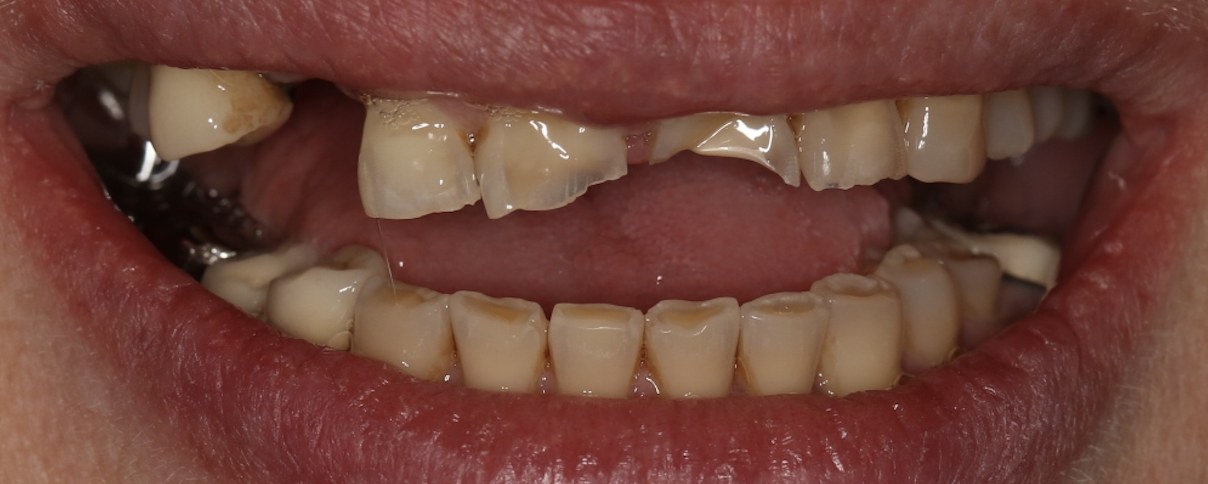
Years of grinding, acid, or heavy chewing can wear the biting surface of a molar down into the softer inner layer (dentin), leaving thin outer walls. A conventional crown needs tall walls to hold on to, and shaping the tooth for one can remove most of what is left (laboratory studies suggest up to roughly 70% of the remaining tooth). For worn, thin-walled teeth, we usually prefer to add material rather than cut more away.
Why Thin Walls Are a Problem
Thin walls can crack under bite force, and short walls give a crown little grip. If less than about 1.5–2 mm of tooth stands above the gum, a crown may not stay on or may fail early. That is why the first step is checking how much healthy tooth is above the gum and bone.
Our Preferred Approach: Bond, Rebuild, and Cover the Cusps
- Adhesive build-up first. We can rebuild thin or missing walls with tooth-colored composite to strengthen the tooth before the final restoration.
- Bonded overlay or onlay. A porcelain or composite overlay covers the weak cusps and protects them. It holds by bonding to the tooth, so it does not depend on tall walls, which makes it a good fit here. See inlays and onlays.
- Direct composite. Built up in the mouth, often guided by a wax-up or mock-up, this is repairable and reversible, and is common when many teeth are worn.
- Restoring bite height. If many teeth are worn, we may rebuild the bite by adding material to create space instead of grinding teeth down. See restoring your bite after tooth wear.
Ceramic Overlay or Direct Composite?
Both can work for a thin-walled molar, and studies show similar tooth survival. The difference is in how they wear and how they are maintained.
- Direct composite is built in one visit, costs less, saves the most tooth, and is easy to repair. Some newer fiber-reinforced composites help support thin cusps. It suits a single tooth with moderate bite forces.
- A bonded ceramic overlay takes two visits and a little more tooth shaping, but stays strong and keeps its color. It is often better for heavy grinders, acid wear, and when several teeth are being rebuilt.
Your bite forces, how much tooth remains, whether the nerve has had treatment, cost, and your preferences all matter. Either way, covering the weak cusps and good bonding matter more than the material itself.
When Gum or Orthodontic Work Comes First
If the wall edge is at or below the gumline, we may need to expose more tooth first. Options include minor gum surgery (crown lengthening), gently pulling the tooth up with braces (orthodontic extrusion), or raising a deep edge with bonded composite (deep margin elevation) when it can be kept dry. Extrusion keeps more bone support, while crown lengthening is faster but removes bone. For a back lower molar with very little tooth to save, we also weigh whether the tooth should be kept at all.
Protecting the Result
If grinding or acid caused the wear, treating that cause matters. A night guard, diet changes, and reflux care help protect the new restoration. Research on these approaches includes mostly short-term studies and case series, so we follow worn teeth closely at checkups.
Sources
- Restorative Options for Moderate and Severe Tooth Wear: A Systematic Review — Alani A, Mehta S, Koning I, Loomans B, Pereira-Cenci T, Journal of Dentistry (2025)
- Longevity of Posterior Direct Versus Indirect Composite Restorations: A Systematic Review and Meta-Analysis — Tennert C, Maliakal C, Suarèz Machado L, et al., Dental Materials (2024)
- Randomized Controlled Trial on the Performance of Direct and Indirect Composite Restorations in Patients With Severe Tooth Wear — Crins LAMJ, Opdam NJM, Kreulen CM, et al., Dental Materials (2021)
- Pressable lithium disilicate ceramic versus CAD/CAM resin composite restorations in patients with moderate to severe tooth wear: Clinical observations up to 13 years — Edelhoff D, Erdelt KJ, Stawarczyk B, Liebermann A, Journal of Esthetic and Restorative Dentistry (2023)
- Performance of Direct and Indirect Onlay Restorations for Structurally Compromised Teeth — Althaqafi KA, Journal of Prosthetic Dentistry (2025)
- Influence of short-fiber composite base on fracture behavior of direct and indirect restorations — Garoushi S, Sungur S, Boz Y, et al., Clinical Oral Investigations (2021)
- The Generated Restorative Space Concept: A Digitally Guided Preparation Protocol for Restoring the Vertical Dimension of Occlusion in Patients With Tooth Wear — Albertini G, Bechelli D, Capusotto A, Blasi A, Esquivel J, Journal of Esthetic and Restorative Dentistry (2026)
- Clinical Performance of Minimally Invasive Full-Mouth Rehabilitation Using Different Materials and Techniques for Patients With Moderate to Severe Tooth Wear: A Systematic Review and Meta-Analysis — Fan J, Wang B, Wang L, et al., Clinical Oral Investigations (2025)
- Structurally compromised teeth. Part II: A novel approach to peripheral build up procedures — Fichera G, Mazzitelli C, Picciariello V, et al., Journal of Esthetic and Restorative Dentistry (2024)
- Composite vertical bite reconstructions in eroded dentitions after 5.5 years: a case series — Attin T, Filli T, Imfeld C, Schmidlin PR, Journal of Oral Rehabilitation (2012)
- Fracture resistance of bonded ceramic overlay restorations prepared in various designs — Channarong W, Lohawiboonkij N, Jaleyasuthumkul P, et al., Scientific Reports (2022)
- A Simplified Approach for Restoration of Worn Dentition Using the Full Mock-Up Concept: Clinical Case Reports — Koubi S, Gurel G, Margossian P, Massihi R, Tassery H, International Journal of Periodontics & Restorative Dentistry (2018)
- Failure load effect of molar axial wall height with CAD/CAM ceramic crowns with moderate occlusal convergence — Hoopes W, Cushen S, DuVall N, et al., Journal of Esthetic and Restorative Dentistry (2018)
- Effect of Molar Preparation Axial Height on Retention of Adhesively-Luted CAD-CAM Ceramic Crowns — Wake R, Buck R, DuVall N, Roberts H, Journal of Adhesive Dentistry (2019)
- Rehabilitation Strategies and Occlusal Vertical Dimension Considerations in the Management of Worn Dentitions: Consensus Statement From SSRD, SEPES, and PROSEC Conference on Minimally Invasive Restorations — Ioannidis A, Pitta J, Panadero RA, et al., Journal of Esthetic and Restorative Dentistry (2025)
- Awareness, perceptions, and clinical use of deep margin elevation in subgingival restorative cases: A cross-sectional multicentric study — Jethwani J, Sundari G, Annamma LM, Tashkandi E, Carrico CK, PLoS One (2026)
Related to This Article
Have a Dental Question of Your Own?
Reach out and we'll help you find the right next step.
Schedule Your Visit Call 212-877-7475