Why Are My Teeth Stained or Discolored? Causes by Color
Stains on the surface and stains inside the tooth look similar but are treated very differently. Here is how color and pattern point to the cause...
By Dr. Boris Zusin · Published November 4, 2026
Not all tooth stains are the same. Some sit on the surface and come off in a cleaning. Others are built into the tooth and need a different approach. Telling them apart is the first step, and color and pattern are good clues.
Surface Stains (Easiest to Fix)
Surface stains collect on the thin film that coats your teeth, and a professional cleaning usually removes them. Common causes include:
- Coffee, tea and red wine: brown stain, often in grooves and near the gumline.
- Tobacco: dark brown to black, often on the back of the lower front teeth.
- Prescription mouth rinses (chlorhexidine and some others): yellow-brown staining between teeth and near the gums, sometimes on the tongue too.
- Bacteria: a thin dark line along the gumline, even in people who brush well (see below), or a green or orange band in children.
- Metals: black or grey stain from iron supplements, certain workplace exposures, or some stannous fluoride products.
The cause matters: removing the stain without addressing the habit or product means it comes back.
Stains Inside the Tooth
These are part of the tooth itself and are harder to lighten:
- Fluorosis: white patches to brown mottling on matching teeth, from too much fluoride while teeth were forming in childhood.
- Tetracycline: grey, yellow or brown bands from certain antibiotics taken while teeth were developing.
- Enamel defects (such as MIH): uneven yellow-brown patches on the first molars and front teeth, with softer enamel.
- Genetic conditions: amber, grey or bluish teeth that run in families.
- Aging: enamel thins and the yellower layer underneath shows through, so teeth darken gradually.
Black Stain That Keeps Coming Back
A thin black line or row of dots along the gumline, which comes back after every cleaning, is a well-known type of bacterial stain. It is harmless. It is not caused by poor brushing and is not a sign of unhealthy teeth; it is actually linked to fewer cavities. It is caused by bacteria that release a sulfur gas, which reacts with iron in saliva and leaves a dark deposit. Some people simply have the right mix of bacteria and saliva for it, and it often fades with age in children.
No treatment stops it permanently. We remove it with a gentle professional cleaning, and it usually returns within weeks to months. Because repeated aggressive polishing can wear enamel and cause sensitivity, we keep removal gentle and schedule it around how much the stain bothers you. Helpful steps include a powered toothbrush with careful brushing at the gumline, a mildly abrasive whitening toothpaste, reviewing iron supplements and dry mouth, and avoiding long-term chlorhexidine rinse, which stains on its own. Other ideas, such as probiotics, lactoferrin or peroxide, have only limited evidence.
When One Tooth Is Different
A single grey, pink or dark tooth is not ordinary staining. It can follow an injury, a nerve that has died, or old filling or root canal material, and a grey tint next to an old silver filling can come from the metal. A dying nerve may cause no pain, so this is worth an exam. We can test the tooth's response to cold and take an X-ray. See Dark Spot on a Tooth? for more.
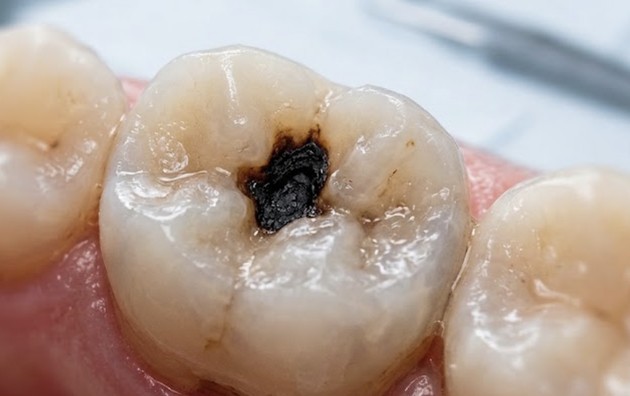
Also note that a brown or black spot that feels rough, chalky or soft is usually a cavity, not a stain.
Dark Spots on the Gums or Inside the Mouth
A new or changing dark patch on the gums, palate or inside the cheek is a different matter. Most are harmless, such as a gray-blue spot beside an old silver filling, but we recommend having any pigmented spot examined, and we may suggest a biopsy if the cause is unclear. Get it checked sooner if it is growing, uneven in color or edge, or ulcerated.
What Works
- Surface stain: a professional cleaning and dealing with the cause. Whitening toothpastes only remove surface stain.
- Mild to moderate internal stain: professional or supervised at-home bleaching. White or brown fluorosis spots may also respond to microabrasion or Icon resin infiltration.
- A dark tooth with a dead nerve: treatment of the nerve (we refer root canals to a specialist), followed by whitening from inside the tooth.
- Severe internal stain, such as dark tetracycline staining: bleaching rarely works well, and veneers or crowns are the usual solution.
Not sure which kind you have? Schedule an exam. Often a cleaning and a few quick tests are enough to tell.
Sources
- Current Perspective on Dental Black Stain of Bacterial Origin: A Narrative Review — Al-Shareef A, González-Martínez R, Cortell-Ballester I, et al., European Journal of Oral Sciences (2025)
- Risk Factors for the Presence of Dental Black Plaque — Ortiz-López CS, Veses V, Garcia-Bautista JA, Jovani-Sancho MDM, Scientific Reports (2018)
- Dental Black Plaque: Metagenomic Characterization and Comparative Analysis With White-Plaque — Veses V, González-Torres P, Carbonetto B, et al., Scientific Reports (2020)
- Effect of Herbal Toothpaste Versus Conventional One on Black Stains in a Group of Egyptian Children: A Randomized Controlled Study — Rashed MF, Zaki ZM, Zeidan HM, et al., Scientific Reports (2026)
- Black Staining: An Overview for the General Dental Practitioner — Janjua U, Bahia G, Barry S, British Dental Journal (2022)
- Oral Manifestations of Commonly Prescribed Drugs — Glick A, Sista V, Johnson C, American Family Physician (2020)
- Home-Use Whitening Toothpastes for Whitening Teeth in Adults — Brennan MM, Hallas D, Jacobs SK, et al., Cochrane Database of Systematic Reviews (2014)
- Professionally-Applied Chemically-Induced Whitening of Teeth in Adults — Carrasco-Labra A, Brignardello-Petersen R, Yanine N, et al., Cochrane Database of Systematic Reviews (2013)
- Home-Based Chemically-Induced Whitening (Bleaching) of Teeth in Adults — Eachempati P, Kumbargere Nagraj S, Kiran Kumar Krishanappa S, Gupta P, Yaylali IE, Cochrane Database of Systematic Reviews (2018)
- An Overview of Tooth-Bleaching Techniques: Chemistry, Safety and Efficacy — Sulieman MA, Periodontology 2000 (2008)
- Tooth Whitening: From the Established Treatments to Novel Approaches to Prevent Side Effects — Rodríguez-Martínez J, Valiente M, Sánchez-Martín MJ, Journal of Esthetic and Restorative Dentistry (2019)
- Validity of Preoperative Clinical Findings to Identify Dental Pulp Status: A National Dental Practice-Based Research Network Study — Pigg M, Nixdorf DR, Nguyen RH, Law AS, Journal of Endodontics (2016)
- Pigmented Lesions of the Oral Mucosa: Clinical Presentation, Histology, and Recommendations for Management — Wolk R, Massi D, Trochesset D, American Journal of Clinical Dermatology (2025)
Related to This Article
Have a Dental Question of Your Own?
Reach out and we'll help you find the right next step.
Schedule Your Visit Call 212-877-7475