Restoring Your Bite After Severe Tooth Wear From Grinding
When grinding has worn teeth down for years, rebuilding the bite means finding room to restore what's been lost — here's how that space is regained safely, and why the fix has to be protected for life...
By Dr. Boris Zusin · Published September 8, 2026
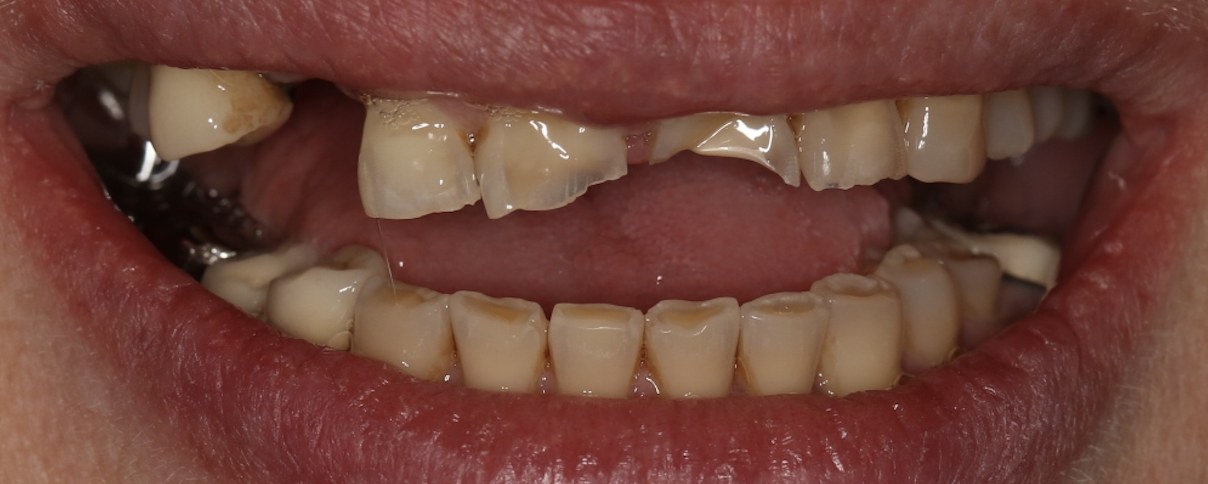
Our teeth grinding page covers what long-term, untreated grinding can do to a bite — flattened back teeth, chipped and worn front teeth, and compensatory eruption that quietly closes up the room needed to fix it. This page goes a level deeper: once that point is reached and it's time to actually rebuild the bite, here's how that's done safely in a patient who still grinds.
Raising Bite Height Doesn't Treat the Grinding — It's a Restorative Decision
It's worth being direct about this upfront: increasing your occlusal vertical dimension (OVD) — essentially, the height of your bite when your back teeth are together — is not a treatment for bruxism itself, and it won't make the grinding stop. The evidence is explicit that irreversible bite changes shouldn't be used as an attempt to "cure" grinding or TMJ disorder. The reason to raise OVD is purely restorative: to regain the physical space needed to rebuild teeth that wear has worn down, and to restore function and appearance. Treating the grinding itself — usually with a protective nightguard — is a separate, parallel goal.
The Key Caveat: Worn Teeth Don't Always Mean Lost Bite Height
A common assumption is that severe wear must mean the bite has "collapsed" and needs to be built back up. That's often not the case. As covered on our grinding page, teeth typically keep erupting to compensate for wear (compensatory eruption), which tends to preserve your overall bite height even as the visible crowns get shorter. The best-evidence consensus on this question found no proof that worn teeth in a grinder erupt so much that raising OVD becomes mandatory — and the amount of extra room available naturally between the teeth when the jaw is at rest (freeway space) varies enormously from person to person, averaging around 3mm but ranging anywhere from 1 to 9mm. In practice, this means OVD should be raised deliberately, to create room for the restorations you need — not on the assumption that height was lost and must be "restored."
How Much Room Is Needed, and What Happens When You Open It
That naturally available freeway space is the real constraint on how much room can be gained. Rebuilding badly worn back teeth often calls for opening the bite by 3mm or more, which can bring the jaw close to, or past, its natural resting position — which is exactly why this isn't done blindly. Opening the bite does temporarily increase muscle activity in the jaw at rest and during clenching, but research following patients through this adjustment found that activity settles back toward baseline within 3 to 4 months as the jaw and muscles adapt, with no evidence connecting the increase to lasting pain.
Testing the New Bite Before Anything Irreversible Happens
Because of that adaptation period, the new bite height is always tried out reversibly first, before any tooth is permanently reshaped. Two main ways this is done:
- A removable splint or long-term temporary restorations built at the full planned bite height — the traditional way to confirm the jaw muscles and joints tolerate the change before committing to it.
- Bonded mock-up restorations placed directly at the new bite height are increasingly preferred over removable splints, since they don't depend on the patient actually wearing something consistently, and they let both patient and dentist see and feel a much closer preview of the final appearance and function.
Whether a patient also has a TMJ disorder helps decide which path fits best: patients with TMJ symptoms, or who need their jaw guided into a new position, are generally better served starting with a rigid, adjustable splint; patients without TMJ symptoms can often move more directly to esthetic temporary restorations.
Rebuilding the Teeth: Minimally Invasive Whenever Possible
Once the new bite height is confirmed to be well tolerated, the actual restorative work favors additive, tooth-preserving techniques over aggressively cutting teeth down for full crowns — raising the bite height is itself what creates the needed space, so heavy tooth preparation usually isn't necessary. Options with real supporting evidence include bonded ceramic onlays or thin occlusal veneers on the back teeth (one material choice, lithium disilicate, has shown essentially 100% survival over an average of 8 years in this exact use), ultra-thin bonded veneers on the front teeth, direct composite build-ups (the most common and least invasive approach, though more prone to needing repair over time in a patient who continues to grind), and increasingly, digitally planned, CAD-CAM-guided full-mouth approaches that map out the entire new bite before any tooth is touched — one such digitally planned case has held up well through 9 years of follow-up.
Bruxism Changes the Math on Materials and Expectations
Ongoing grinding is, on its own, a proven risk factor for restorations failing sooner — alongside things like inconsistent oral hygiene and simply how long the restoration has been in place. Ceramic tends to hold up better than composite under this kind of load (one study found roughly 98% of ceramic veneers still intact after 6 to 8 years, versus about 92% of composite ones, which failed more often from wear and fatigue), and restorations made in a lab (indirect) generally outlast those built directly in the mouth for localized wear cases. None of this means restoring a grinder's bite isn't worthwhile — it means going in with realistic expectations that some repair or maintenance along the way is part of the plan, not a sign something went wrong.
Localized Front-Tooth Wear: The Dahl Approach Revisited
For wear that's mostly limited to the front teeth, with the back teeth still meeting normally and no signs of lost bite height, the "Dahl" approach mentioned on our grinding page — a small platform placed at a slightly increased height that lets the front teeth settle down while the back teeth erupt into new contact — has a solid track record: pooled results show the back teeth typically re-establish full contact in roughly 87% of cases, most often within about 1 to 25 months, and restorations placed in a lab tend to fail less often than those built directly at the chair. That said, the evidence base behind exactly why this works, and how durable it is long-term, is still considered relatively limited, and occasional cases where it doesn't fully succeed have been reported — which is part of why it's monitored closely rather than assumed to work automatically.
The One Step That Isn't Optional: Protecting the New Bite for Life
Whatever combination of restorations is used, the same forces that wore down the original teeth are still there afterward if the grinding itself isn't controlled. That's why a custom nightguard or occlusal splint, worn consistently, is a standard, non-negotiable part of the plan once restorative work at a new bite height is complete — it won't eliminate grinding, but it shields the investment in the new bite from the same fate as the original teeth. See our TMJ Appliances page for more on how these are custom-fitted, or our guide to caring for a nightguard to keep it working as intended.
Sources
- Prosthodontic Planning in Patients With Temporomandibular Disorders and/or Bruxism: A Systematic Review — Manfredini D, Poggio CE, The Journal of Prosthetic Dentistry (2017)
- Sleep Bruxism: An Overview for Clinicians — Beddis H, Pemberton M, Davies S, British Dental Journal (2018)
- Myths Surrounding Vertical Dimension of Occlusion in Restorative Dentistry: A Scoping Review — Lassmann Ł, Calamita MA, Manfredini D, Journal of Esthetic and Restorative Dentistry (2025)
- Occlusal Vertical Dimension: Best Evidence Consensus Statement — Goldstein G, Goodacre C, MacGregor K, Journal of Prosthodontics (2021)
- Randomised Controlled Trial on Testing an Increased Vertical Dimension of Occlusion Prior to Restorative Treatment of Tooth Wear — Crins LAMJ, Opdam NJM, Kreulen CM, et al., Journal of Oral Rehabilitation (2023)
- CAD/CAM: Applications for Transitional Bonding to Restore Occlusal Vertical Dimension — LeSage BP, Journal of Esthetic and Restorative Dentistry (2020)
- The Generated Restorative Space Concept: A Digitally Guided Preparation Protocol for Restoring the Vertical Dimension of Occlusion in Patients With Tooth Wear — Albertini G, Bechelli D, Capusotto A, Blasi A, Esquivel J, Journal of Esthetic and Restorative Dentistry (2026)
- Restoration of Severe Tooth Wear: Converting the Splint Jaw Position Into Definitive Restorations — Aini T, Güth JF, Seidel K, Görl S, Graf T, Journal of Esthetic and Restorative Dentistry (2025)
- The One Step-No Prep Technique: A Straightforward and Minimally Invasive Approach for Full-Mouth Rehabilitation of Worn Dentition Using Polymer-Infiltrated Ceramic Network (PICN) CAD-CAM Prostheses — Mainjot AKJ, Journal of Esthetic and Restorative Dentistry (2020)
- Indirect Restorations for Increasing the Vertical Dimension of Occlusion — Thorpe-Matthisson L, Jäggi M, Rohr N, Zitzmann NU, Zaugg LK, Journal of Esthetic and Restorative Dentistry (2025)
- Contemporary Full-Mouth Rehabilitation Using a Digital Smile Design in Combination With Conventional and Computer-Aided Design/Manufacturing Restorative Materials in a Patient With Bruxism: A Case Report — Lee JH, Kim SH, Han JS, Yeo IL, Yoon HI, Medicine (2019)
- Full Mouth Oral Rehabilitation of a Severely Worn Dentition Based on a Fully Digital Workflow — Lanis A, Gallucci G, Pedrinaci I, Journal of Esthetic and Restorative Dentistry (2023)
- Long-Term Clinical Performance of Bilaminar Veneers Combined With the Dahl Concept for the Management of Localized Anterior Tooth Wear: An Ambispective Cohort Study — Lempel E, Németh KD, Dunavári EK, Jeges S, Szalma J, Dental Materials (2026)
- Clinical Outcomes of Fixed Dahl Restorations for Localized Tooth Wear: A Systematic Review and Meta-Analysis — Fan J, Wang B, Wang L, et al., The Journal of Prosthetic Dentistry (2026)
- A Guide to Managing Tooth Wear: The Radboud Philosophy — Loomans B, Opdam N, British Dental Journal (2018)
- The Dahl Concept: Best Evidence Consensus Statement — Goldstein G, Campbell S, Journal of Prosthodontics (2022)
- Bruxism Treatment Outcomes: A Systematic Review and Meta-Analysis — Assiri HA, Almuawi LF, Asiri BA, et al., Medicine (2025)
Related to This Article
Have a Dental Question of Your Own?
Reach out and we'll help you find the right next step.
Schedule Your Visit Call 212-877-7475