How Your Dentist Sets the Length of Your Front Teeth: Rest, Smile, and Speech
Before veneers, crowns, or a full-mouth rebuild, one decision comes first: where the edges of your upper front teeth should sit. Here's the four-step process dentists use to set it, from how much tooth shows at rest to how you say 'F' and 'S'...
By Dr. Boris Zusin · Published October 9, 2026
When we plan veneers, crowns, or a full rebuild of a worn bite, the first decision isn't tooth color or shape — it's where the edges of your upper front teeth should sit. That single position dictates the angle of your biting plane, how far your jaws are apart when you bite, how long your teeth look, and how clearly you speak. Get it wrong and everything built after it is compromised, which is why it's set before any other cosmetic or bite decision.
It's determined in a set order: first how much tooth shows at rest, then refining the length against your full smile, then double-checking with speech, and finally trying it out in your mouth.
The Four Steps at a Glance
The diagram below is an original illustration built for this post, not a reproduction of any published figure.
Step 1: How Much Tooth Shows at Rest
With you sitting upright, head in a natural position, and lips relaxed, we measure how much of the upper front teeth peeks out below your resting upper lip. A simple way to get a true relaxed position is to have you say “Emma” and then let your lips part slightly on their own.
The typical range is roughly 1 to 4 millimeters of the upper central incisors, adjusted for your age, sex, lip length, and lip tone. The classic age pattern is about 3 mm at age 30, about 1 mm at 50, and under 1 mm by 60, because the upper lip gradually lengthens over time. That's why a smile that looked right at 30 can look “flat” or toothless at rest decades later.
The ideal isn't a single number, either. It depends on lip form: a straight lip looks best with only around 2 mm of show, while moderate or high lip forms look best with roughly 4 to 5 mm. In people whose teeth have worn down, there's often no tooth showing at rest at all. If the edges sit, for example, 3 mm short of the lower border of the upper lip, lengthening by roughly 3.5 to 4 mm is a reasonable starting estimate for bringing the edges back into view. The canine is often the steadiest reference point for judging this, since how much of the central incisors shows varies so widely from person to person.
Step 2: Refine It Against Your Full Smile
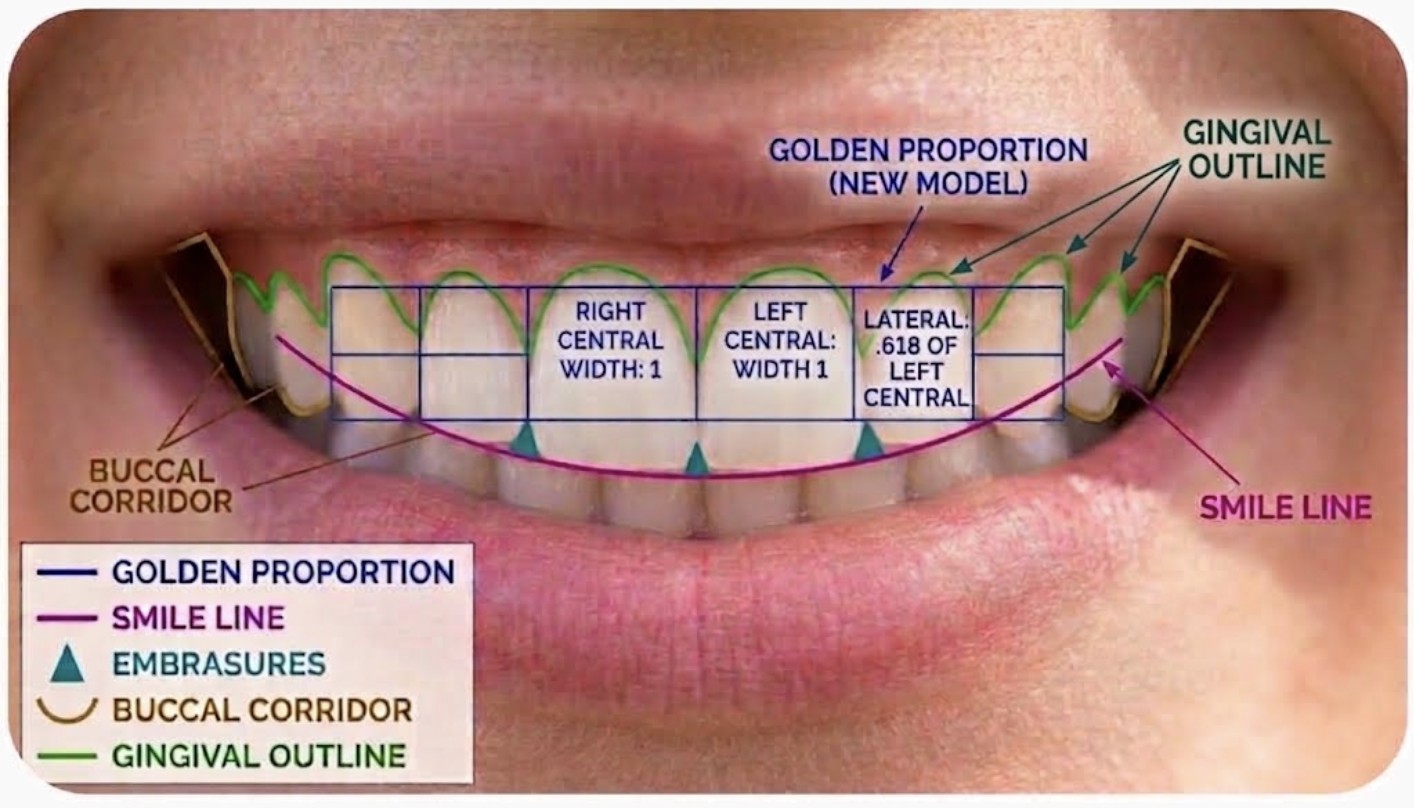
Next we watch how far your lip travels from rest to your biggest, natural smile. That tells us whether you have a low, medium, or high smile line, and how much extra length is esthetically safe before too much gum starts to show. We also look at your smile arc — how the curve of your upper edges lines up with the curve of your lower lip — and note how much gum you show at full smile. Women, on average, show a little more gum in a social smile than men do.
To keep these measurements reliable rather than eyeballed, we use standardized photographs, facial reference tools, and digital rulers laid over overlapping photos, so the rest and smile positions can be compared side by side.
Step 3: Check It With Speech
Your speech is a surprisingly precise test of whether the edges are in the right place:
- “F” and “V” sounds. When you say these, the upper front edges should lightly touch the boundary between the wet and dry parts of your lower lip. If the teeth are too long or too far forward, they'll hit the dry part of the lip or its inner side; if they're too short or set too far back, they won't touch at all.
- “S” sounds. The upper and lower front teeth should come close during an “S” but not touch, leaving a very small gap (the “closest speaking space”). Edges that are too long can cause a lisp or an audible clicking. We test a range of sounds — S, Z, Sh, and Ch — rather than relying on just one, since a single sound isn't reliable on its own.
The sibilant sounds also mark the most forward, highest position your lower jaw reaches while speaking, which makes them a practical functional check on how long the upper edges should be.
Step 4: Test-Drive It Before It's Permanent
The appearance-based and speech-based findings complement each other, and the speaking-space and display measurements vary widely between people, so no single method should decide on its own. Once we've combined them, we transfer the planned edge position into a diagnostic wax-up or a mock-up you can wear. That lets you and us check, in your own mouth, how much shows at rest, how it sounds, and how the smile looks — and adjust — before any permanent restoration is made.
Why Your Face Matters More Than a Formula
Lip length and thickness change the ideal quite a bit. Thinner lips may look better with slightly more forward front teeth, and the rule-of-thumb display numbers don't hold up for very high or very low lip forms. We also check your horizontal reference lines — the line between your pupils, the corners of your mouth, and your facial midline — individually, because most faces aren't perfectly symmetrical. The goal is for your front teeth to look natural with your face as it actually is, not to match an idealized symmetry.
What This Means for You
If you're considering veneers, a smile makeover, or rebuilding teeth that have worn down from grinding, this sequence is what happens behind the scenes before anything is made. If your teeth look short, flat, or barely visible when you're relaxed, or you notice a lisp or whistle when you speak, mention it at your consultation — those are exactly the clues this process is designed to catch. For more on the proportions we design around once the edge position is set, see Anatomy of a Perfect Smile.
Sources
- Three-Dimensional Esthetic Analysis in Treatment Planning for Implant-Supported Fixed Prosthesis in the Edentulous Maxilla: Review of the Esthetics Literature — Bidra AS, Journal of Esthetic and Restorative Dentistry (2011)
- Maxillary Lip Dynamics and Gingival Display Revisited: Utilizing Standardized Metrics — Bakeman EM, Kois JC, Journal of Esthetic and Restorative Dentistry (2023)
- The “Smile Design and Space” Concept for Altering Vertical Dimension of Occlusion and Esthetic Restorative Material Selection — Lassmann Ł, Calamita MA, Blatz MB, Journal of Esthetic and Restorative Dentistry (2025)
- Influence of Lip Form on the Perceived Ideal Incisal Show at Rest — Yong CW, Lee LX, Lee JJ, et al., American Journal of Orthodontics and Dentofacial Orthopedics (2022)
- Dentogingival Display Through Lip Border Movements: Report of the Committee on Research in Fixed Prosthodontics of the American Academy of Fixed Prosthodontics — Walter RD, An H, Pannu DS, The Journal of Prosthetic Dentistry (2022)
- Esthetic Templates for Complex Restorative Cases: Rationale and Management — Kois DE, Schmidt KK, Raigrodski AJ, Journal of Esthetic and Restorative Dentistry (2008)
- Evaluation of the Utility of Cephalometric Parameters in Constructing Complete Denture. Part II: Placement of Anterior Teeth — Bassi F, Rizzatti A, Schierano G, Preti G, Journal of Oral Rehabilitation (2001)
- Determination of Occlusal Vertical Dimension for Complete Dentures Patients: An Updated Review — Alhajj MN, Khalifa N, Abduo J, Amran AG, Ismail IA, Journal of Oral Rehabilitation (2017)
- Mandibular Incisor Position for English Consonant Sounds — Burnett CA, The International Journal of Prosthodontics (2000)
- Digital Workflow for the Restoration of the Vertical Dimension of Occlusion Evaluated by 3D Stereophotogrammetry — Benalcazar-Jalkh EB, de Carvalho LF, Zahoui A, et al., Journal of Esthetic and Restorative Dentistry (2025)
- Evaluation of the Ideal Position of the Maxillary Incisor Relative to Upper Lip Thickness — El Asmar R, Akl R, Ghoubril J, El Khoury E, American Journal of Orthodontics and Dentofacial Orthopedics (2020)
- Digital Assessment of Vertical and Horizontal Esthetic Alignment in Young Adults: A Cross-Sectional Study — Sozen Yanik I, Guncu MB, Sahin Hazir D, Aktas G, Deniz EE, Journal of Esthetic and Restorative Dentistry (2026)
Related to This Article
Have a Dental Question of Your Own?
Reach out and we'll help you find the right next step.
Schedule Your Visit Call 212-877-7475