Anatomy of a Perfect Smile: The Science Behind Smile Design
What makes a smile look 'right' isn't guesswork -- decades of research into smile design have identified a consistent set of proportions and landmarks cosmetic dentists check before any treatment begins...
By Dr. Boris Zusin · Published September 5, 2026
Cosmetic dentistry isn't guesswork. Decades of research into what people actually perceive as an attractive smile have produced a consistent set of proportions and landmarks — the same ones we map out during a veneer, bonding, or full smile-makeover consultation.
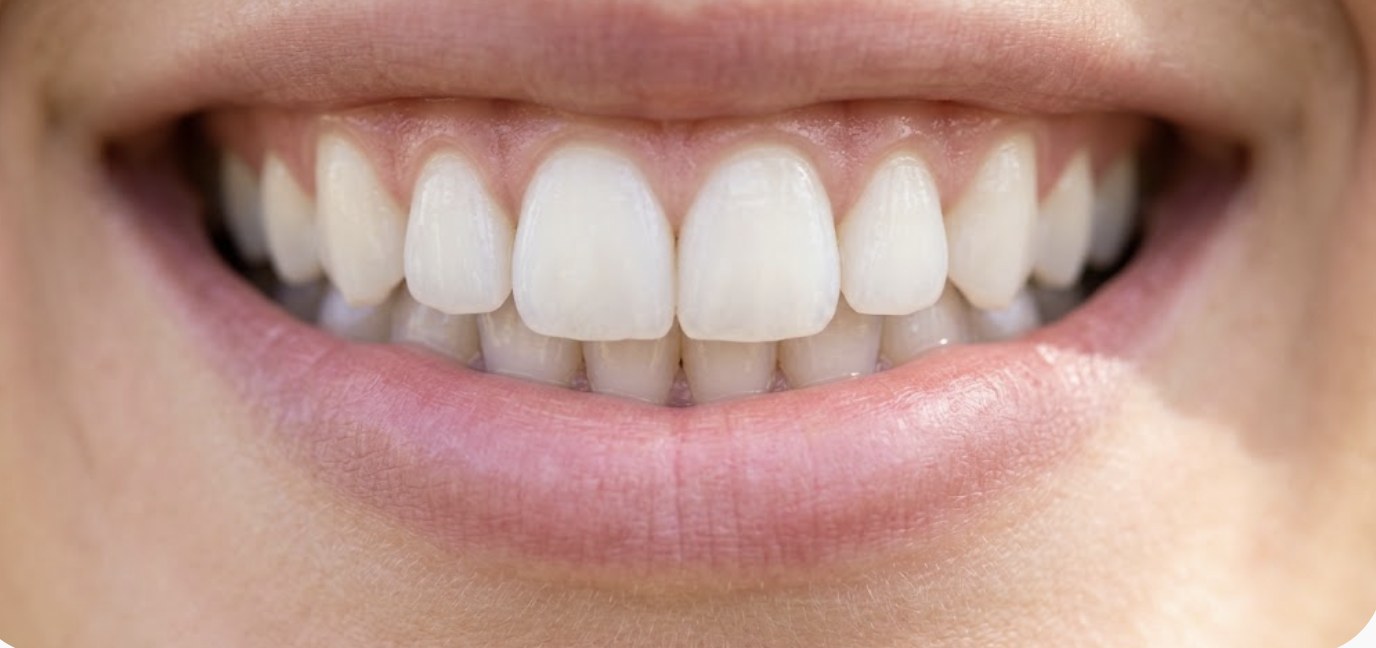
Illustrative reference overlay for patient education, not a photo of an actual Zusin Dental patient or treatment outcome.
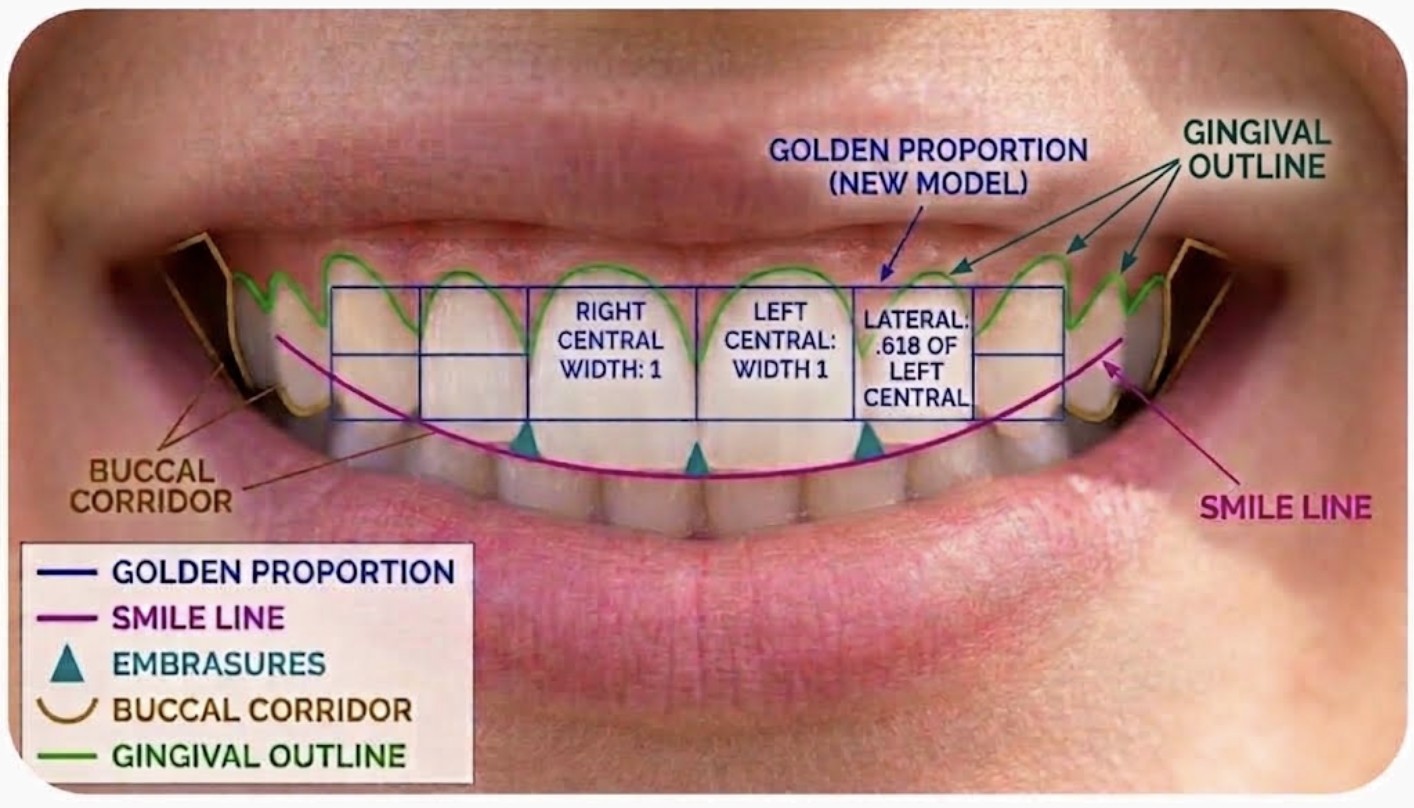
The overlay above marks the reference points a cosmetic dentist checks before any design work begins.
The Consonant Smile Arc
An attractive smile isn't flat. The curve formed by the biting edges of the upper front teeth should follow — or "harmonize" with — the upward curve of the lower lip's wet-dry border. This is called a consonant smile arc. When the incisal edges are flattened or reversed (curving the wrong way), a smile tends to look aged or worn, even if the teeth themselves are healthy. Early research quantifying lip-teeth relationships found this curved, lip-mirroring pattern was consistently rated as the most attractive arrangement.
Central Incisor Dominance and the Golden Proportion
The two front teeth (central incisors) are meant to visually anchor the smile. A well-proportioned central incisor has a width that's roughly 75–80% of its own height. From straight on, each tooth moving outward — central, lateral, canine — looks narrower than the one before it. The classic "golden proportion" says each should be 62% of its neighbor, but studies of natural smiles find that ratio is uncommon, and in preference studies both dentists and non-dentists rated it the least attractive of the options tested. A more flexible idea, the recurring esthetic dental (RED) proportion, keeps the same step-down ratio from tooth to tooth but lets the ratio change to suit the smile; about 70% is the version most people preferred for teeth of normal length. We treat all of these as starting points, not rules, because natural teeth vary and the right design depends on your face, your lips, and the length of your teeth.
Incisal Embrasures
Look closely between adjacent teeth at the biting edge and you'll see small triangular gaps — incisal embrasures. In a natural, youthful smile these embrasures are small between the two front teeth and progressively widen moving toward the back of the mouth. That gradual progression (rather than uniform, boxy gaps) is part of what reads as natural rather than "denture-like." The size and location of these gaps are also tied to how close the contact point between teeth sits to the underlying bone — get that relationship wrong and the gum tissue can't fill the space the way it should.
Gingival Display and Zeniths
How much gum shows when you smile matters too. In an ideal, relaxed full smile, only about 1–2mm of gum tissue is visible above the front teeth. Just as important is the shape of that gumline: the highest points of gum tissue (the "zeniths") over the central incisors and canines should sit at roughly the same level, while the zeniths over the lateral incisors sit about a millimeter lower. That small, consistent offset is what makes a natural gumline look intentional rather than uneven.
Axial Inclination and the Dental Midline
The front teeth aren't perfectly vertical — they carry a subtle tilt toward the midline as you move from central incisor to canine, and that tilt should read as a mirror image on each side of the face. The dental midline itself — the line between the two front teeth — ideally lines up with the facial midline running from the base of the nose through the center of the upper lip. Research on this specific point has found that people are far more bothered by a midline that's tilted (canted) than by one that's shifted slightly left or right but still vertical — so a straight, centered line matters more than perfect centering.
Balanced Buccal Corridors
The dark negative space visible at the corners of the mouth during a smile — between the back teeth and the cheeks — is called the buccal corridor. Smiles with corridors that are too wide can look narrow or "sunken," while corridors that are completely eliminated can look artificially wide, sometimes described as a "denture smile." The evidence points to a middle ground: broad smiles with a small-to-moderate amount of visible corridor space tend to be preferred over either extreme.
None of this is a rigid template. These are population-level patterns, not a one-size-fits-all formula — the right smile design still depends on your own facial proportions, age, gender, and what looks natural on you specifically. That's exactly what a smile-design consultation is for. See our Porcelain Veneers and Smile Makeover pages for how these principles translate into an actual treatment plan.
Sources
- The Importance of the Smile in Orthodontic Diagnosis and Treatment Planning: Part 1. Smile Design — Sarver DM, American Journal of Orthodontics and Dentofacial Orthopedics (2001)
- An Esthetic Evaluation of Lip-Teeth Relationships Present in the Smile — Hulsey CM, American Journal of Orthodontics and Dentofacial Orthopedics (1970)
- The Principles of Visual Perception and Their Clinical Application to Denture Esthetics — Lombardi RE, Journal of Prosthetic Dentistry (1973)
- Dental Esthetics and the Golden Proportion — Levin EI, Journal of Prosthetic Dentistry (1978)
- Width/Length Ratios of Normal Clinical Crowns of the Maxillary Anterior Dentition in Man — Sterrett JD, Oliver T, Robinson F, et al., Journal of Clinical Periodontology (1999)
- Macroesthetic Elements of Smile Design — Morley J, Eubank J, Journal of the American Dental Association (2001)
- The Effect of the Distance From the Contact Point to the Crest of Bone on the Presence or Absence of the Interproximal Dental Papilla — Tarnow DP, Magner AW, Fletcher P, Journal of Periodontology (1992)
- Gingival Zenith Positions and Levels of the Maxillary Anterior Dentition — Chu SJ, Tan JH, Stappert CF, Tarnow DP, Journal of Esthetic and Restorative Dentistry (2009)
- Comparing the Perception of Dentists and Laypersons to Altered Dental Esthetics — Kokich VO, Kiyak HA, Shapiro PA, Journal of Esthetic Dentistry (1999)
- Evaluation of Dental Midline Position and Angulation: How Much Is Too Much? — Beyer JW, Lindauer SJ, American Journal of Orthodontics and Dentofacial Orthopedics (1998)
- Attractiveness of Variations in the Position of the Maxillary Dental Midline and Axial Inclination of the Maxillary Central Incisors — Thomas JL, Hayes C, Zawaideh S, American Journal of Orthodontics and Dentofacial Orthopedics (2003)
- Buccal Corridors and Smile Esthetics — Moore T, Southard KA, Casko JS, Qian F, Southard TE, American Journal of Orthodontics and Dentofacial Orthopedics (2005)
- The Dynesthetic Interpretation of the Dentogenic Concept — Frush JP, Fisher RD, Journal of Prosthetic Dentistry (1958)
- Proportional Smile Design: Using the Recurring Esthetic Dental Proportion to Correlate the Widths and Lengths of the Maxillary Anterior Teeth With the Size of the Face — Ward DH, Dental Clinics of North America (2015)
- Revisiting the Maxillary Teeth in 384 Subjects Reveals a Deviation From the Classical Aesthetic Dimensions — Melo M, Ata-Ali F, Huertas J, et al., Scientific Reports (2019)
- Analysis of the Esthetic Preferences of Spanish Laypersons and Dentists Regarding the Different Width Proportions of the Maxillary Anterior Teeth — Rodriguez-Lopez S, Escobedo Martinez MF, Garcia-Pola M, Junquera LM, The Journal of Prosthetic Dentistry (2023)
- A Study of Dentists' Preferred Maxillary Anterior Tooth Width Proportions: Comparing the Recurring Esthetic Dental Proportion to Other Mathematical and Naturally Occurring Proportions — Ward DH, Journal of Esthetic and Restorative Dentistry (2007)
Related to This Article
Have a Dental Question of Your Own?
Reach out and we'll help you find the right next step.
Schedule Your Visit Call 212-877-7475