Sharp Tooth Pain From Hot Water When Brushing: Causes & When to Worry
A quick, sharp jab when hot water hits a tooth is usually exposed dentin — but a lingering, throbbing ache afterward is a different signal entirely. Here's how dentists actually sort out heat sensitivity...
By Dr. Boris Zusin · Published September 28, 2026
Sharp pain when hot water hits a tooth during brushing is a common complaint, and the combination of heat plus the tactile pressure of the toothbrush is a classic trigger for exposed dentin. But heat sensitivity deserves a closer look than cold sensitivity does, because in dental diagnosis, a lingering response to heat specifically is one of the more reliable warning signs that a tooth's nerve is already in trouble.[1]
The Key Question: Does the Pain Stop When the Heat Does?
The single most useful piece of information is pain duration relative to the stimulus. Dentin hypersensitivity produces a short, sharp pain that stops as soon as the hot water is removed — typically within seconds. Pulpal pathology, on the other hand, produces a dull, lingering, often poorly localized ache that continues well after the stimulus is gone, sometimes building into a throb.[1,2] If you can pinpoint the exact tooth and the pain fades the moment you stop, that's reassuring. If the ache lingers, spreads, or is hard to pinpoint, that's the pattern worth getting checked.
Most Likely Cause: Dentinal Hypersensitivity
The most common explanation for sharp, well-localized pain that resolves quickly is dentinal hypersensitivity — exposed dentin allowing thermal, tactile, and osmotic stimuli to reach nerve fibers near the pulp through microscopic tubules. It affects roughly 30–47% of adults at some point, most often at the gumline of canines and premolars.[1,3] The two most common anatomical causes are:
- Gingival recession — exposed root surface lacks the protective enamel layer and is naturally more reactive to temperature, often from aggressive brushing over time.[3]
- Toothbrush abrasion or acid erosion — cervical notching from a hard-bristled brush or dietary acid wears through enamel and opens the tubules underneath.[4]
Other Explanations to Rule Out
- A cavity, especially at the cervical (gumline) or root surface, can produce thermal sensitivity and is usually visible on exam or an X-ray.[5,6]
- A defective or leaking filling — marginal breakdown or decay recurring underneath an old restoration lets heat reach the nerve more directly.[4]
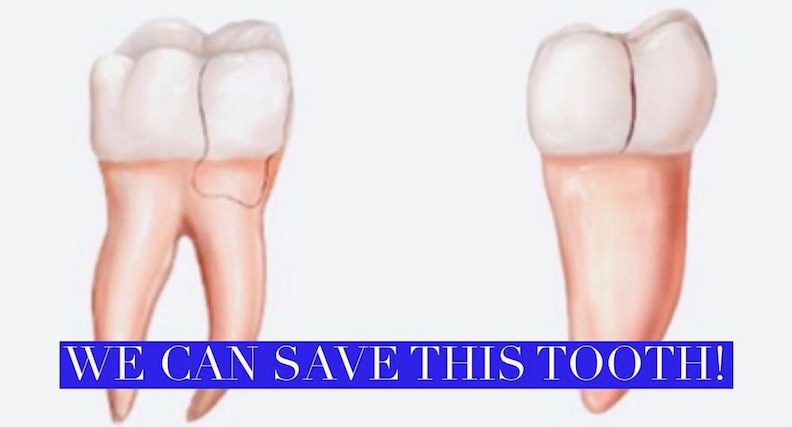
- Cracked tooth syndrome — worth suspecting if there's also sharp pain on biting down and releasing, in addition to the thermal sensitivity, particularly in a restored back tooth. This is diagnosed with a bite test, transillumination, and magnification rather than an X-ray alone, since cracks are frequently invisible on standard imaging.[7,8]
- Reversible pulpitis — the pulp is inflamed but the inflammation is still reversible if the underlying irritant (a cavity, exposed dentin) is treated. The pain is thermally provoked but still short-lived, similar to simple hypersensitivity.[5,6]
The Cannot-Miss Pattern: Irreversible Pulpitis
Heat-provoked pain that lingers or throbs after the hot water is gone, pain that happens spontaneously with no trigger at all, pain that wakes you up at night, or pain that's difficult to localize to one tooth — these all point toward irreversible pulpal inflammation, meaning the nerve inside the tooth is unlikely to recover on its own and will generally need root canal treatment or extraction. One detail dentists specifically watch for: heat sensitivity that is relieved by cold water is considered a red flag for irreversible pulpitis, since it suggests pressure buildup from an already-compromised, partially necrotic pulp.[2,9]
Separately, watch for signs of a spreading infection rather than just a sensitive nerve: facial or gum swelling, fever, difficulty opening your mouth fully, or trouble swallowing. Any of these mean the issue has moved beyond the tooth itself and needs urgent evaluation rather than a routine appointment.[10,11]
How We Sort It Out at an Exam
A focused exam starts with pinpointing which tooth is involved and inspecting it for recession, abrasion notches, decay, cracks, or a failing restoration, then reproducing the pain with air-drying or a controlled thermal and tactile test.[1] From there:
- Cold testing (generally more diagnostically accurate than heat testing) with or without an electric pulp test checks whether the nerve is still healthy; a lingering response to cold also suggests irreversible pulpitis, and no response at all can indicate the pulp has already died.[9,12]
- A bite test and transillumination are used if a crack is suspected, since cracks frequently don't show up clearly on a standard X-ray.[7]
- A bitewing or periapical X-ray remains the primary imaging tool to check for decay, restoration problems, and any changes at the root tip; 3D imaging (CBCT) is reserved for cases that remain unclear after standard imaging.[13]
What Treatment Looks Like
If the workup points to uncomplicated hypersensitivity, first-line management is a potassium-nitrate or stannous-fluoride desensitizing toothpaste used consistently for 2–4 weeks, along with switching to a soft-bristled brush and a gentler technique to stop further recession or abrasion. Cases that don't respond to toothpaste alone may need an in-office tubule-occluding treatment or, for a deep, well-defined notch, a small bonded (Class V) filling to physically seal the exposed area.[3,4] If the pattern instead points toward a lingering, throbbing response, the appropriate next step is root canal treatment rather than a desensitizing product, since a genuinely inflamed or dying nerve won't settle down with toothpaste.
Not sure which pattern your pain fits? Come in for an exam, or compare notes with our guide on cold water tooth pain, since the two often overlap but aren't always caused by the same thing.
Sources
- Treatment of Dentin Hypersensitivity — Trushkowsky RD, Oquendo A, Dental Clinics of North America (2011)
- Endodontic Diagnosis — American Association of Endodontists, Colleagues for Excellence (2013)
- A Randomized Clinical Trial of Dentin Hypersensitivity Reduction Over One Month After a Single Topical Application of Comparable Materials — Abuzinadah SH, Alhaddad AJ, Scientific Reports (2021)
- In Vitro Effects of Hydroxyapatite Containing Toothpastes on Dentin Permeability After Multiple Applications and Ageing — Hiller KA, Buchalla W, Grillmeier I, Neubauer C, Schmalz G, Scientific Reports (2018)
- Imaging of Orofacial Pain — Whyte A, Matias MATJ, Journal of Oral Pathology & Medicine (2020)
- Differential Diagnosis of Toothache to Prevent Erroneous and Unnecessary Dental Treatment — De Laat A, Journal of Oral Rehabilitation (2020)
- Review of Cracked Tooth Syndrome: Etiology, Diagnosis, Management, and Prevention — Li F, Diao Y, Wang J, et al., Pain Research & Management (2021)
- X-Ray Dark-Field Tomography Reveals Tooth Cracks — Jud C, Sharma Y, Günther B, et al., Scientific Reports (2021)
- Diagnostic Accuracy of 5 Dental Pulp Tests: A Systematic Review and Meta-Analysis — Mainkar A, Kim SG, Journal of Endodontics (2018)
- Introducing the FATLIPS Acronym for Assessing the Red Flag Clinical Features of Dental Infection — Cole-Healy Z, Adam D, Noh K, Graham RM, British Dental Journal (2021)
- Odontogenic Infections in the Antibiotic Era: Approach to Diagnosis, Management, and Prevention — Lou Y, Sun Z, Ma H, et al., Infection (2024)
- Evaluation of Accuracy, Reliability, and Repeatability of Five Dental Pulp Tests — Chen E, Abbott PV, Journal of Endodontics (2011)
- American Dental Association and American Academy of Oral and Maxillofacial Radiology Patient Selection for Dental Radiography and Cone-Beam Computed Tomography — Benavides E, Krecioch JR, Allareddy T, et al., Journal of the American Dental Association (2026)
Related to This Article
Have a Dental Question of Your Own?
Reach out and we'll help you find the right next step.
Schedule Your Visit Call 212-877-7475