Understanding Teeth Grinding: What You Need to Know
Teeth grinding can wear, fracture, and even shift teeth over time — here's how it happens, two examples of what it can lead to, and conservative ways to address it...
By Dr. Boris Zusin · Updated July 31, 2026
“So what if I grind my teeth?” This is one of the most common questions patients ask, usually right after being told a tooth is worn down. Here's why it matters, illustrated with two examples: one showing the mechanism, and one showing where it can lead if it goes unaddressed.
Example 1: Loss of Canine Guidance
Normally, the canine is the tooth that takes the contact when your jaw slides side to side, which keeps your back teeth from grinding against each other — a protective mechanism called canine guidance, or "disclusion" of the posterior teeth. When grinding wears the canine down, that protection is lost, and all of the back teeth on that side end up in contact instead, taking on destructive forces they were never meant to handle.
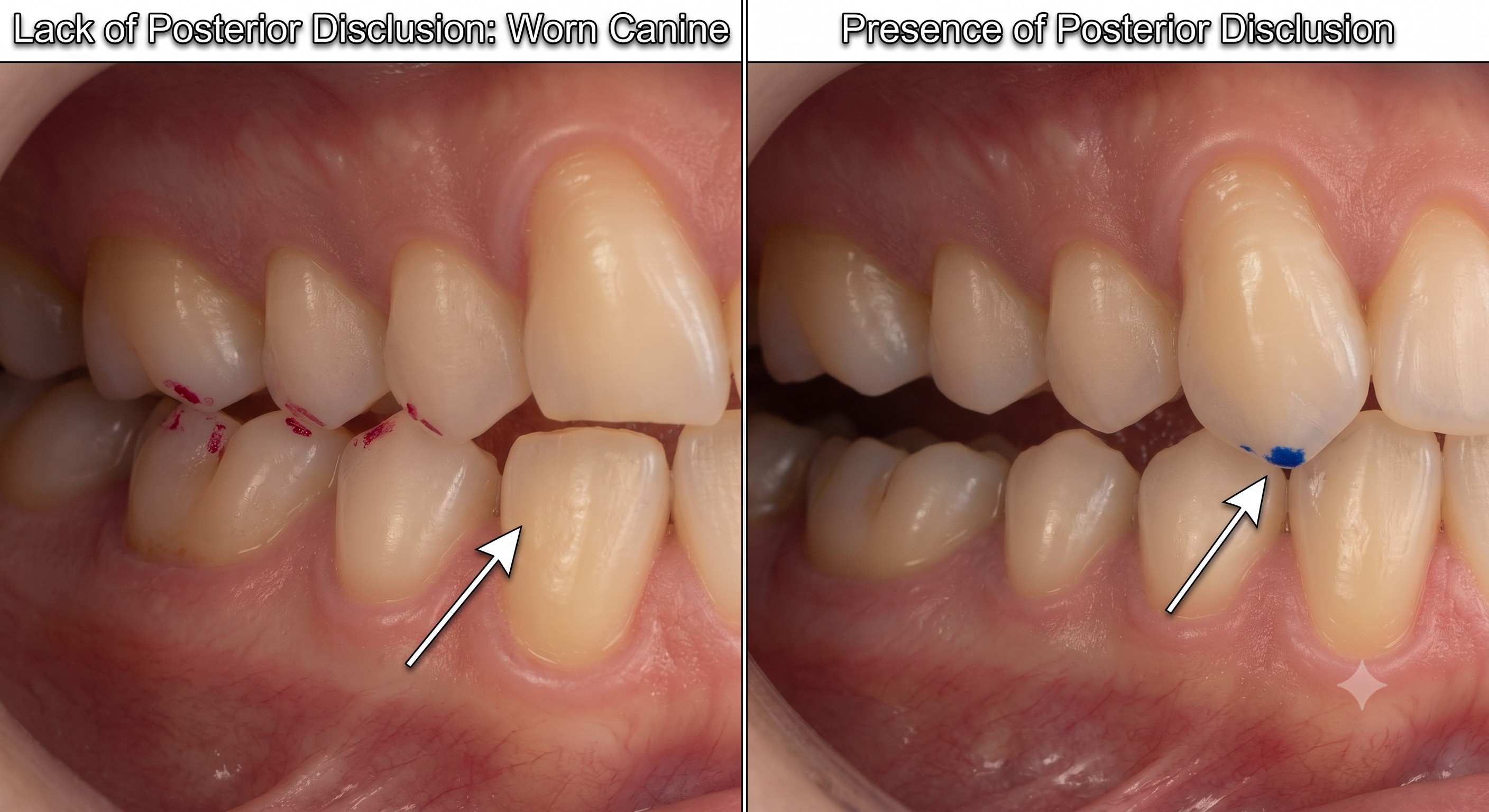
The comparison above shows this directly: on the left, with a worn canine, multiple back teeth are marked as being in contact during a side-to-side movement — a sign of lost guidance. On the right, with the canine restored, only that one tooth is marked, exactly how a healthy bite should function. One conservative way to fix this is bonding: restoring a worn canine back to its original shape and length re-establishes that protective guidance, so the back teeth go back to being shielded from these forces during normal jaw movement.
Example 2: What Longstanding, Untreated Grinding Can Lead To
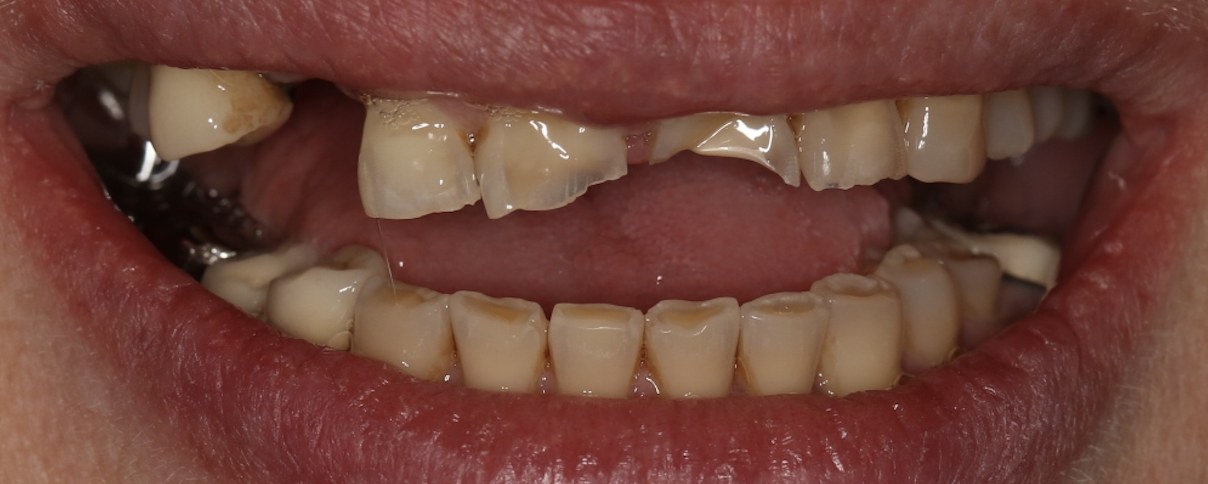
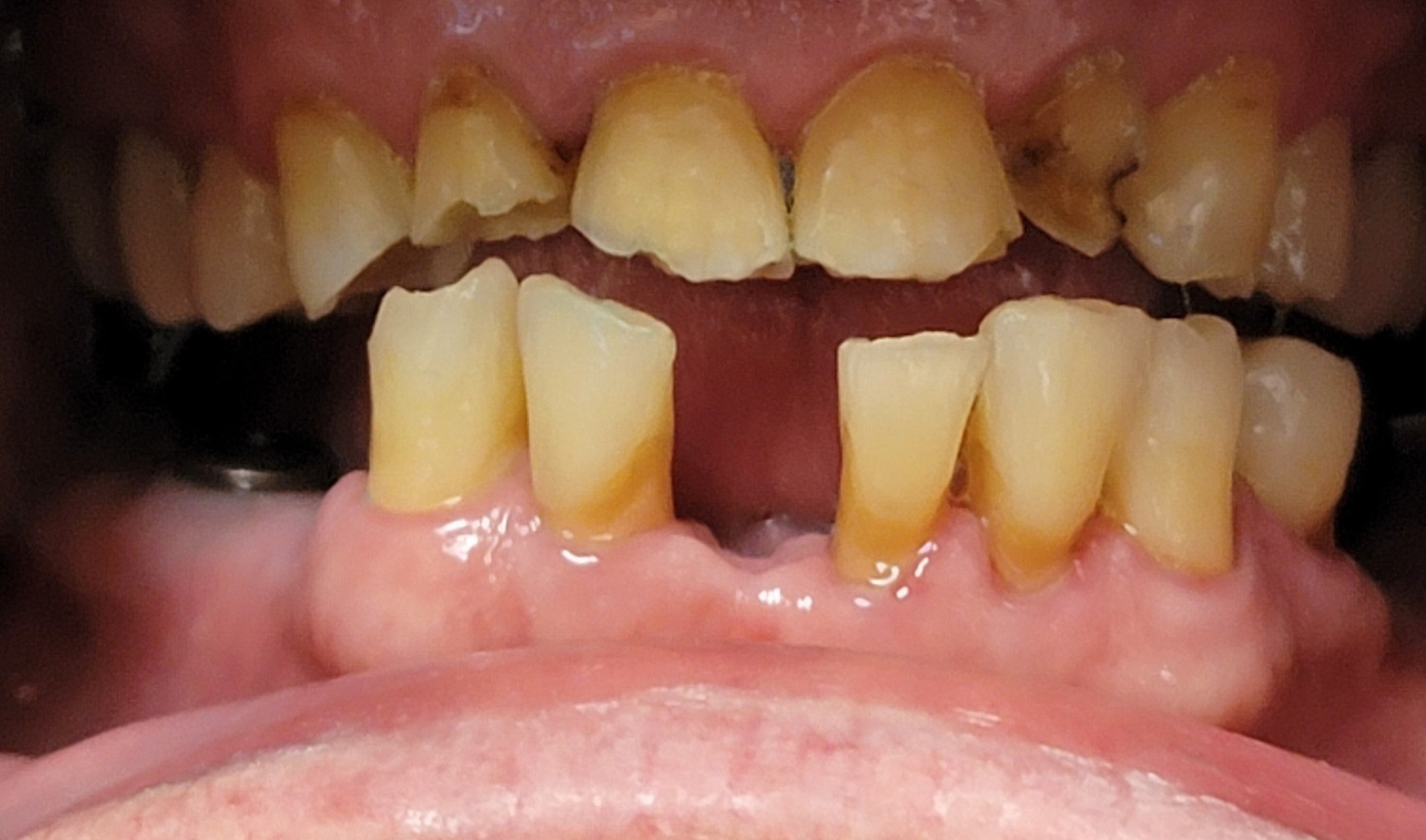
This example shows what grinding can do left unaddressed for years: the back teeth are worn flat and the upper front teeth show severe wear as well. This is a much bigger repair — crowns, and often a bridge or implant to replace what's badly damaged — than the simple bonding used to fix Example 1. Catching grinding damage early, before it reaches this point, is exactly why we watch for it at every checkup.
Grinding Doesn't Just Wear Teeth Down — It Can Move Them
Wear and fracture are the obvious effects of grinding, but there's a subtler one: over time, teeth can actually shift position through a process called compensatory (or passive) eruption. This is a well-documented, physiologic response to wear, not a disease process: as grinding grinds down the biting edges of the front teeth, a tooth keeps erupting — slowly emerging further out of the gum — to re-establish contact with the tooth it used to bite against and keep your bite stable. Patients usually notice this as a tooth that looks "longer" than it used to, a bite that feels different than it did a few years ago, or small gaps opening up between teeth that used to be flush. It's a gradual process, which is exactly why it's easy to miss without regular checkups.
Original illustrative diagram — not a substitute for an in-person exam.
The sequence, illustrated above: parafunctional grinding wears down the incisal edge, the tooth loses clinical crown height, and it keeps erupting to re-establish occlusal contact. Because the gum tissue and the underlying bone follow the tooth as it erupts, this can bring the alveolar bone and gum margin coronally along with it — which is exactly why the visible crown often ends up shorter and the gumline uneven, even though nothing is actually wrong with the periodontal attachment. A deep overbite makes this worse, since it increases the load and wear on the upper front teeth in the first place, leaving even less room to restore them once the wear catches up. One useful distinction when wear is confined to the front teeth and the back teeth are still meeting normally: your overall bite height (the vertical dimension of occlusion) is usually preserved, since the back teeth are holding it in place — the problem isn't that your bite has collapsed, it's that compensatory eruption has quietly closed up the exact space you'd need to rebuild the worn front teeth.
Why This Isn't the Same as Gum Disease
This is the key clinical trap: root exposure from compensatory eruption can look, at a glance, like the gum recession caused by periodontitis — but the mechanism, and the fix, are completely different. With compensatory eruption, the periodontium (gum, ligament, and bone) is healthy and simply followed the tooth coronally; there's no true attachment loss. Gum disease, by contrast, causes tooth migration by actually destroying the bone and ligament holding a tooth in place — a distinct mechanism covered in more detail on our early signs of gum disease page. Telling the two apart on exam (and on x-rays, checking where the bone crest sits relative to the cementoenamel junction) matters, because treating compensatory eruption like gum disease — or vice versa — leads to the wrong treatment. In practice, grinding and gum disease can also show up together and compound each other, which is one more reason we check both at every visit.
What Restoring a Compensated, Worn Bite Involves
When wear and compensatory eruption have progressed enough to need restoration, the central problem is usually space: eruption closes up exactly the room that wear created, leaving little interocclusal clearance to rebuild the tooth. We manage the cause first — typically a custom nightguard or occlusal splint to stop further wear from ongoing grinding — and asymptomatic, stable cases are often simply monitored rather than restored right away. When restoration is needed, options range from conservative, minimally invasive composite build-ups at a slightly increased bite height (sometimes using a "Dahl" approach, where a small anterior platform placed at that increased height causes the front teeth to gradually intrude while the back teeth settle into new contact, opening restorative space without a full-mouth reconstruction — research following these cases long-term has found the gained space holds up well, with minimal relapse) up to orthodontic intrusion of the over-erupted teeth for more involved cases, which can level the gumline and restore crown height directly, sometimes alongside crown-lengthening surgery. Composite build-ups are usually favored over full crowns for younger patients specifically because they're reversible and preserve tooth structure, though it's worth knowing upfront that repairs in a patient who continues to grind won't last as long as they would otherwise — which is exactly why controlling the grinding itself is always step one. When over-eruption shows up alongside crowding, gum recession, or other missing teeth, planning usually draws on more than one specialty — restorative, orthodontic, and periodontal — rather than a single fix in isolation. For a deeper look at how this space is regained and tested safely before any tooth is permanently reshaped, see our guide to restoring a severely worn bite.
Grinding and Sleep Apnea: What's the Real Connection?
Teeth grinding and obstructive sleep apnea (OSA) show up together often — research puts the overlap somewhere around 20–50% of adults who have either condition. But overlapping isn't the same as one causing the other: most current evidence doesn't establish a clear, consistent link between the two in adults specifically (the connection looks stronger and more plausible in children). The leading theory ties both to brief arousals during sleep — grinding tends to happen right at the tail end of one of these micro-wake-ups, and a breathing pause is one of the things that triggers them. So grinding may largely be a byproduct of the same sleep disruption driving the apnea, rather than something the apnea directly causes.
Why this matters for treatment: if you grind your teeth and also snore heavily, have been told you stop breathing or gasp during sleep, or feel excessively tired during the day, it's worth being screened for sleep apnea before starting with a standard night guard. A conventional guard sits over the upper teeth and can, in some patients, reduce space in the airway — not what you want if sleep apnea is part of the picture. Signs worth mentioning to your physician include loud snoring, witnessed breathing pauses, and daytime sleepiness. If that sounds familiar, our Sleep Apnea Treatment page has more on the connection — when OSA is present, airway-focused treatment is usually the better starting point, and treating the apnea often reduces the grinding as a side benefit too.
Sources
- TMD (Temporomandibular Disorders) — National Institute of Dental and Craniofacial Research, NIH
- Relationship Between Obstructive Sleep Apnoea Syndrome and Sleep Bruxism: A Systematic Review — Jokubauskas L, Baltrušaitytė A, Journal of Oral Rehabilitation (2017)
- Understanding the Clinical Management of Co-Occurring Sleep-Related Bruxism and Obstructive Sleep Apnea in Adults: A Narrative and Critical Review — Dal Fabbro C, Bornhardt-Suazo T, Landry Schönbeck A, de Meyer M, Lavigne GJ, Journal of Prosthodontics (2025)
- Sleep Bruxism and Obstructive Sleep Apnea: Association, Causality or Spurious Finding? A Scoping Review — Pauletto P, Polmann H, Conti Réus J, et al., Sleep (2022)
- Sleep Bruxism in Respiratory Medicine Practice — Mayer P, Heinzer R, Lavigne G, Chest (2016)
- Factors Affecting the Lifespan of the Human Dentition in Britain Prior to the Seventeenth Century — Kerr NW, Ringrose TJ, British Dental Journal (1998)
- Effect of Orthodontic Treatment on the Periodontal Tissues — Antoun JS, Mei L, Gibbs K, Farella M, Periodontology 2000 (2017)
- Location of the Wear, Interdisciplinary Workflow and Therapeutic Approach for Tooth Wear: LIT Classification — Albertini G, Bechelli D, Capusotto A, Blasi A, Journal of Esthetic and Restorative Dentistry (2026)
- Diagnosis and Management of Maxillary Incisors Affected by Incisal Wear: An Interdisciplinary Case Report — Bernardo JK, Maia EA, Cardoso AC, de Araújo Júnior EM, Monteiro Júnior S, Journal of Esthetic and Restorative Dentistry (2003)
- The Restorative Management of the Deep Overbite — Beddis HP, Durey K, Alhilou A, Chan MF, British Dental Journal (2014)
- Tooth Wear and Wear Investigations in Dentistry — Lee A, He LH, Lyons K, Swain MV, Journal of Oral Rehabilitation (2012)
- Rehabilitation of the Worn Dentition — Johansson A, Johansson AK, Omar R, Carlsson GE, Journal of Oral Rehabilitation (2008)
- A Guide to Managing Tooth Wear: The Radboud Philosophy — Loomans B, Opdam N, British Dental Journal (2018)
- Sleep Bruxism: An Overview for Clinicians — Beddis H, Pemberton M, Davies S, British Dental Journal (2018)
Related to This Article
Have a Dental Question of Your Own?
Reach out and we'll help you find the right next step.
Schedule Your Visit Call 212-877-7475