Invisalign Care Instructions: Wear Time, Cleaning, and Handling Your Aligners
Invisalign only works if you actually wear the aligners correctly — here's the real wear schedule, how to clean them, how often trays change, and what to do if one gets lost or cracked...
By Dr. Boris Zusin · Published September 2, 2026
Invisalign's biggest advantage — that the aligners are removable — is also its biggest risk: the treatment only works if you actually wear them enough. Here's the real day-to-day routine, not just the marketing version. (Wondering about soreness with a new tray? See our guide on what Invisalign pain actually feels like.)
How Many Hours a Day You Actually Need to Wear Them
Aligners need roughly 20–22 hours a day of wear to move your teeth on the plan's timeline — that leaves about 2–4 hours out per day for eating, drinking, and cleaning. Falling meaningfully short of that on a regular basis is one of the most common reasons a case runs longer than originally planned, since the teeth don't move on schedule if the aligner isn't actually seated against them for most of the day.
When It's OK to Take Them Out
Take your aligners out to eat or drink anything except plain water — food and sugary or acidic drinks trapped against your teeth under an aligner is worse than normal exposure, since there's no saliva flow to help rinse it away. Always brush (and ideally floss) before putting aligners back in; never reinsert clean aligners over unbrushed teeth, since that traps plaque and bacteria against your enamel for hours at a stretch. See our full guide on brushing and flossing with Invisalign for the specifics on technique.
Cleaning the Aligners Themselves
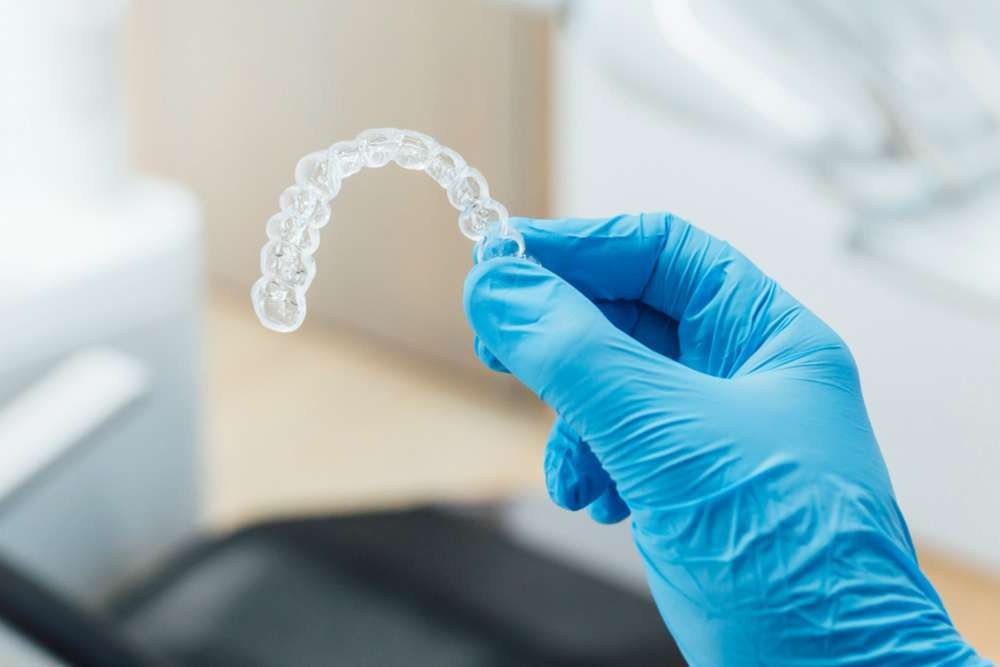
Rinse your aligners every time you take them out, under cool water only — never hot, which deforms the thermoplastic material and changes the fit. Brush them gently once or twice a day with a soft toothbrush and cool water; plain, non-abrasive toothpaste is fine, but skip whitening or otherwise abrasive toothpaste, since it's rough enough to leave microscopic scratches in the clear plastic. Those scratches do two things at once — they make the aligner more visibly cloudy over time, and they give bacteria more surface area to cling to, which is part of why brushing alone isn't the whole story.
The best-supported routine actually combines two steps rather than relying on brushing alone: mechanical cleaning (brushing) plus a chemical soak. Use a manufacturer-specific cleaning product (Invisalign's own Cleaning Crystals, for example) or an effervescent retainer/denture-cleanser tablet, following the label's soak time — typically a short 5–15 minutes in a glass of cool water — then rinse thoroughly before putting the aligner back in. Research comparing cleaning methods under magnification found that brushing alone leaves visible linear scratches, while combining brushing with a chemical soak gives the best balance of actually disinfecting the aligner and keeping its surface (and clarity) intact. For patients who tend to build up plaque quickly, a household ultrasonic cleaner used with a diluted chlorhexidine rinse has been shown to get retainers cleaner than brushing or soaking alone, without harming color, surface smoothness, or the material itself — worth asking about if staining or buildup has been a recurring issue for you.
A few cleaning habits are worth avoiding specifically: skip prolonged or repeated soaking beyond the product's recommended time (leaving a tray in a cleaning solution overnight, for instance, can actually degrade certain aligner plastics over time rather than just cleaning them more thoroughly), and avoid colored or alcohol-based mouthwash as a routine soak, which can discolor and damage the material. And as above, avoid hot water entirely, including hot tap water or a dishwasher — the plastic can warp out of shape, which affects both fit and how well the tray is actually doing its job. One honest caveat: most of this cleaning research comes from lab and small clinical studies on aligner and retainer material specifically, rather than large trials, and 3D-printed aligners in particular may not tolerate the same cleaning methods as well as traditionally manufactured ones — when in doubt, your specific aligner brand's care instructions take precedence over general guidance. See our step-by-step aligner and retainer cleaning guide for a quick daily-routine version of all of this.
How Often You'll Switch to a New Set
Most patients move to a new aligner in the series roughly every 1–2 weeks, though your specific schedule is set at your consultation and may be adjusted along the way based on how your teeth are tracking. We check fit and progress at your regular appointments and will slow down or add a refinement round if a stage isn't tracking as planned — sticking to the wear schedule is what keeps the plan on track between visits.
Traveling or Away From Home
Bring your current aligner, your case, and it's worth packing your most recent previous tray as a backup in case your current one is lost or damaged while you're away from home. Never leave aligners loose in a pocket, napkin, or bag without the case — and never leave them anywhere hot, like a car dashboard or near a heater, since the same heat that can warp them in a dishwasher applies just as much in a hot car.
If You Lose or Crack a Tray
Call us as soon as it happens rather than waiting. Depending on how far along you are in that stage, we may have you go back to wearing the previous tray, move ahead to the next one a bit early, or order a replacement — the right call depends on timing, so it's worth a quick call rather than guessing on your own.
After Your Last Tray: Retainers
Finishing your last aligner isn't the end of the routine — teeth have a lifelong tendency to drift, so a retainer becomes part of holding the result in place indefinitely, the same way it would after braces. See our Invisalign page for the retainer options we recommend after treatment wraps up.
Frequently Asked Questions
Your teeth will still move, just more slowly and less predictably than the plan accounts for — expect your treatment to take longer than originally estimated, and possibly need an extra refinement round to finish accurately. Consistent under-wear is one of the most common reasons a case runs past its original timeline.
Take them out first. Beyond the staining risk to the clear plastic itself, sugary or acidic drinks trapped against your teeth under an aligner sit there far longer than they would with normal saliva flow, which raises your risk of decay along the gumline where the aligner edge sits.
Yes, that's expected. Each tray fits most snugly right after you switch to it and loosens slightly as your teeth finish that stage's movement, which is exactly the sign that it's done its job and you're ready for the next one.
No special toothpaste is needed for your teeth — your regular fluoride toothpaste is fine. For the aligners themselves, skip whitening or otherwise abrasive toothpaste, since it scratches the clear plastic. A plain, non-abrasive toothpaste with a soft brush is fine for daily cleaning, and adding a soak in an aligner or retainer cleaning tablet a few times a week — available at any pharmacy — gets them cleaner than brushing alone.
Sources
- Clear Aligners in Orthodontic Treatment — Weir T, Australian Dental Journal (2017)
- Clinical Effectiveness of Clear Aligner Treatment Compared to Fixed Appliance Treatment: An Overview of Systematic Reviews — Yassir YA, Nabbat SA, McIntyre GT, Bearn DR, Clinical Oral Investigations (2022)
- Treatment Outcome With Orthodontic Aligners and Fixed Appliances: A Systematic Review With Meta-Analyses — Papageorgiou SN, Koletsi D, Iliadi A, Peltomaki T, Eliades T, European Journal of Orthodontics (2020)
- The Effectiveness of Different Cleaning Methods for Clear Orthodontic Aligners: Impacts on Physical, Mechanical, and Chemical Properties — an In Vivo Study — Alweneen A, Alqahtani N, Polymers (2025)
- Impact of Various Cleaning Protocols on the Physical and Aesthetic Properties of 3D-Printed Orthodontic Aligners — Šimunović L, Pečanić P, Marić AJ, et al., Scientific Reports (2025)
- Effectiveness of Household Ultrasonic Cleaning With Chemical Agents on Thermoplastic Retainers: A Clinical Study — Sambhavaphol P, Torrungruang K, Premsuriya N, et al., American Journal of Orthodontics and Dentofacial Orthopedics (2025)
- Effects of Cleaning Protocols on Surface Roughness and Optical Properties of Thermoplastic Orthodontic Retainers — Huang X, Jia A, Peng M, et al., Clinical Oral Investigations (2025)
- Microbiological Evaluation in Invisible Aligner Chemical Cleaning Methods Against Candida Albicans and Streptococcus Mutans — Bonafé ACF, Oliveira DFLM, Fernandes EE, et al., American Journal of Orthodontics and Dentofacial Orthopedics (2023)
Related to This Article
Have a Dental Question of Your Own?
Reach out and we'll help you find the right next step.
Schedule Your Visit Call 212-877-7475