
TMJ Disorders and Headaches: Is Your Jaw Causing Your Migraines?
If you deal with recurring headaches and jaw pain, tension, or clicking, the two may be more connected than you'd think — here's what the research says about TMJ and migraines...
By Dr. Boris Zusin · Published August 2, 2026
Chronic headaches and jaw pain often get treated as two separate problems — one for a neurologist or primary care doctor, one for a dentist. Research increasingly suggests that, for a meaningful number of patients, they're not separate at all.
What the Research Shows
A 2022 systematic review and meta-analysis of the existing literature found a high rate of overlap between temporomandibular disorders (TMD) and primary headache disorders — and among headache types specifically, migraine showed the strongest association with TMD. In plain terms: people with TMD are considerably more likely to also have migraines than people without a jaw disorder, and vice versa.
Why the Two Are Connected
The leading explanation involves shared nerve pathways. The trigeminal nerve carries sensation from the jaw joint, jaw muscles, and much of the face and head — so irritation or inflammation originating in the jaw can trigger pain signals that are felt as a headache, particularly around the temples. Chronically tight or overworked jaw muscles from clenching or grinding can also directly refer tension into the head. Some research has additionally found a degree of shared genetic risk between TMD-related jaw pain and migraine in twin studies, suggesting the two may share some underlying biological susceptibility on top of the mechanical connection.
Figure: the shared trigeminal nerve pathway is why jaw problems often surface as headache, ear, or facial pain.
Does Treating TMD Help Headaches?
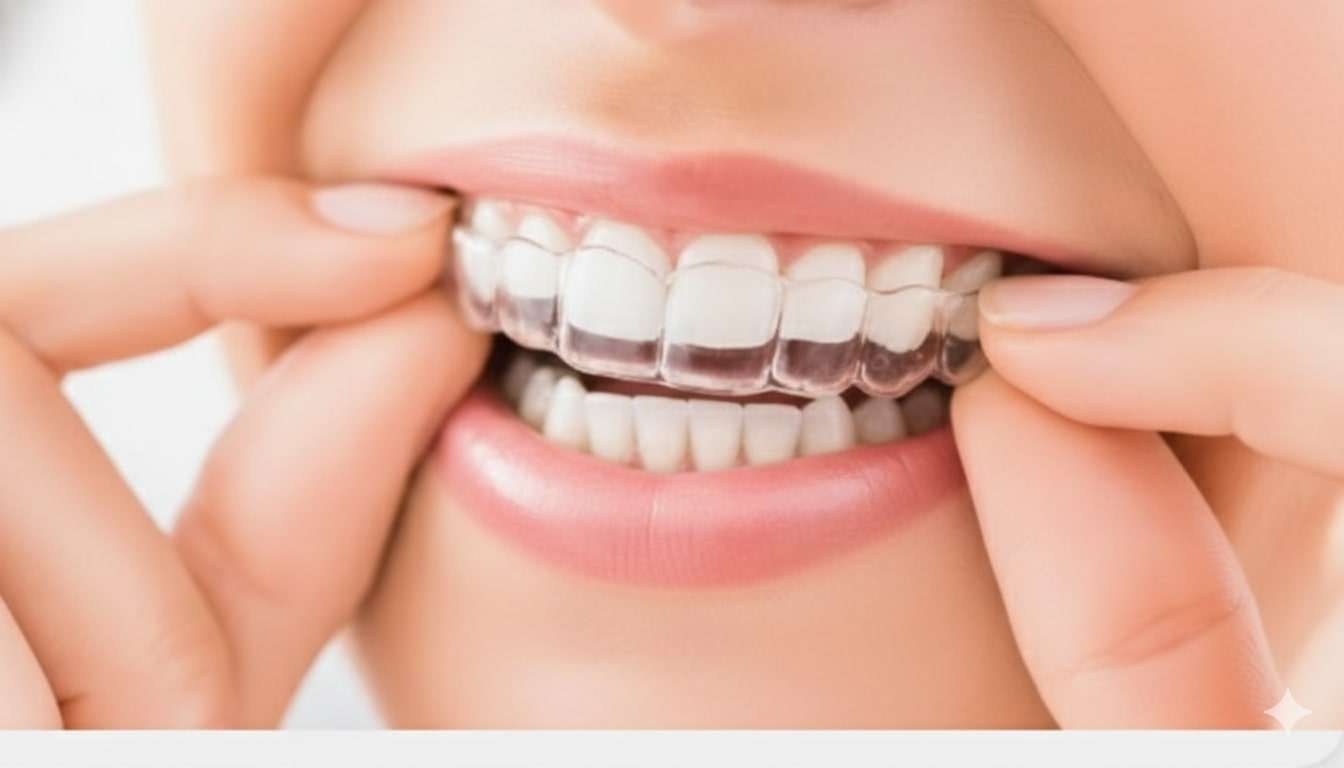
Several studies suggest it can. Because the trigeminal nerve pathway is shared, reducing the mechanical strain and inflammation at the jaw joint — through a custom nightguard, bite adjustment, or other TMJ-focused treatment — has been associated with improvement in migraine frequency or severity for some patients, particularly those whose headaches are concentrated around the temples or worsen with jaw movement or chewing.
Signs Worth Paying Attention To
Headaches that cluster around the temples, worsen when you chew or talk for a long time, come with jaw clicking or popping, or are accompanied by morning jaw soreness (a common sign of nighttime grinding) are worth mentioning to a dentist, not just a doctor treating the headache in isolation. It's also worth knowing that a headache tied to a specific tooth — rather than the jaw joint or muscles — is its own separate diagnosis; see our breakdown of dental (odontogenic) headache if a particular tooth seems to be part of the picture.
Dealing with both? Learn more about our TMJ appliance treatment, or see the full picture on our mouth-body connection page.
Sources
- TMJ Disorders: Symptoms, Treatment & Prevention — Cleveland Clinic
- Temporomandibular disorder and headache prevalence: A systematic review and meta-analysis — Yakkaphan et al., Cephalalgia Reports (2022)
- Temporomandibular Disorders: Old Ideas and New Concepts — List T, Jensen RH, Cephalalgia (2017)
- Diagnosis and Treatment of Temporomandibular Disorders — Gauer RL, Semidey MJ, American Family Physician (2015)
Related to This Article
Have a Dental Question of Your Own?
Reach out and we'll help you find the right next step.
Schedule Your Visit Call 212-877-7475