The Anatomy of a Dental Implant: What's Actually Going Into Your Jaw?
If you are considering replacing a missing tooth, you have likely heard the term “dental implant” thrown around constantly. But what happens beneath the gumline?
By Dr. Boris Zusin · Published December 11, 2025
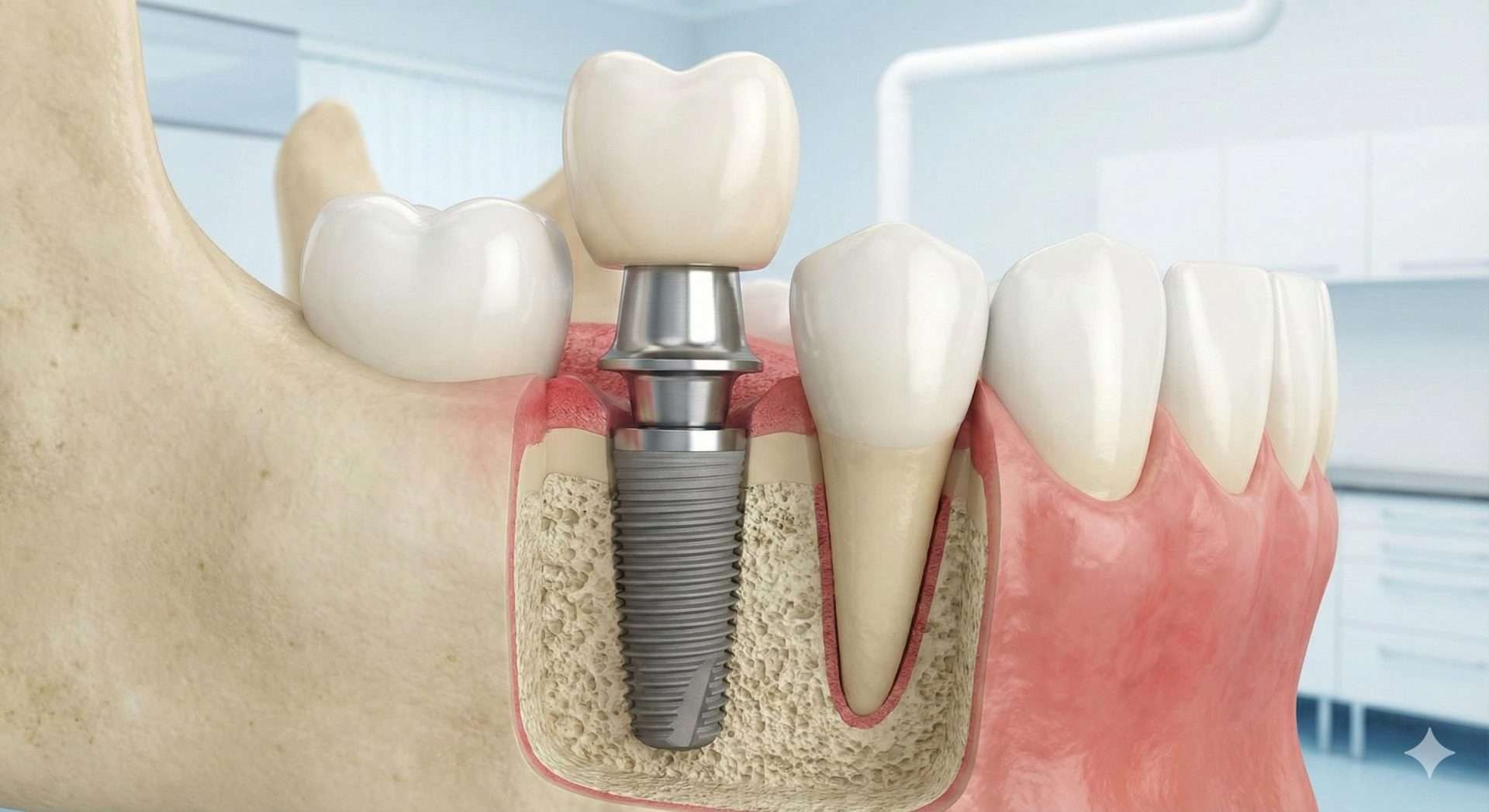
If you are considering replacing a missing tooth, you have likely heard the term “dental implant” thrown around constantly — it’s the gold standard of modern dentistry. But for many patients the concept remains abstract: you know it involves a screw and a tooth, but what happens in between, and why does it cost what it costs? A dental implant isn’t just a “fake tooth” — it’s a three-part engineering system designed to mimic nature so closely your body forgets it’s artificial.
The Foundation: The Implant Fixture (The “Root”)
The fixture is the part no one will ever see once healing is complete — it’s surgically placed into the jawbone as a replacement for the natural tooth root. Most fixtures are medical-grade titanium: in the 1950s, Swedish researcher Per-Ingvar Brånemark discovered that bone doesn’t just tolerate titanium, it fuses to it — a process called osseointegration that effectively makes the implant part of your skeleton. Under a microscope, a fixture looks like a high-tech screw: large macro-threads grip the bone for initial stability, and micro-threads near the gumline distribute stress evenly to prevent bone loss over time. Zirconia (ceramic, metal-free) implants are also available for patients with metal allergies or thin gums.
The Connector: The Abutment
Once the fixture fuses to bone — typically 3 to 6 months — an abutment connects the buried screw to the visible tooth, screwing into the fixture and protruding through the gum. The abutment shapes the “emergence profile” — how the gum tissue meets the tooth. Stock abutments (pre-manufactured, one-size) work well for back teeth; custom, CAD/CAM-designed abutments are often used for front teeth so the tooth appears to grow naturally out of the gum. Abutments can be titanium (strongest, used for back teeth), gold, or zirconia (white, used in the esthetic zone so no dark line shows if gums recede slightly).
The Visible Result: The Prosthesis (The Crown)
This is the “tooth” you see when you smile, cemented or screwed onto the abutment and engineered to withstand implant-level biting forces. Cement-retained crowns are glued on, similar to a crown on a natural tooth, with no visible screw hole; screw-retained crowns have a small hole (filled with tooth-colored composite) that lets the dentist retrieve and repair the crown years later if needed. Materials like Lithium Disilicate (E.max) or layered zirconia let a lab technician hand-paint the crown to match the translucency and color of your neighboring teeth.
Why the Anatomy Matters
Understanding these three components — fixture, abutment, and prosthesis — explains why implants are an investment: biocompatible surgery that fuses to your body, custom engineering matched to your gum shape, and lab artistry that replicates nature. It’s also a caution against “bargain” implant centers that cut costs with generic fixtures, ill-fitting stock abutments, or crowns made from materials that chip easily. When something is permanently screwed into your jawbone, quality in every layer is what makes it last a lifetime rather than a few years.
Related to This Article
Have a Dental Question of Your Own?
Reach out and we'll help you find the right next step.
Schedule Your Visit Call 212-877-7475