
Panthera Appliance vs. Other Oral Appliances: What Makes It Different?
Not all mandibular advancement devices are built the same way — metal hinges and bulky acrylic vs. a single-material nylon design, and what the price difference actually buys you...
By Dr. Boris Zusin · Published July 31, 2026 · Updated August 24, 2026
Once you've decided to pursue oral appliance therapy for sleep apnea, you'll find there are dozens of FDA-cleared devices on the market, built from different materials with different mechanical designs. Dr. Boris Zusin uses Panthera as the appliance of choice at Zusin Dental — here's what the evidence actually says matters, and where Panthera's design fits in.
What Matters Most: Custom-Made and Titratable, Before Material Even Enters the Picture
The research on mandibular advancement devices is fairly consistent on this point: the biggest driver of outcomes isn't the specific polymer a device is made from — it's whether the device is custom-fabricated to your bite versus a generic, ready-made design, and whether it can be titrated (gradually adjusted) over time. A systematic review and meta-analysis found custom-made appliances produced significantly greater reduction in breathing events, better daytime sleepiness scores, and higher patient-reported adherence than ready-made, boil-and-bite-style devices. Panthera is both custom-fabricated from a digital scan of your own bite and titratable in 0.5mm increments — which puts it in the evidence-favored category before you even get to the question of material.
Where Nylon's Semi-Rigidity Fits In
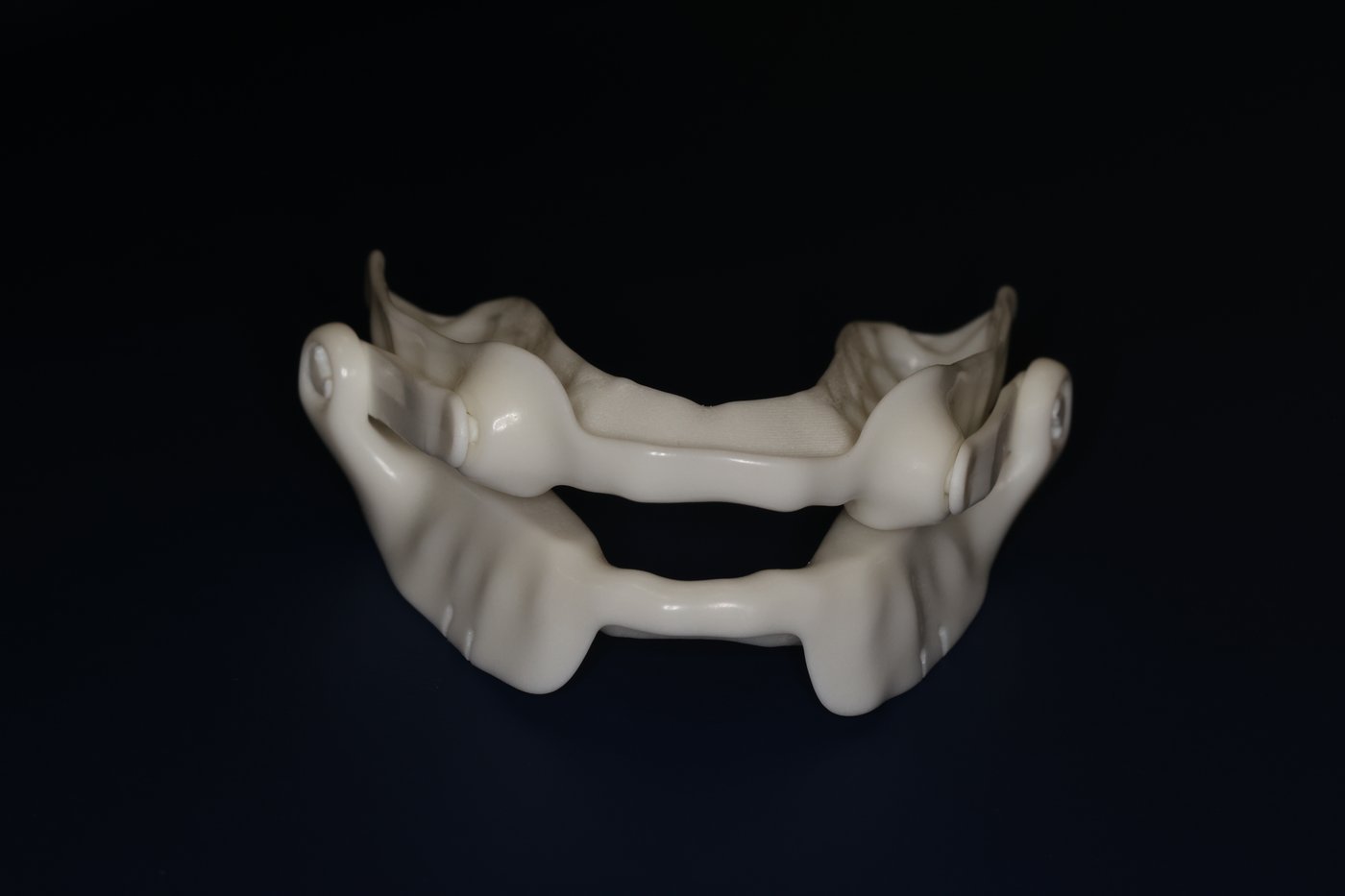
Material rigidity, not the specific polymer name, is what the evidence connects to outcomes. Federal clinical practice guidance on oral appliance therapy notes that digitally engineered, custom-milled appliances made of semi-rigid materials produce the least tooth movement over time and function more like an orthodontic retainer, while soft, flexible liners are discouraged because they allow more migration. Panthera's nylon (polyamide 12) is a semi-rigid, digitally 3D-printed polymer that falls into this favorable, retainer-like category — we're not aware of head-to-head trials that isolate nylon specifically against other semi-rigid materials, so the honest claim is that it fits the category the evidence favors, not that nylon itself has been proven superior to every alternative.
Traditional Appliances: Molded by Hand, Often Built With Metal Hardware
Many oral appliances are still made from a physical impression of your teeth — a mold is taken in-office, sent to a lab, and a technician hand-fabricates the device. Per a 2025 review by the American Academy of Sleep Medicine's Emerging Technology Committee, common mechanical designs for advancing the jaw include laterally placed elastic straps, telescope-style metal hinges, Herbst-style dual metal arms, and adjustable metal hinge-flanges. These designs are clinically legitimate and, when custom-made and titratable, can perform well — but metal hinges, screws, and connector rods are also moving parts worn every night for years, and they can loosen, corrode from constant saliva exposure, or eventually crack a housing, snap, or detach, sometimes requiring an unplanned office visit and a repair mid-treatment.
Panthera's Single-Material Design: No Metal Parts
Panthera appliances are 3D-printed from a single block of nylon — including the titration rods used to adjust jaw position — rather than acrylic reinforced with metal hinges or connectors. Per the manufacturer's product specifications, this single-material design has no metal parts, which the company states means a structurally low risk of breakage and no risk of swallowing or aspirating a loose metal component overnight. This is a practical, mechanical difference rather than a proven efficacy advantage, but it's a real one for a device you're wearing every night for years.
A Fair Trade-Off Worth Knowing About: Monoblock vs. Two-Piece Titration
Not every design choice favors a titratable appliance like Panthera. A systematic review and meta-analysis of randomized controlled trials found one-piece (monoblock) devices had a notably higher overall success rate than two-piece (duoblock), titratable devices in head-to-head comparison, even though two-piece designs allow the chairside adjustability that helps fine-tune fit and can improve tolerance. Panthera uses a two-piece, rod-based titration system, which trades some of that theoretical success-rate ceiling for the ability to precisely dial in your jaw position over time without remaking the appliance — a trade-off Dr. Boris Zusin can discuss with you directly based on your case.
Why Bulk (or the Lack of It) Matters
Acrylic devices with metal hardware often need extra material thickness to keep the hinges and connectors anchored securely, which adds bulk in the mouth. The AASM's review notes that thicker acrylic devices remain a reasonable choice for patients with heavy teeth grinding (bruxism) who need a design that tolerates higher force, but that slimmer, digitally designed devices are now more widely available for patients prioritizing comfort, tongue space, and speech. Panthera's nylon construction is built thin without the reinforcement a metal hinge requires — the manufacturer's occlusal-plane-aligned design is rated to reduce stress on the jaw and chewing muscles by roughly 30% — which is one reason patients often find it easier to tolerate wearing every night. Consistent nightly wear is what actually determines whether treatment controls your apnea.
Durability, in Real Terms
Nylon polyamide 12 has high tensile strength and is manufacturer-rated as resistant to bruxing, cracking, and abrasion, backed by a 3-year warranty against in-mouth breakage. That's a meaningfully different durability profile than a device relying on a metal hinge or spring-loaded connector to hold its position — there's no small metal part to lose tension, corrode, or fatigue and fail over years of nightly use.
Is Paying a Little More Actually Worth It?
A lower-cost, custom, titratable appliance with metal hardware isn't a bad-faith option — it's a legitimate, evidence-supported design, and plenty of patients do fine with it. The case for a semi-rigid, metal-free design like Panthera comes down to a few concrete, honest points: it already meets the two criteria — custom-made and titratable — most strongly tied to better outcomes; its semi-rigid nylon fits the tooth-movement-minimizing category federal guidance favors; and it removes metal hinges and connectors as a mechanical failure point, at the trade-off of the monoblock-vs-duoblock success-rate difference noted above. Since the entire point of oral appliance therapy is consistent nightly use, comfort that supports actually wearing it matters as much as any single design spec.
What the Cost Difference Actually Looks Like Per Night
The sticker price is easier to stomach once you break it down to a nightly cost. Custom sleep apnea oral appliances generally run in the range of a couple thousand dollars — see our full oral appliance cost breakdown for what goes into that figure. As an illustrative example, a $2,000–$3,000 appliance spread over three years of nightly use (roughly its warranty period) works out to about $1.80–$2.75 per night; spread over five years of use, that drops to roughly $1.10–$1.65 per night. That's in the same range as a daily cup of coffee, and less than many people spend on a single specialty latte — except this nightly cost goes toward treating a diagnosed medical condition tied to real cardiovascular and safety risks when left untreated, and it's frequently offset at least partially by medical insurance once obstructive sleep apnea is formally diagnosed. Your actual cost depends on your specific case and device, which we'll walk through at a consultation.
FDA Clearance and Clinical Track Record
Like other legitimate oral appliance options, Panthera is FDA-cleared for the treatment of obstructive sleep apnea and snoring when prescribed and fitted by a qualified dentist — the digital design process is a manufacturing refinement, not an unproven alternative approach.
Why We Chose It
After working with multiple appliance systems, Dr. Boris Zusin has found Panthera delivers a reliably precise fit, strong patient comfort, and durable, metal-free results for patients being treated for obstructive sleep apnea and snoring — which is why it's the appliance used for sleep apnea patients at Zusin Dental.
If you're comparing oral appliance options or curious whether Panthera is right for your case, a consultation is the best way to find out.
Sources
- Clinical Practice Guideline for the Treatment of Obstructive Sleep Apnea and Snoring with Oral Appliance Therapy (2015) — AASM & American Academy of Dental Sleep Medicine, J Clin Sleep Med
- Technological Advances in Mandibular Advancement Devices — Paruthi S, Goswami U, So J, Taweesedt P, Verma N, Holfinger S, on behalf of the AASM Emerging Technology Committee (2025)
- Sleep Apnea Devices — Classic (Panthera D-SAD Product Specifications) — Panthera Dental
- The Management of Chronic Insomnia Disorder and Obstructive Sleep Apnea (Insomnia/OSA) Clinical Practice Guideline — Sharafkhaneh A, Thomas A, Ulmer C, et al., U.S. Department of Veterans Affairs / Department of Defense (2025)
- Ready-Made Versus Custom-Made Mandibular Advancement Appliances in Obstructive Sleep Apnea: A Systematic Review and Meta-Analysis — Johal A, Agha B, Journal of Sleep Research (2018)
- Effectiveness of Different Mandibular Advancement Device Designs in Obstructive Sleep Apnoea Therapy: A Systematic Review of Randomised Controlled Trials With Meta-Analysis — Bartolucci ML, Bortolotti F, Corazza G, et al., Journal of Oral Rehabilitation (2021)
Related to This Article
Have a Dental Question of Your Own?
Reach out and we'll help you find the right next step.
Schedule Your Visit Call 212-877-7475