How to Handle a Knocked-Out Tooth (Step by Step)
A knocked-out permanent tooth is one of the few dental emergencies where what you do in the first few minutes can decide whether the tooth is saved. Here's exactly what to do...
By Dr. Boris Zusin · Published August 2, 2026
Quick answer: pick the tooth up by the crown (never the root), rinse it gently if dirty, try to reinsert it into the socket, and if you can't, keep it in milk and get to a dentist within 30 minutes — the first few minutes are what usually decide whether the tooth can be saved.
A knocked-out (avulsed) permanent tooth is one of the few dental emergencies where the first few minutes genuinely matter. Handled correctly and quickly, a knocked-out tooth can often be saved. Handled the wrong way — or too slowly — it usually can't be. Here's exactly what to do.
1. Find the Tooth and Pick It Up by the Crown
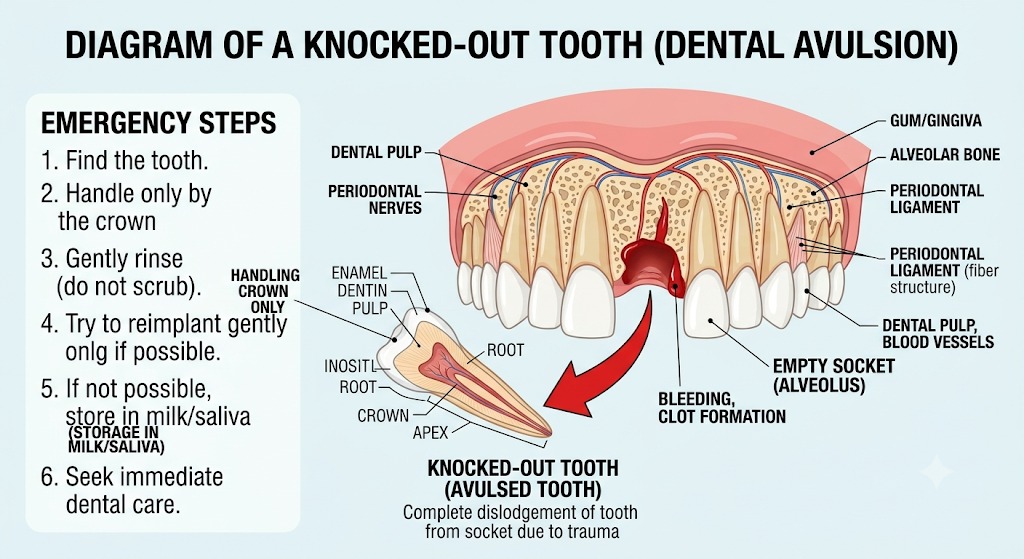
Locate the tooth and pick it up by the chewing surface (the crown) — never touch the root. The root is covered in delicate ligament fibers that need to survive for the tooth to be successfully replanted, and handling the root can damage them.
2. Rinse It Gently If Dirty — Don't Scrub
If the tooth is dirty, rinse it briefly with milk or water, holding it by the crown. Don't scrub it, don't use soap or any cleaning agent, and don't dry it off or wrap it in a tissue or paper towel — keeping the root surface moist is essential.
3. Try to Reinsert It Into the Socket
If possible, gently place the tooth back into its socket facing the right way and hold it in place by biting down softly on something like gauze or a clean cloth. This is the single best way to keep the root cells alive, and it's safe to attempt even before you reach a dentist. If it's a baby tooth, don't try to reinsert it — forcing a baby tooth back in can damage the developing permanent tooth underneath.
4. Can't Reinsert It? Keep It in Milk
If you can't get the tooth back into the socket — or the person is a young child who might swallow it — keep the tooth in a small container of cold milk. Milk has a similar pH and osmotic balance to the inside of the mouth and keeps the root's ligament cells alive far longer than water or a dry paper towel would. In a pinch, a specialized tooth-preservation solution (sold in some emergency dental kits) or the inside of your cheek can work, but milk is the most reliable option most people actually have on hand. Do not store the tooth in plain water — it damages the root surface cells.
5. Get to a Dentist Immediately — Minutes Matter
The general guidance is to get the tooth reinserted or into milk and see a dentist within 30 minutes for the best chance of successful replantation; the odds drop meaningfully with each additional hour. If it's after hours, go to an emergency room or urgent dental clinic rather than waiting until morning — this is one of the true "don't wait" dental emergencies.
What to Expect at the Dental Visit
If the tooth can be saved, the dentist will clean and reposition it, splint it to the adjacent teeth to hold it stable while the ligament reattaches, and likely start or plan root canal treatment, since the nerve inside an avulsed tooth typically doesn't survive even when the tooth itself does. You'll also want a tetanus check if the injury happened somewhere the wound could have been contaminated (like a fall on pavement or a sports field).
Frequently Asked Questions
How long can a knocked-out tooth survive outside the mouth?
Best chance is reinsertion or milk storage within 5 minutes and a dentist visit within 30 minutes. Odds drop significantly with each additional hour, and replantation after 1–2 hours without proper storage rarely succeeds.
Can a knocked-out baby tooth be put back in?
No — forcing a primary tooth back into the socket can damage the permanent tooth developing underneath. Control bleeding with gauze, keep the child calm, and call a dentist promptly.
Does a knocked-out tooth always need a root canal?
Almost always. The nerve inside an avulsed tooth typically doesn't survive the injury even when the tooth is successfully replanted, so root canal treatment is usually started or planned as follow-up care.
If you or your child has a knocked-out tooth, call us right away — we'll tell you exactly what to do on the phone and get you in as fast as possible. See our full guide to dental emergencies for what to do while you're on your way.
Sources
- Knocked-Out Tooth — MouthHealthy, American Dental Association (ADA)
- Traumatic Dental Injuries — American Association of Endodontists (AAE)
Related to This Article
Have a Dental Question of Your Own?
Reach out and we'll help you find the right next step.
Schedule Your Visit Call 212-877-7475