Snoring vs. Sleep Apnea: What's the Difference?
Not everyone who snores has sleep apnea, and not everyone with sleep apnea snores loudly. Here's how to tell the difference — and why it matters...
By Dr. Boris Zusin · Published July 22, 2026 · Updated July 31, 2026
Snoring gets a lot of jokes made about it, but it can also be the most visible clue to a much more serious condition. The tricky part: not everyone who snores has sleep apnea, and not everyone with sleep apnea is a loud snorer. Here's how to tell the difference.
What Causes Snoring?
Snoring happens when air moves past relaxed tissues in the throat — the soft palate, tongue, and tonsils — causing them to vibrate. It can be caused by sleep position, nasal congestion, alcohol before bed, weight, or simply the natural anatomy of your airway, and for a lot of people it's harmless, if annoying for a bed partner.
What Is the Main Cause of My Snoring?
Across all the possible contributors, one mechanism sits underneath almost every case: relaxed soft tissue in the throat — the soft palate, the back of the tongue, and the tonsils — vibrating as air moves past it during sleep. Everything else is really a reason that tissue ends up looser, more crowded, or harder to breathe past in the first place. Sleeping on your back lets gravity pull the tongue backward into the airway; alcohol and sedatives relax throat muscles more than usual; nasal congestion forces you to breathe through the mouth, which narrows the effective airway; extra tissue around the neck and throat (from weight, or simply anatomy) leaves less room for air to pass without turning that tissue into a vibrating obstruction; and age brings a natural loss of muscle tone that makes the same tissue more prone to sagging during sleep. For some people it's mostly one of these factors, for others it's several stacking together — which is why a proper evaluation looks at your specific anatomy and habits rather than assuming a single universal cause.
What Makes It Sleep Apnea?
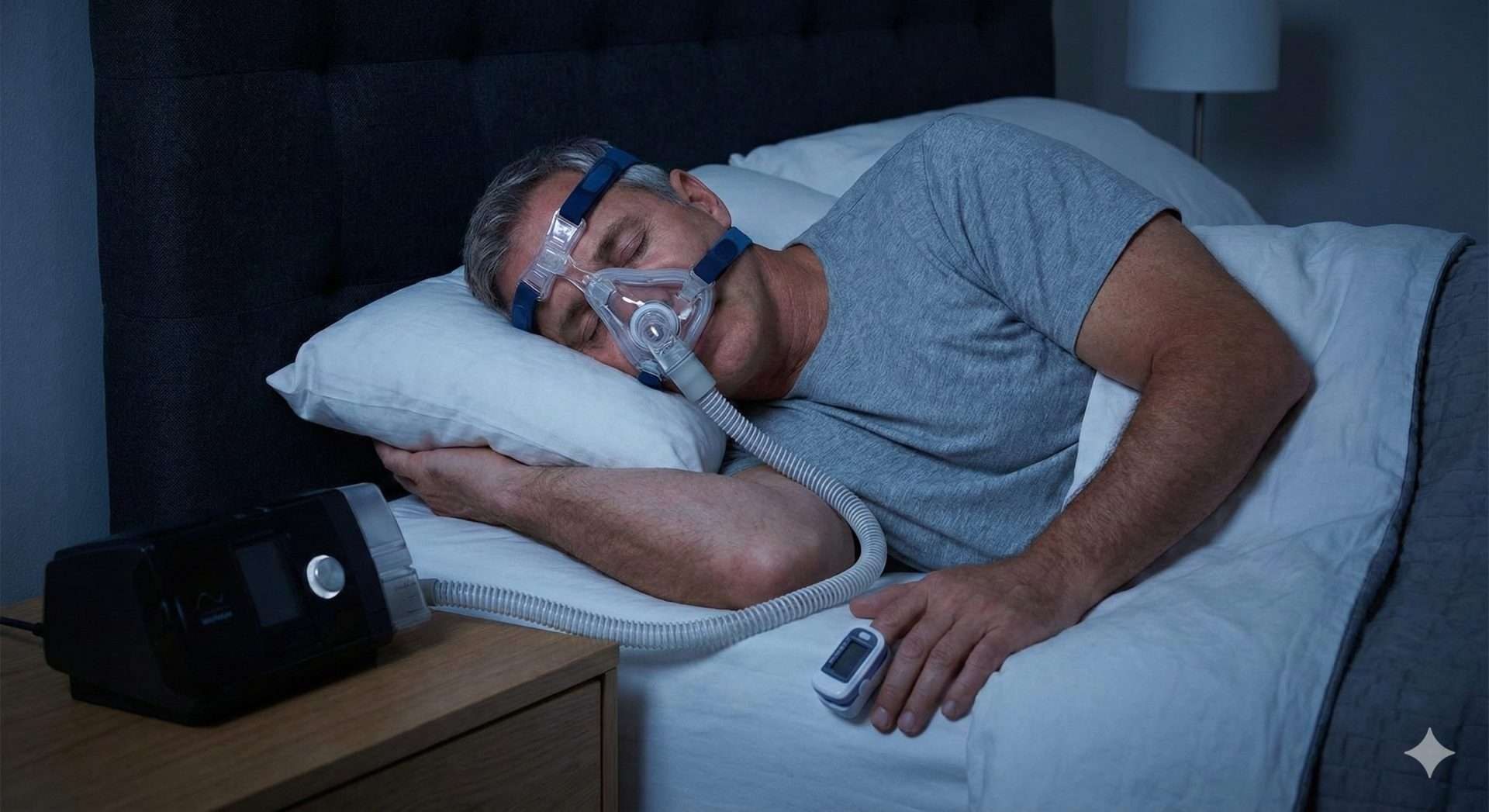
Obstructive sleep apnea is what happens when that same airway narrowing goes a step further — the soft tissue doesn't just vibrate, it actually collapses and blocks airflow for several seconds or longer, repeatedly throughout the night. Each pause forces a brief, often unremembered awakening to restart breathing, which is what fragments sleep and drives most of sleep apnea's downstream health effects.
Simple Snoring vs. Sleep Apnea: Key Differences
Simple snoring is usually consistent in volume, doesn't involve pauses in breathing, and doesn't come with gasping, choking, or witnessed apneas. It also typically doesn't cause significant daytime fatigue. Sleep apnea, by contrast, often involves louder and more irregular snoring, witnessed breathing pauses, gasping or choking sounds, and daytime symptoms like fatigue, morning headaches, or difficulty concentrating — even after a full night in bed.
Is My Snoring a Sign of Sleep Apnea?
Snoring alone doesn't confirm sleep apnea, but it's the single most common symptom of obstructive sleep apnea (OSA) and it's worth being screened — especially if it comes with witnessed breathing pauses, gasping or choking, or daytime sleepiness. The tricky part is that snoring is highly sensitive but poorly specific for OSA: it shows up in roughly 50–60% of people who have the condition, yet plenty of habitual snorers turn out to have “simple snoring” — a normal apnea-hypopnea index (AHI under 5) with no pathological significance at all. The single most useful distinguishing feature isn't the snoring itself; it's nocturnal gasping or choking, or a bed partner witnessing actual pauses in breathing. If you had to ask just one screening question, “do you stop breathing during sleep?” is more specific for OSA than any question about the snoring sound itself.
A few features raise the odds that snoring reflects something more than a harmless habit: witnessed apneas, gasping, or choking during sleep (the most reliable clinical clue); excessive daytime sleepiness or unrefreshing sleep despite a full night in bed; and anatomic or demographic risk factors including male sex, older age, obesity, a large neck circumference (over 17 inches/43 cm in men, over 16 inches/41 cm in women), a recessed lower jaw, an enlarged tongue, enlarged tonsils, or a high, narrow palate. Associated conditions worth mentioning to your doctor include hypertension (especially the kind that's resistant to medication), atrial fibrillation, type 2 diabetes, and a prior stroke — OSA shows up at high rates alongside all of these. Nasal obstruction or chronic sinus congestion, and alcohol or sedative use before bed, are other snoring contributors worth considering; they can worsen OSA but don't cause it on their own.
None of this replaces an actual diagnosis. A reasonable next step is screening with a validated tool like STOP-Bang (below), asking a bed partner directly about witnessed apneas or gasping, and, if OSA seems likely, confirming with a sleep study — a home sleep apnea test is often accurate and cost-effective for suspected moderate-to-severe OSA, while in-lab polysomnography is generally preferred if there's significant heart or lung disease, a neuromuscular condition, opioid use, a prior stroke, severe insomnia, or a home test that comes back negative despite strong clinical suspicion. Bottom line: snoring is a reason to be evaluated, not a diagnosis in itself. Witnessed pauses, gasping, daytime sleepiness, or risk factors like obesity, a large neck, or hypertension are reasons to pursue testing; isolated snoring without any of those features is more likely to be simple snoring, though a screening questionnaire helps confirm that rather than just assuming it.
STOP-Bang Sleep Apnea Risk Screening
STOP-Bang is a validated 8-item questionnaire used to estimate OSA risk. Answer all 8 questions, then click “See My Result.”
STOP-Bang is a validated OSA screening questionnaire, used here as a self-assessment tool — it is not a diagnosis. A score of 3 or higher has been shown to have 88–94% sensitivity for moderate-to-severe OSA; a physician-ordered sleep study is the only way to confirm a diagnosis.
How Do I Know If I Stop Breathing in My Sleep?
This is the hardest part of the whole picture to self-diagnose, because by definition you're asleep when it happens — most people who stop breathing overnight have no memory of it at all. In practice, there are really only two ways this comes to light: a bed partner (or, less reliably, a phone recording app) witnesses an actual pause in your breathing followed by a gasp, snort, or choking sound as you resume breathing; or the indirect daytime clues add up — waking up unrefreshed no matter how many hours you slept, a headache most mornings, or dozing off during quiet daytime moments like reading or watching TV. If you sleep alone, that first route isn't available to you, which is exactly why the STOP-Bang questionnaire above and a home sleep apnea test exist: they're built to answer this question without needing a witness in the room. If a partner has ever told you that you stopped breathing, gasped, or choked in your sleep, take that report seriously and bring it up with your doctor or dentist — it's the single most reliable sign in the entire picture.
Why the Distinction Matters
Simple snoring, while worth mentioning at a dental or medical visit, generally isn't a health risk beyond disrupting a partner's sleep. Untreated obstructive sleep apnea, on the other hand, is linked to high blood pressure, heart disease, stroke risk, and type 2 diabetes — which is why it's worth taking seriously rather than assuming it's “just snoring.”
Is Loud Snoring Dangerous to My Health?
Volume alone doesn't answer the question — but it's a reasonable prompt to ask it. Mild, occasional snoring generally isn't a health concern beyond disturbing a bed partner's sleep. Loud, jarring, or irregular snoring is more often associated with obstructive sleep apnea, and it's the downstream effects of untreated OSA, not the sound itself, that carry the real health risk: repeated overnight oxygen drops place ongoing stress on the cardiovascular system, and OSA is linked to high blood pressure that's difficult to control with medication alone, heart disease, elevated stroke risk, and type 2 diabetes. Loudness is a useful clue precisely because it tends to track with how much the airway is actually collapsing — but it's not a diagnostic test on its own, and quieter snoring doesn't rule out OSA either. What matters more than decibels is the pattern: does it come with witnessed breathing pauses, gasping, or choking, and is it followed by daytime fatigue or morning headaches despite a full night in bed? Those are the features that separate a snorer who just needs reassurance from one who should pursue an evaluation.
Do Nasal Strips and Nasal Dilators Actually Work?
They can help with the nose, but not with the underlying mechanism that causes either simple snoring or sleep apnea. Adhesive external strips and internal nasal dilators are designed to widen the nasal passage and reduce nasal airflow resistance — and for people whose snoring is driven by nasal congestion or mouth breathing, opening that airway route can genuinely make breathing easier and quiet things down somewhat. But a 2026 systematic review and meta-analysis pooling 17 studies and 496 participants found no statistically significant improvement in apnea-hypopnea index, apnea index, hypopnea index, snoring index, oxygen saturation, or sleep architecture with nasal dilators compared to control — whether measured across controlled trials or before-and-after within the same patients. The reason comes down to anatomy: nasal resistance is an upstream, largely fixed narrowing near the front of the nose, while obstructive sleep apnea is driven by dynamic collapse of the soft tissue further back in the throat during sleep. Widening the nostril doesn't reach that collapsing tissue, so even a meaningful improvement in nasal airflow tends not to translate into fewer apneas or better oxygen levels overnight.
In practice, that makes nasal strips and dilators a reasonable, low-risk thing to try if congestion or a stuffy nose seems to be part of your snoring — but not a treatment for sleep apnea, and not a substitute for figuring out which one you actually have. If you're using one nightly and still snoring loudly, still experiencing witnessed pauses or gasping, or still waking up unrefreshed, that's a sign the problem sits at the throat rather than the nose, and it's worth pursuing an actual evaluation rather than assuming the strip should be doing more than it can.
How to Find Out Which One You Have
The only way to know for certain is a sleep study, ordered by a physician, which measures how often and how severely your breathing is interrupted overnight. If you or your partner suspect it's more than simple snoring, that's the right next step — and if a diagnosis confirms obstructive sleep apnea, a dental sleep medicine provider can talk you through oral appliance therapy as a treatment option.
When Should I See a Doctor or an ENT Specialist for Snoring?
A few specific signs point toward getting evaluated rather than waiting it out: witnessed pauses in breathing, gasping, or choking during sleep; loud, disruptive snoring most or every night; excessive daytime sleepiness, morning headaches, or trouble concentrating despite a full night in bed; high blood pressure that's difficult to control, especially if it developed alongside the snoring; and snoring that's one-sided, has changed character recently, or is accompanied by nasal obstruction, facial pain, or hearing changes. Snoring in a child is also worth bringing up with a pediatrician, since enlarged tonsils or adenoids are common, treatable causes in that age group.
Which specialist makes sense depends on what's driving the picture. A primary care physician or a dental sleep medicine provider is a reasonable starting point for straightforward snoring or suspected sleep apnea, and can order or arrange a sleep study. An ENT (ear, nose, and throat) specialist is the right referral when there's a structural component — a deviated septum, chronically enlarged tonsils or adenoids, nasal polyps, or other airway anatomy that a physical exam or imaging can identify and that may be surgically correctable. In practice, many patients end up seeing both: a sleep study to characterize the severity, and an ENT evaluation if anatomy looks like a meaningful contributor. None of this requires guessing on your own — if any of the red-flag symptoms above apply, that's reason enough to get evaluated rather than assume it will resolve on its own.
Do I Need a Sleep Study (Polysomnography)?
Not everyone who snores needs one, but a sleep study is the only way to actually confirm or rule out obstructive sleep apnea — snoring by itself, even loud snoring, isn't enough to diagnose it. Whether one is worth pursuing generally comes down to the same red flags discussed above: witnessed breathing pauses, gasping, or choking; excessive daytime sleepiness or unrefreshing sleep despite adequate time in bed; treatment-resistant high blood pressure; or several of the anatomic and demographic risk factors (large neck circumference, obesity, a recessed jaw, enlarged tonsils) stacking together. A validated screening tool like STOP-Bang is a reasonable way to gauge that risk before deciding whether to pursue testing at all.
There are two main formats, and which one applies depends on your situation. A home sleep apnea test is a simplified, take-home version that measures airflow, breathing effort, and oxygen levels overnight in your own bed — it's generally accurate and more convenient for people whose history strongly suggests moderate-to-severe OSA without other complicating factors. In-lab polysomnography, done overnight at a sleep center with more extensive monitoring (including brain wave activity, muscle movement, and eye movement in addition to breathing and oxygen), is generally preferred when there's significant heart or lung disease, a neuromuscular condition, chronic opioid use, a prior stroke, severe insomnia that could confound a home test, suspicion of a sleep disorder other than OSA (like periodic limb movement disorder), or when a home test comes back negative despite strong clinical suspicion.
The practical takeaway: if your snoring comes with any of the red-flag symptoms above, that's reason enough to talk to a physician about testing rather than trying to guess your own risk. If it's isolated, unaccompanied snoring with none of those features, a sleep study is less urgent, though it's still a reasonable thing to mention at your next medical or dental visit. Either way, the decision of which test format is appropriate is best made with a physician who can weigh your specific health history — not something to self-select based on convenience alone.
How to Find Out Which One You Have
The only way to know for certain is a sleep study, ordered by a physician, which measures how often and how severely your breathing is interrupted overnight. If you or your partner suspect it's more than simple snoring, that's the right next step — and if a diagnosis confirms obstructive sleep apnea, a dental sleep medicine provider can talk you through oral appliance therapy as a treatment option.
Sources
- Sleep Apnea — Causes and Risk Factors — NHLBI, National Institutes of Health
- Six Facts About Sleep Apnea — American Academy of Sleep Medicine
- Obstructive Sleep Apnea and Cardiovascular Disease: A Scientific Statement — American Heart Association, Circulation (2021)
- Diagnosis and Management of Obstructive Sleep Apnea: A Review — Gottlieb DJ, Punjabi NM, JAMA (2020)
- Difference in Spectral Power Density of Sleep EEG Between Patients With Simple Snoring and Those With Obstructive Sleep Apnoea — Kang JM, Kim ST, Mariani S, et al., Scientific Reports (2020)
- Self-Reported Obstructive Sleep Apnea, Simple Snoring, and Various Markers of Sleep-Disordered Breathing as Predictors of Cardiovascular Risk — Niiranen TJ, Kronholm E, Rissanen H, Partinen M, Jula AM, Sleep & Breathing (2016)
- Sleep Disordered Breathing and Cardiovascular Disease: JACC State-of-the-Art Review — Cowie MR, Linz D, Redline S, Somers VK, Simonds AK, Journal of the American College of Cardiology (2021)
- A Portrait of Obstructive Sleep Apnea Risk Factors in 27,210 Middle-Aged and Older Adults in the Canadian Longitudinal Study on Aging — Thompson C, Legault J, Moullec G, et al., Scientific Reports (2022)
- Home Sleep Apnea Testing for the Diagnosis of Obstructive Sleep Apnea — Hoff S, Collop N, JAMA (2023)
- Diagnosis and Treatment of Obstructive Sleep Apnea — Lastra AC, Neborak JM, Mokhlesi B, JAMA Internal Medicine (2025)
- Clinical Effectiveness of Nasal Dilators in Sleep-Disordered Breathing: A Systematic Review and Meta-Analysis — Alotaibi S, Bin Saddiq BW, Alfarhoud RS, et al., Cureus (2026)
Related to This Article
Have a Dental Question of Your Own?
Reach out and we'll help you find the right next step.
Schedule Your Visit Call 212-877-7475