The Straw Demo: How a Drinking Straw Explains Snoring and Sleep Apnea
Two simple drinking-straw demonstrations show, in seconds, why a relaxed airway vibrates into a snore or collapses into an apnea event — and why a jaw-advancing appliance actually works...
By Dr. Boris Zusin · Published August 30, 2026
Explaining why a relaxed throat turns into a snore, or why breathing can actually stop during sleep, is hard to do with words alone. So at the chair, we sometimes reach for two ordinary drinking straws instead — because the same physics that make a straw buzz or collapse under suction are exactly what's happening in a floppy airway at night.
The First Demo: Why Snoring Makes Noise
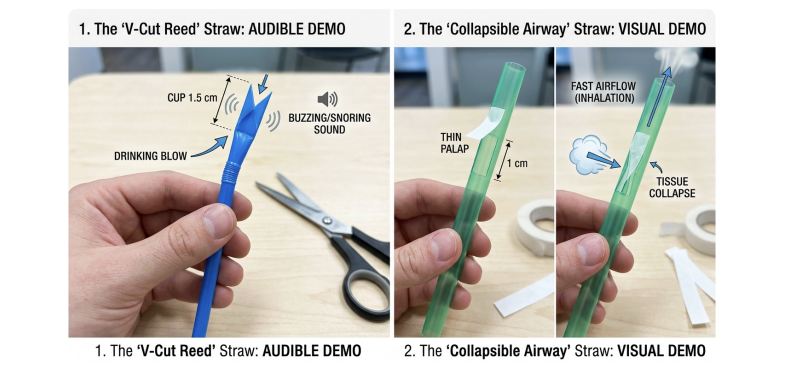
The first prop is a straw with the tip trimmed into two narrow, flexible flaps that almost touch. Blow past that narrow slit and the flaps flutter rapidly against each other, producing a loud buzzing sound — not unlike a duck-call reed or a kazoo. That fluttering is a physical stand-in for what happens to the soft palate and the base of the tongue during sleep: as air rushes past floppy tissue at high speed, the tissue vibrates. That vibration is the sound of snoring.
The Second Demo: Why Breathing Can Actually Stop
The second prop takes it a step further. It's a wider straw with a small window cut into the side, covered loosely with a thin paper flap. Breathe past it gently, and the flap barely moves — that's normal, relaxed airflow. Breathe in sharply and hard, and the flap gets pulled inward, sealing the opening completely. That's a physical demonstration of what happens in an actual obstructive sleep apnea event: air moving fast enough through a narrow point that it doesn't just vibrate the tissue — it pulls the passage shut.
The Physics Behind Both Demos: Bernoulli's Principle
Both demos come down to the same fluid-dynamics concept: Bernoulli's principle. As air speeds up moving through a narrowed passage, the pressure inside that narrowed section drops. In a rigid tube, that pressure drop doesn't matter much — the walls don't move. But the upper airway isn't rigid; researchers model it as a collapsible tube (a “Starling resistor”), and during sleep, the muscle tone that normally keeps it taut relaxes. When that floppy passage narrows even slightly — from the tongue falling back, extra soft tissue, or simply lying on your back — the air has to move faster to get the same breath through, which drops the local pressure further, which pulls the walls inward, which narrows the passage even more. It's a self-reinforcing cycle. A wall fluttering rapidly right at that narrow point is the vibration you hear as snoring; if the vacuum effect pulls the passage all the way shut, that's an obstructive sleep apnea event.
How a Mandibular Advancement Device (MAD) Breaks the Cycle
A custom oral appliance works by gently holding the lower jaw — and the tongue attached to it — slightly forward during sleep. That does two things at once, and both trace directly back to the physics above:
- It widens the passage. A wider cross-section means the same amount of air moves through more slowly. Lower velocity means a smaller pressure drop, which means less of the vacuum effect that pulls tissue inward in the first place.
- It tightens the surrounding tissue. Advancing the jaw also stretches the muscles and soft tissue along the sides of the throat, similar to pulling a sail taut — tissue under tension is far less prone to flutter (snoring) or fully collapse (apnea) than tissue left slack.
Figure: the same collapsible-tube physics shown in the straw demo, applied to the airway — a narrow, floppy gap versus a wide one held open by a forward jaw position.
By widening the airway and adding tension before you ever fall asleep, a mandibular advancement device eliminates the vacuum effect at its source, rather than trying to counteract it after the fact. See our full breakdown of how a mandibular advancement device works for more on fitting, titration, and candidacy.
If snoring or witnessed breathing pauses sound familiar — yours or a partner's — a sleep apnea evaluation is the place to start. We're glad to walk through this same explanation at your visit.
Sources
- The Pharynx as a Starling Resistor in Obstructive Sleep Apnea — Gold AR, Schwartz AR, Chest (1996)
- Adult Obstructive Sleep Apnea: Pathophysiology and Diagnosis — Patil SP, Schneider H, Schwartz AR, Smith PL, Chest (2007)
- Oral Appliance Treatment for Obstructive Sleep Apnea: An Update — Sutherland K, Vanderveken OM, Tsuda H, Marklund M, Gagnadoux F, Kushida CA, Cistulli PA, Journal of Clinical Sleep Medicine (2014)
- Clinical Practice Guideline for the Treatment of Obstructive Sleep Apnea and Snoring with Oral Appliance Therapy (2015) — AASM & American Academy of Dental Sleep Medicine, J Clin Sleep Med
Related to This Article
Have a Dental Question of Your Own?
Reach out and we'll help you find the right next step.
Schedule Your Visit Call 212-877-7475