Oral Appliance vs CPAP: Which Sleep Apnea Treatment Is Right for You?
If you’ve been diagnosed with obstructive sleep apnea (OSA), you’ve likely heard that CPAP therapy is the gold standard. While CPAP is highly effective for many patients...
By Dr. Boris Zusin · Published February 5, 2026 · Updated July 31, 2026
If you’ve been diagnosed with obstructive sleep apnea (OSA), you’ve likely heard that CPAP therapy is the gold standard. While CPAP is highly effective for many patients, it’s far from the only option. Dental sleep apnea solutions — particularly oral appliance therapy — have emerged as a comfortable, effective alternative for patients who struggle with CPAP or prefer a less invasive approach.
What Is the Best Treatment for Sleep Apnea?
There isn’t one universal “best” treatment — the right choice depends on how severe your OSA is, your anatomy, and which treatment you’ll actually use consistently night after night, since even the most effective device does nothing sitting in a drawer. CPAP remains the most effective option at reducing the apnea-hypopnea index across every severity level and is generally considered first-line for severe OSA. Oral appliance therapy is the guideline-recommended alternative for mild-to-moderate OSA and for patients who are diagnosed with severe OSA but can’t tolerate or decline CPAP. Lifestyle measures — weight loss, positional therapy, reducing alcohol before bed — can meaningfully reduce severity in some patients but rarely eliminate moderate-to-severe OSA on their own, and surgery or nasal treatments are generally reserved for specific anatomical causes or as a last resort. In practice, the “best” treatment is the one a sleep physician and dentist help you match to your specific diagnosis, and the sections below walk through how CPAP and oral appliance therapy compare in more detail.
Are There Alternatives to a CPAP Machine?
Yes — CPAP is the most-prescribed treatment, but it’s not the only one, and a meaningful share of patients who are prescribed it don’t end up using it consistently. Oral appliance therapy, discussed throughout this article, is the most relevant dental-provided alternative and is specifically recommended by sleep medicine guidelines for mild-to-moderate OSA or for CPAP-intolerant patients regardless of severity. Beyond that, a few other options come up: nasal EPAP devices (small one-way valves worn over the nostrils) are an option for some patients with mild-to-moderate OSA; hypoglossal nerve stimulation (marketed as Inspire) is an implanted device that can be considered for moderate-to-severe OSA when CPAP hasn’t worked and a patient isn’t a good fit for an oral appliance; and positional therapy or weight loss can meaningfully reduce severity as an adjunct, though they rarely resolve moderate-to-severe OSA on their own. Airway or jaw surgery is generally reserved for specific anatomical findings rather than being a first-choice option. None of these are something to self-select from an online list — which alternative makes sense, if any, depends on your diagnosed severity and anatomy, which is why this is a decision made together with your sleep physician and a dentist trained in sleep medicine.
Understanding CPAP Therapy
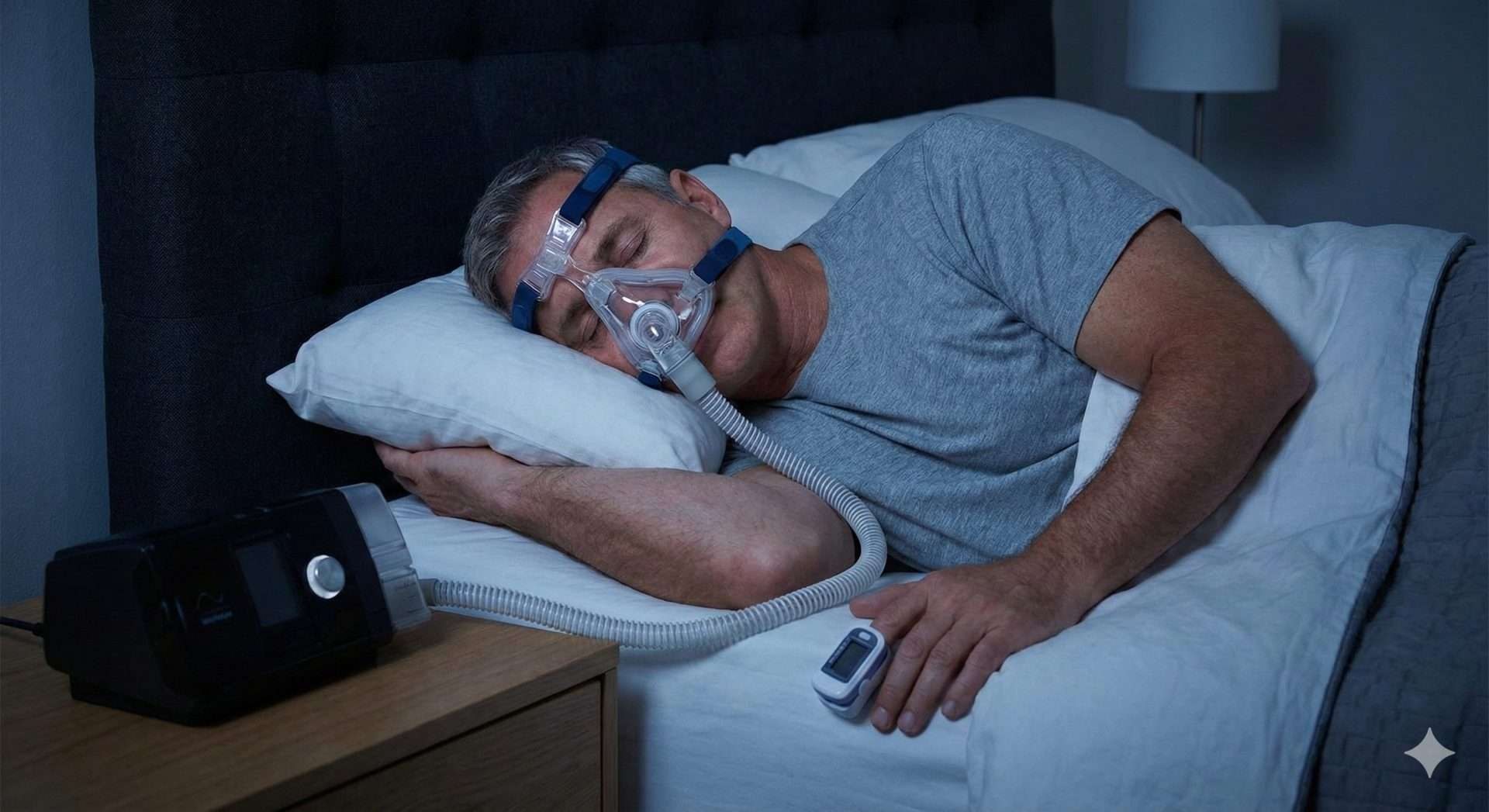
CPAP stands for Continuous Positive Airway Pressure. It uses a machine that delivers a steady stream of pressurized air through a mask worn over the nose or mouth during sleep, keeping the airway open by preventing the soft tissues of the throat from collapsing. Benefits include effectiveness across all severities of sleep apnea, immediate improvement in oxygen levels, and a long clinical track record. Common challenges include mask discomfort, dry mouth or nasal congestion, claustrophobia, noise, and difficulty traveling with the equipment — a large share of patients prescribed CPAP don’t end up using it as directed.
What About BiPAP?
Some patients who struggle with CPAP are switched to BiPAP (bilevel positive airway pressure) by their sleep physician rather than referred for an oral appliance. BiPAP delivers two pressures instead of one — a higher pressure on inhale and a lower pressure on exhale — which makes breathing out against the machine noticeably easier and can add a degree of ventilatory support on top of simply holding the airway open. It’s worth knowing that for routine, uncomplicated OSA, randomized trials have found no proven advantage of BiPAP over CPAP in either effectiveness or how consistently patients actually use it, and BiPAP is more expensive equipment that typically requires its own separate sleep-lab titration. Guidelines generally reserve it for more specific situations — CPAP that isn’t controlling breathing events despite an adequate pressure setting, or a coexisting condition like obesity hypoventilation syndrome or overlap with COPD or heart failure where carbon dioxide retention needs its own ventilatory support — rather than simple mask discomfort. For that far more common problem of CPAP being hard to tolerate, switching to BiPAP has shown a real benefit in comfort and adherence in patients who were struggling with CPAP specifically. An oral appliance addresses that same intolerance from a different angle entirely, without adding another pressurized-air device or another sleep-lab visit to set it up.
What Is Oral Appliance Therapy?
Oral appliance therapy is a dentist-provided treatment using a custom-made device worn in the mouth during sleep. Most are mandibular advancement devices (MADs), which gently reposition the lower jaw forward to increase airway space, prevent the tongue from collapsing backward, and stabilize the soft tissues of the throat. Some patients may instead benefit from a tongue-retaining device, depending on their anatomy. Appliances are small, comfortable, quiet, easy to travel with, require no electricity, and are often better tolerated night after night — making them less intrusive for bed partners too.
Effectiveness, Compliance, and Comfort
CPAP is generally more effective at reducing the apnea-hypopnea index (AHI) when used consistently, and oral appliances are highly effective for mild to moderate obstructive sleep apnea. In the real world, though, effectiveness often favors oral appliances because more patients actually wear them consistently — a treatment used every night can outperform a theoretically superior treatment that sits in a drawer. Oral appliances are especially appealing for side sleepers, frequent travelers, and patients whose partners are disturbed by CPAP noise or masks.
Side Effects
CPAP side effects can include nasal irritation, facial pressure, and swallowing air. Oral appliance side effects — usually mild and manageable with dental monitoring — can include temporary jaw soreness, tooth discomfort, and gradual bite changes.
Who Should Choose Which?
CPAP may be the best option for severe OSA, significant oxygen desaturation, or patients who tolerate it well and need maximum AHI reduction. Oral appliances are often ideal for mild-to-moderate OSA, CPAP-intolerant patients, and those with favorable jaw and airway anatomy seeking a quieter, portable option. For some patients, an oral appliance can replace CPAP entirely; for others, it serves as a travel backup or is combined with CPAP to reduce pressure requirements. A sleep study and dental evaluation determine candidacy, and treatment decisions should be made collaboratively between patient, sleep physician, and dentist.
If you struggle with CPAP or want to explore a non-invasive alternative, a consultation with a trained dental sleep provider can help determine whether oral appliance therapy is right for you.
Sources
- Clinical Practice Guideline for the Treatment of Obstructive Sleep Apnea and Snoring with Oral Appliance Therapy (2015) — AASM & American Academy of Dental Sleep Medicine, J Clin Sleep Med
- Sleep Apnea — Treatment — NHLBI, National Institutes of Health
- Obstructive Sleep Apnea and Cardiovascular Disease: A Scientific Statement — American Heart Association, Circulation (2021)
- Determinants of Bilevel Therapy in the Management of Obstructive Sleep Apnea — Shah S, Smotherman C, Louis M, Sleep & Breathing (2021)
- Management of Obstructive Sleep Apnea in Adults: A Clinical Practice Guideline From the American College of Physicians — Qaseem A, Holty JE, Owens DK, et al., Annals of Internal Medicine (2013)
- A Randomized, Double-Blind Clinical Trial Comparing Continuous Positive Airway Pressure With a Novel Bilevel Pressure System for Treatment of Obstructive Sleep Apnea Syndrome — Gay PC, Herold DL, Olson EJ, Sleep (2003)
- Diagnosis and Treatment of Obstructive Sleep Apnea — Lastra AC, Neborak JM, Mokhlesi B, JAMA Internal Medicine (2025)
- Non-Surgical Treatment of Obstructive Sleep Apnea Syndrome — Tingting X, Danming Y, Xin C, European Archives of Oto-Rhino-Laryngology (2018)
- Non-Invasive Positive Pressure Ventilation for Central Sleep Apnoea in Adults — Pinto ACPN, Rocha A, Pachito DV, Drager LF, Lorenzi-Filho G, The Cochrane Database of Systematic Reviews (2022)
- Obstructive Sleep Apnea in Adults: Common Questions and Answers — Gawrys B, Silva TW, Herness J, American Family Physician (2024)
- Effect of Switching From Continuous to Bilevel Positive Airway Pressure on Sleep Quality in Patients With Obstructive Sleep Apnea: The Prospective POP IN VAuto Study — Palot A, Nguyên XL, Launois S, et al., Journal of Thoracic Disease (2023)
Related to This Article
Have a Dental Question of Your Own?
Reach out and we'll help you find the right next step.
Schedule Your Visit Call 212-877-7475