Invisalign vs. Veneers: Which One Actually Solves Your Problem?
Both promise a straighter, better-looking smile, but Invisalign and veneers solve genuinely different problems — one moves your teeth, the other covers them. Here's how to tell which one you actually need...
By Dr. Boris Zusin · Published August 22, 2026
“Should I get Invisalign or veneers?” is a question we hear often, and it usually comes from a reasonable place of confusion — both are marketed as ways to get a better-looking smile, and both show up in the same “smile makeover” searches. But they're not really alternatives to each other. They solve different problems, and understanding which problem you actually have is the real question.
Invisalign Moves Your Teeth
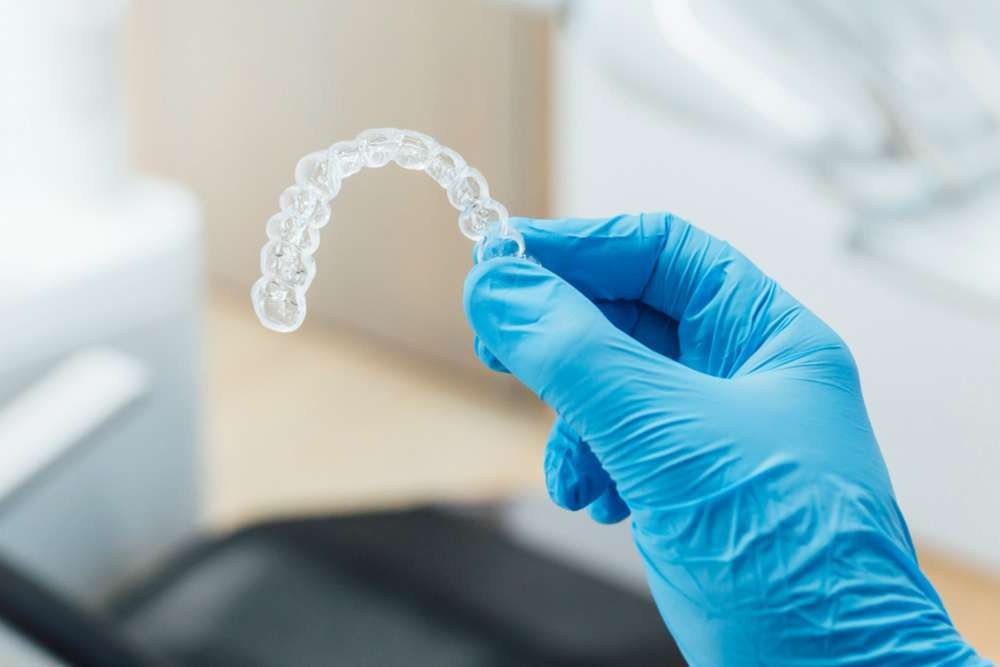
Invisalign is an orthodontic treatment — a series of custom, clear aligners that gradually shift your teeth into a new position over months. It changes where your teeth actually sit: closing gaps, untangling crowding, and correcting bite issues like an overbite, underbite, or crossbite. The teeth themselves stay exactly as they are — same shape, same color, same surface — just repositioned.
Veneers Cover Your Teeth
Veneers are thin, custom-made shells — typically porcelain — bonded to the front surface of your existing teeth. They don't move anything. Instead, they change how your teeth look: covering chips, gaps, discoloration, unusual shape, or minor misalignment by masking it with a new, uniform surface. The teeth underneath stay in the same position; what changes is what you see.
The Core Question: Position or Appearance?
If your teeth are crowded, gapped, or your bite doesn't line up correctly, veneers can't actually fix that — they'd be bonded onto teeth that are still misaligned underneath, which usually isn't a good long-term solution and can look and function worse than addressing the position directly. If your teeth are already reasonably well-positioned but you're unhappy with chips, staining, or the shape of a few teeth, moving them with Invisalign wouldn't address any of that — the teeth would end up in a better position but look exactly the same.
What Each One Can't Fix
Invisalign can't change tooth color, shape, or repair chips and wear — it only repositions. Veneers can't correct a genuine bite problem or meaningfully close larger gaps or resolve real crowding without over-contouring the teeth in a way that usually looks bulky and unnatural and puts the gum tissue at risk. Each treatment has a real, specific job, and asking one to do the other's work tends to produce a compromised result either way.
When the Real Answer Is Both
It's genuinely common to need both, done in sequence — Invisalign first to get the teeth into a good position, then veneers afterward for any remaining cosmetic refinement (color, shape, minor chips) that orthodontic movement alone wouldn't address. This sequencing, sometimes called a combination or comprehensive smile plan, tends to produce a more stable, better-looking result than trying to shortcut straight to veneers over misaligned teeth.
Cost and Timeline Differences
They're not comparable financially or time-wise either. Invisalign is a gradual process, typically months, with cost driven by how much movement is needed — see our full Invisalign cost breakdown. Veneers are usually completed in two visits and priced per tooth, with cost driven by how many teeth are being treated. Neither is inherently “more expensive” in general — it depends on your specific case and how many teeth are involved.
How to Actually Decide
The honest starting point is a real exam: if your teeth are misaligned or your bite is off, that's an Invisalign conversation. If your teeth are well-positioned but you don't love how they look, that's a veneers conversation. And if it's genuinely both, a combined plan — done in the right order — is usually the better long-term answer than trying to solve a positioning problem with a cosmetic fix.
Not sure which category your case falls into? That's exactly what a consultation is for — we'll tell you honestly which treatment (or combination) actually addresses what you're seeing in the mirror.
Sources
- Clear Aligners in Orthodontic Treatment — Weir T, Australian Dental Journal (2017)
- Veneers — MouthHealthy, American Dental Association (ADA)
- Long-Term Survival and Complication Rates of Porcelain Laminate Veneers in Clinical Studies: A Systematic Review — Alenezi A, Alsweed M, Alsidrani S, Chrcanovic BR, Journal of Clinical Medicine (2021)
Related to This Article
Have a Dental Question of Your Own?
Reach out and we'll help you find the right next step.
Schedule Your Visit Call 212-877-7475