Invisalign or Braces If You Have Had Gum Disease or Bone Loss?
Teeth drifting after gum disease can often be moved back, but your gums must be healthy first. Here is how aligners and braces compare when bone support is reduced...
By Dr. Boris Zusin · Published November 15, 2026
Gum disease can loosen teeth and let them drift, tilt or spread apart. Many people with this problem wonder if Invisalign or braces can move them back. Often they can, but the gums come first.
Gum Health Comes First
Moving teeth while gum disease is active can lead to more bone loss. Before any orthodontic force is applied, the gum disease must be treated and stable. Your gums should be free of infection, with plaque and bleeding scores low. After a deep cleaning, movement can often begin soon. After gum surgery, it typically begins within a few weeks.
Aligners or Braces?
Neither is proven better for people with reduced bone support. Each has advantages:
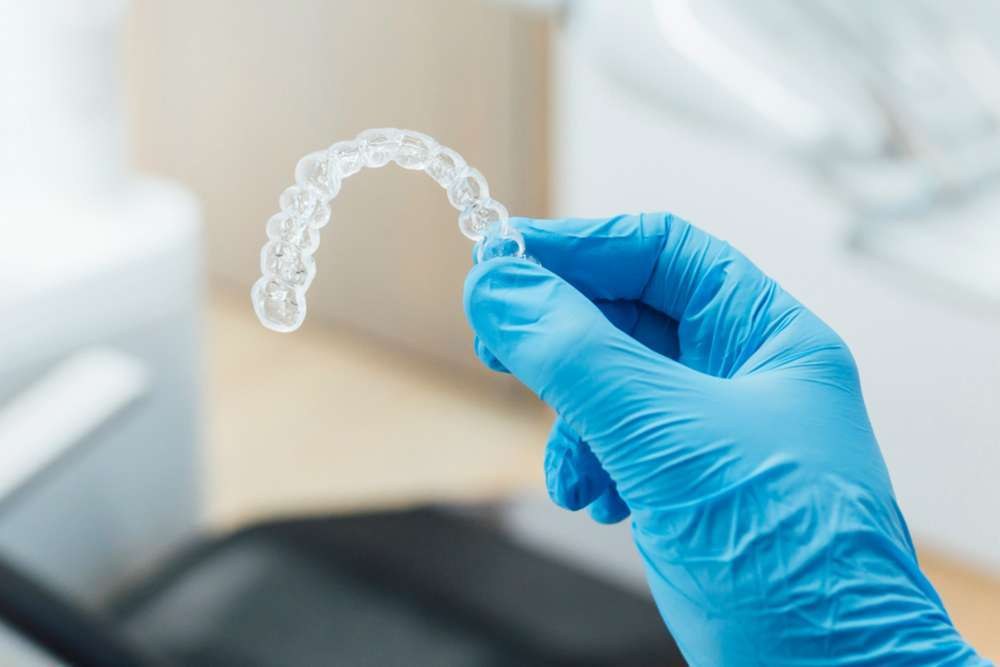
- Aligners are removable, so they are easier to clean around, and gum measures are slightly better on average. They suit teeth with mild to moderate bone loss and simple movements, but only if worn about 20 to 22 hours a day.
- Braces give more control over harder movements, such as pulling flared front teeth back and in, and can steady loose teeth. They are often used soon after gum surgery or for more complex cases.
Gentler Forces, Closer Monitoring
Teeth with less bone support need lighter forces and slower steps, especially when they are being pushed deeper into the bone. We watch your gums closely during treatment, and you will keep your gum maintenance visits every 3 to 6 months.
Retainers for Life
After treatment, a retainer is essential. For teeth with reduced bone support, we usually recommend a thin wire bonded behind the teeth, with lifelong maintenance. Removable retainers alone are discouraged when bone loss is more advanced.
Wondering whether your teeth can be moved safely? Schedule an exam. We will check your gums and bone support first.
Sources
- Impact of Clear Aligners and Conventional Fixed Orthodontic Appliances on Oral Hygiene and Periodontal Health: A Systematic Review With GRADE Assessment of the Certainty of Evidence — Alhuwaizi MA, Saloom HF, Cobourne M, European Journal of Orthodontics (2026)
- Assessment of the Periodontal Health Status and Gingival Recession During Orthodontic Treatment With Clear Aligners and Fixed Appliances: A Systematic Review and Meta-Analysis — Crego-Ruiz M, Jorba-García A, Medicina Oral, Patologia Oral y Cirugia Bucal (2023)
- Regenerative Periodontal Surgery and Orthodontic Therapy in the Treatment of Patients With Stage IV Periodontitis and Pathologic Tooth Migration — Jepsen K, Tietmann C, Proff P, Jepsen S, Periodontology 2000 (2026)
- Clinical Effectiveness of Clear Aligner Treatment Compared to Fixed Appliance Treatment: An Overview of Systematic Reviews — Yassir YA, Nabbat SA, McIntyre GT, Bearn DR, Clinical Oral Investigations (2022)
- Treatment of Stage IV Periodontitis: The EFP S3 Level Clinical Practice Guideline — Herrera D, Sanz M, Kebschull M, et al., Journal of Clinical Periodontology (2022)
- Precautions and Possibilities in Orthodontic Treatment of Periodontally Compromised Patients: Current Recommendations — Han SH, Ko Y, Ham LK, Park JH, Kim Y, Journal of Esthetic and Restorative Dentistry (2024)
- Periodontal Health During Orthodontic Treatment With Clear Aligners and Fixed Appliances: A Meta-Analysis — Jiang Q, Li J, Mei L, et al., Journal of the American Dental Association (2018)
- Biomechanical Analysis of Maxillary Incisor Intrusion With Clear Aligners Under Different Periodontal Conditions: A Finite Element Analysis — Li Q, Zhang Y, Xu B, Bai L, Yang K, Frontiers in Bioengineering and Biotechnology (2026)
- Periodontal Considerations During Orthodontic Intrusion and Extrusion in Healthy and Reduced Periodontium — Antonarakis GS, Zekeridou A, Kiliaridis S, Giannopoulou C, Periodontology 2000 (2024)
- Evaluating the Impact of Clear Dental Aligners on Dental and Periodontal Conditions, Oral Microbial Patterns, and the Immune System — Esmaeili S, Shahbazi S, Ziaei H, Younessian F, Advances in Experimental Medicine and Biology (2025)
- Biomechanical Factors in the Open Gingival Embrasure Region During the Intrusion of Mandibular Incisors: A New Model Through Finite Element Analysis — Zhang Y, Gao J, Wang X, et al., Frontiers in Bioengineering and Biotechnology (2023)
- Supportive Periodontal Care During Active Orthodontic Therapy in Patients With History of Stage IV Periodontitis: A Narrative Review — Stähli A, Orishko A, Imber JC, et al., Periodontology 2000 (2025)
Related to This Article
Have a Dental Question of Your Own?
Reach out and we'll help you find the right next step.
Schedule Your Visit Call 212-877-7475