Burning Tongue or Mouth: Causes, Red Flags, and Burning Mouth Syndrome Explained
A burning feeling on the tongue or in the mouth has a real differential, from a yeast infection to a nutritional deficiency to primary burning mouth syndrome — and one simple question helps sort them out...
By Dr. Boris Zusin · Published August 1, 2026 · Updated August 30, 2026
A burning feeling on the tongue, gums, or roof of the mouth is uncomfortable and, understandably, a little unsettling when it shows up without an obvious cause. The good news is that most causes are identifiable and treatable once you know what to look for — and one simple question does a lot of the sorting: does the burning get better or worse when you eat?
The Key Question: Better or Worse With Eating?
Pain that's clearly triggered or worsened by eating and contact — especially with acidic, spicy, or hot foods — points toward an identifiable local cause, most often oral thrush. Pain that's actually relieved by eating, or that's simply always present regardless of what you eat, is a pattern more typical of primary burning mouth syndrome. It's a genuinely useful first clue to mention at your exam, because it points the workup in a different direction from the start.
Oral Thrush (Candidiasis)
A yeast overgrowth in the mouth is one of the more common identifiable causes of burning, and it tends to worsen with eating rather than ease up. It shows up more often in people with dry mouth, dentures, a recent course of antibiotics, inhaled steroids, or diabetes. One specific pattern — a smooth, reddened, diamond-shaped patch in the center-back of the tongue, called median rhomboid glossitis — is frequently candidal in origin. This is checked with a simple swab or smear at the exam, and it's treatable with an antifungal.
Nutritional Deficiency
Low iron, vitamin B12, or folate can each produce a smooth, glossy, reddened tongue (atrophic glossitis) along with a burning sensation, and B-complex vitamins, zinc, and vitamin D deficiency have also been linked to burning mouth symptoms. In one 10-year screening study of burning mouth patients at the Mayo Clinic, the most common abnormalities found were low vitamin D (in 15% of patients), low B12 (15%), low B6 (5.7%), and low zinc (5.7%); a separate, larger cohort found meaningfully higher rates of anemia, iron/B12/folate deficiency, and elevated homocysteine in burning mouth patients compared to the general population. This is exactly the kind of cause that's simple to check with routine bloodwork and straightforward to correct once identified.
Dry Mouth
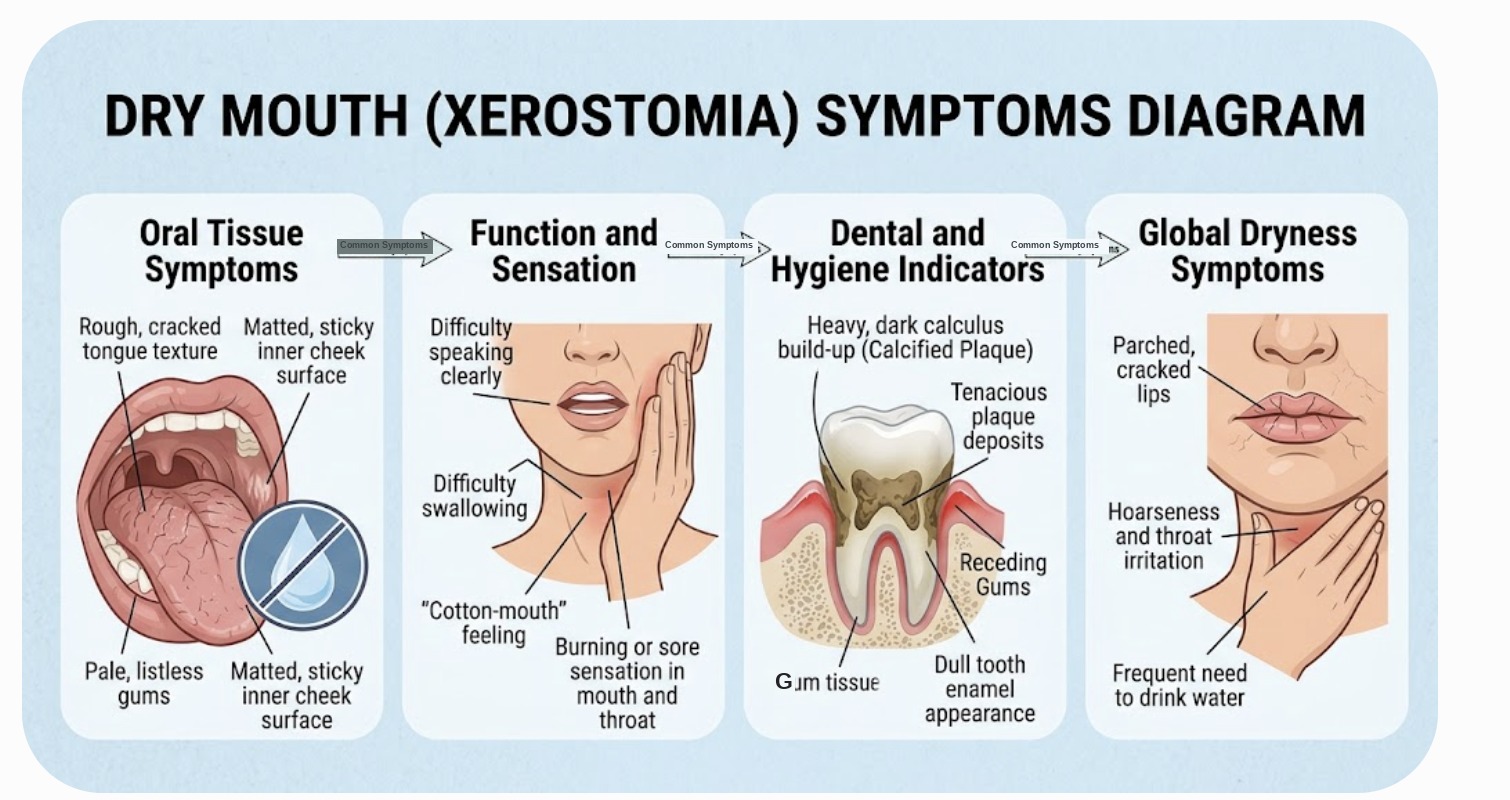
Reduced saliva flow is one of the strongest individual risk factors for oral burning — it leaves tissue more exposed and irritated, which often shows up as a burning or raw sensation rather than obvious dryness. It's frequently medication-related, especially in patients taking several medications with a drying side effect, or related to Sjögren's disease. See our dry mouth breakdown for more on causes and management.
Diabetes and Thyroid Conditions
Elevated blood sugar and low thyroid function are both associated with oral burning, and both are simple to check with routine bloodwork — a fasting glucose or A1c for one, a TSH for the other. In one burning mouth cohort, roughly a quarter of patients had elevated fasting glucose.
Contact Irritation, Ill-Fitting Dentures, and Diet
A reaction to a dental material, a toothpaste or mouthwash ingredient, or a specific food can irritate oral tissue enough to cause burning, sometimes with a pattern that lines up with when you use the product. Dentures that no longer fit properly — often because the gums and jawbone have changed shape over time — can create friction points that feel like persistent burning or soreness, especially later in the day. Highly acidic or spicy foods and tobacco or alcohol use can add to any of the above, particularly in tissue that's already sensitive.
Medications
ACE inhibitor blood pressure medications are among the most frequently reported drug triggers of burning mouth symptoms. If a burning sensation started around the same time as a new prescription, that timing is worth mentioning to whoever prescribed it.
Primary Burning Mouth Syndrome
When a thorough evaluation doesn't turn up any of the causes above — the mucosa looks completely normal, and bloodwork and an oral exam are clean — the diagnosis becomes primary burning mouth syndrome (also called glossodynia). By the current research diagnostic criteria, this means burning or altered sensation for more than two hours a day, on most days, for more than three months, with no identifiable cause. It's now understood as a neuropathic pain condition rather than a purely psychological one, it overwhelmingly affects women around and after menopause, and it most often centers on the front two-thirds of the tongue, frequently alongside dry mouth and taste changes. Importantly, this is a diagnosis of exclusion — it's only reached after the other, more treatable causes above have genuinely been ruled out, not assumed by default.
Red Flags We Take Seriously
Burning mouth syndrome should never be diagnosed on a tongue that has a visible lesion. Any white or red patch (leukoplakia or erythroplakia), a sore that hasn't healed, a firm or thickened (indurated) area, or a lump — especially on the side of the tongue — needs a biopsy or a head-and-neck specialist referral, not a burning-mouth-syndrome label. This isn't a hypothetical caution: case reports and reviews have documented oral cancer presenting with years of burning-mouth-like symptoms before the actual lesion was identified, particularly in older patients. Separately, sudden mouth pain with skin blistering or peeling, or rapid swelling of the tongue or lips affecting breathing or swallowing, are emergencies that need immediate care, not a routine dental visit.
What a Workup Typically Involves
A thorough evaluation starts with a detailed history — when it started, whether it's better or worse with eating, dry mouth or taste changes, current medications, and menopausal status — followed by a careful inspection of the entire mouth and tongue for anything suspicious, plus a candidal swab when indicated. If the exam is clean, bloodwork typically checks iron/ferritin, B12, folate, zinc, vitamin D, fasting glucose or A1c, and thyroid function, since correcting an identified deficiency or condition frequently resolves the burning entirely.
If It Is Primary Burning Mouth Syndrome
Treatment evidence for confirmed primary burning mouth syndrome is still fairly limited, but topical clonazepam (a lozenge dissolved in the mouth rather than swallowed) has the most consistent supporting evidence among the options studied, including in a recent network meta-analysis that found it the only treatment likely to outperform placebo. Alpha-lipoic acid, photobiomodulation (low-level laser therapy), and cognitive behavioral therapy have also been studied as additional options, generally with more modest or mixed evidence. Because this is a chronic pain condition rather than a straightforward dental problem, confirmed cases are typically best managed in coordination with an oral medicine specialist rather than in general dental practice alone.
If a burning sensation has been sticking around, the right first step is a dental exam to check for the identifiable, treatable causes — contact us to get scheduled.
Sources
- Developing a Research Diagnostic Criteria for Burning Mouth Syndrome: Results From an International Delphi Process — Currie CC, Ohrbach R, De Leeuw R, et al., Journal of Oral Rehabilitation (2021)
- Interventions for Treating Burning Mouth Syndrome — McMillan R, Forssell H, Buchanan JA, et al., Cochrane Database of Systematic Reviews (2016)
- Challenge in the Diagnosis, Evaluation, and Management of Burning Mouth Sensation: A Retrospective Cohort Study — Wu S, Zhang W, Wang X, He C, Yan Z, Journal of the American Dental Association (2023)
- Topical Gabapentin Solution for the Management of Burning Mouth Syndrome: A Retrospective Study — Gramacy A, Villa A, PLoS One (2023)
- Burning Mouth Syndrome: Unraveling Multifactorial Etiologies and Advancing Management Strategies — Lin J, Wan J, Zha T, et al., Oral Diseases (2026)
- Common Oral Conditions — Stoopler ET, Villa A, Bindakhil M, Díaz DLO, Sollecito TP, The Journal of the American Medical Association (2024)
- Common Tongue Conditions in Primary Care — Straub L, Schettini P, Myrex P, American Family Physician (2024)
- Burning Mouth Syndrome: Results of Screening Tests for Vitamin and Mineral Deficiencies, Thyroid Hormone, and Glucose Levels — Experience at Mayo Clinic Over a Decade — Morr Verenzuela CS, Davis MDP, Bruce AJ, Torgerson RR, International Journal of Dermatology (2017)
- Anemia, Hematinic Deficiencies, Hyperhomocysteinemia, and Serum Gastric Parietal Cell Antibody Positivity in 884 Patients With Burning Mouth Syndrome — Chiang CP, Wu YH, Wu YC, et al., Journal of the Formosan Medical Association (2020)
- Geriatric Oral and Maxillofacial Dysfunctions in the Context of Geriatric Syndrome — Nam Y, Kim NH, Kho HS, Oral Diseases (2018)
- Burning Mouth Syndrome: A Review and Update — Sun A, Wu KM, Wang YP, et al., Journal of Oral Pathology & Medicine (2013)
- Case Report: Hidden Oral Squamous Cell Carcinoma in Oral Somatic Symptom Disorder — Suga T, Tu TTH, Takenoshita M, et al., Frontiers in Psychiatry (2021)
- Burning Mouth in Oncology Care: A Systematic Review — Normando AGC, Santos-Silva AR, Epstein JB, Supportive Care in Cancer (2024)
- Taste Function Assessed by Electrogustometry in Burning Mouth Syndrome: A Case-Control Study — Braud A, Descroix V, Ungeheuer MN, Rougeot C, Boucher Y, Oral Diseases (2017)
- Head and Neck Cancers — National Comprehensive Cancer Network (NCCN)
- Efficacy of Different Therapeutic Options for Pain Relief and Treatment of Burning Mouth Syndrome: A Systematic Review — Rossetti A, Teixeira A, Milhazes N, Clinical Oral Investigations (2025)
- Treatments for Burning Mouth Syndrome: A Network Meta-Analysis — Alvarenga-Brant R, Costa FO, Mattos-Pereira G, et al., Journal of Dental Research (2023)
- Burning Mouth Syndrome: A Systematic Review of Treatments — Liu YF, Kim Y, Yoo T, Han P, Inman JC, Oral Diseases (2018)
Related to This Article
Have a Dental Question of Your Own?
Reach out and we'll help you find the right next step.
Schedule Your Visit Call 212-877-7475